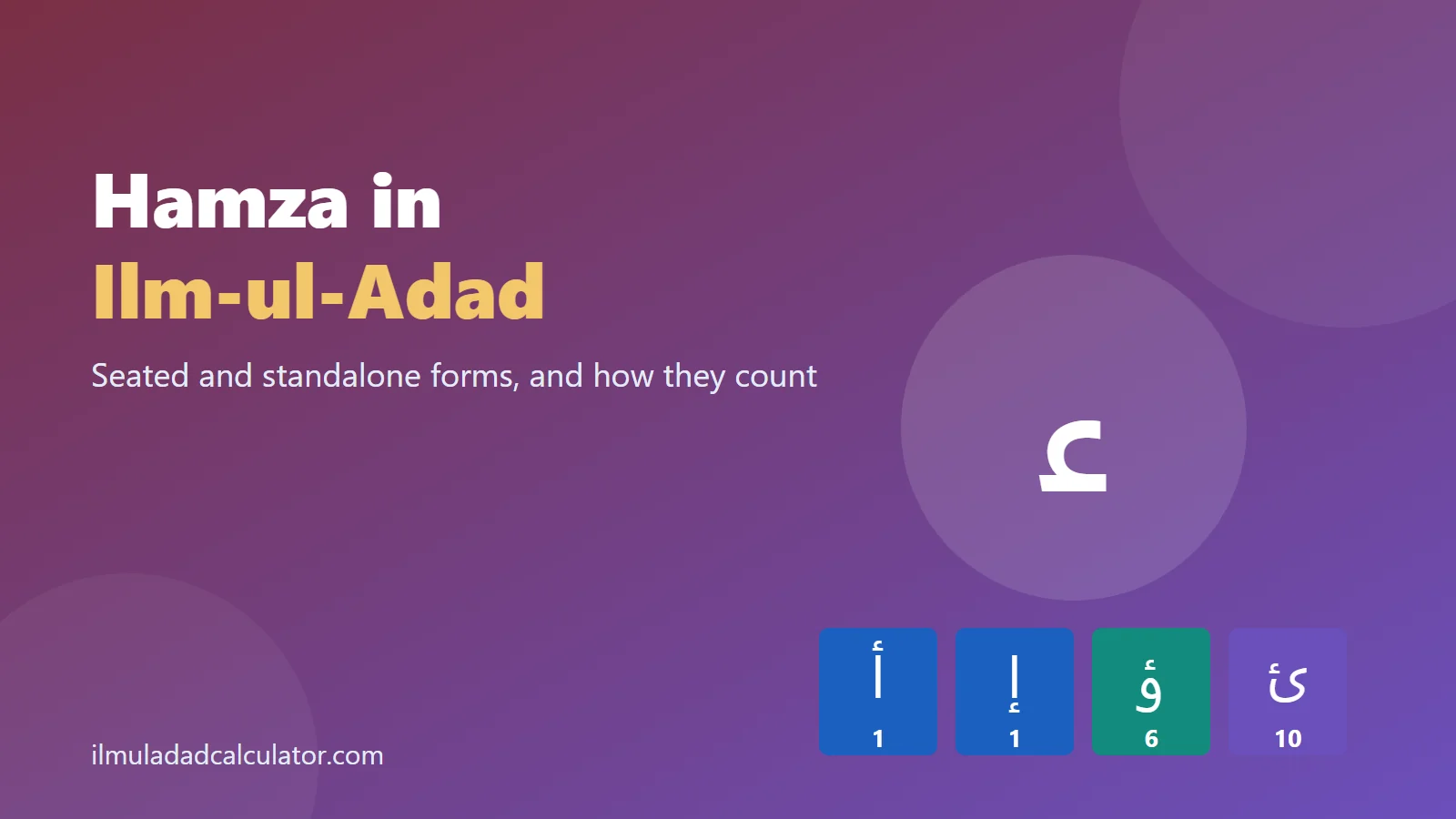
In Ilm-ul-Adad, a seated hamza takes the value of its seat. So أ and إ count as 1, ؤ as 6 and ئ as 10. A standalone hamza (ء) is usually not counted, but some traditions count it as 1.
Why Is Hamza Not One of the 28 Letters?
The abjad order has 28 letters, and hamza is not among them. The hamza began as a small mark written on alif to show a catch in the voice, the glottal stop.
Arabic grammar still treats it as a sign more than a full letter of the alphabet. So each counting tradition had to decide how to handle it.
How Is a Seated Hamza Counted?
A seated hamza counts as its seat. The hamza mark adds nothing, and the seat keeps its normal value.
| Form | Seat | Value | Example | Total |
|---|---|---|---|---|
| أ | alif | 1 | أحمد (Ahmad) | 53 |
| إ | alif | 1 | إسلام (Islam) | 132 |
| ؤ | waw | 6 | مؤمن (Mumin) | 136 |
| ئ | ya | 10 | بئر (bir (well)) | 212 |
How Does Arabic Choose the Seat?
Arabic picks the seat from the vowels around the hamza. At the start of a word, the hamza always sits on or under an alif.
- Start of a word: أ before an a or u sound, and إ before an i sound.
- Middle of a word: an i sound wins over u, and u wins over a. The winner picks ya, waw or alif.
- End of a word: after a long vowel or a consonant, the hamza sits alone on the line.
The word mi’ah (hundred) shows the middle rule. Its i sound wins, so it is written مئة with a ya seat and totals 55.
The word shay’ (thing) shows the end rule. It is written شيء, so it gives 310 by default and 311 with the option.
The seat rules decide the spelling, and the spelling decides the total. So learn the correct spelling first, then count it.
What About the Standalone Hamza?
A standalone hamza has no seat, so there is no letter to count. Most calculators, including the ones on this site, give it no value by default.
Some traditions count it as 1, treating it like an alif. The Abjad value calculator has an option to count it this way.
Each standalone hamza adds exactly 1 when the option is on. The word ماء (water) gives 41 by default and 42 with the option.
Can the Seat Change Between Spellings?
Yes, some words are written with the hamza on different seats. The word mas’ul (responsible) appears as both مسئول and مسؤول.
م 40 + س 60 + ئ 10 + و 6 + ل 30 = 146
م 40 + س 60 + ؤ 6 + و 6 + ل 30 = 142
The gap of 4 comes from the seat alone, since ya is 10 and waw is 6. Check both spellings with the value comparison tool before you quote a total.
Which Hamza Signs Add Nothing?
A small hamza written as a separate mark above a letter (ٔ) adds nothing. Vowel marks on a hamza, such as fatha or sukun, add nothing either.
The alif wasla (ٱ) found in Quranic text counts as a plain alif, worth 1. Alif madda (آ) counts as one alif on this site.
How Are Urdu Hamza Letters Counted?
Urdu has its own hamza forms, such as ۓ (bari ye with hamza) and ۀ (he with hamza). This site counts ۓ as ya (10) and ۀ as he (5).
The Urdu word جاۓ (go), for example, gives 14 in the Mashriqi system. The letter values table lists every letter these forms are based on.
How Does Urdu Use Hamza?
Urdu uses hamza differently from Arabic. It rarely marks a catch in the voice, except in some words borrowed from Arabic.
Inside an Urdu word, hamza usually marks the break between two vowels. Urdu also never puts a hamza on an alif at the start of a word.
| Urdu | Said as | Meaning | Total |
|---|---|---|---|
| عائشہ | Aisha | name | 386 |
| صائمہ | Saima | name | 146 |
| فائزہ | Faiza | name | 103 |
| آئے | aaye | came | 21 |
| کوئی | koi | someone | 46 |
| نئی | nai | new | 70 |
| رائے | raye | opinion | 221 |
On a keyboard, these words are typed with ئ, so each hamza counts 10. The Urdu عائشہ and the Arabic عائشة both give 386.
Urdu also uses hamza for the izafat, the -e- that links two words. It sits on choti he, ye or bari ye at the end of the first word.
On choti he, this hamza adds nothing. So خانۂ gives 656, the same as خانہ.
Why Can One Urdu Word Give Two Totals?
Some Urdu words can be typed in two ways that look almost alike. The verb jaye (may go) is the clearest case.
ج 3 + ا 1 + ئ 10 + ے 10 = 24
ج 3 + ا 1 + ۓ 10 = 14
The first spelling uses ئ plus ے, so it has one more letter. That extra ya adds 10 to the total.
The same gap shows up in آئے (21) and آۓ (11). Arabic and Urdu can even pick different seats, as in مسألة (136) and مسئلہ (145).
So read the letter list in the calculator before you trust a total. If you copied the word from a website, check which form it uses.
How Do You Type Each Hamza Form?
Most computer keyboards have a key for each hamza form. This table covers two Windows layouts, Arabic (101) and Urdu.
| Form | Arabic (101) | Urdu |
|---|---|---|
| ء | X | Shift + H |
| أ | Shift + H | Shift + Ctrl + H |
| إ | Shift + Y | Shift + Ctrl + J |
| ؤ | C | Shift + B |
| ئ | Z | Shift + N |
| ۓ | none | Shift + C |
| ۂ | none | Shift + G |
Phone keyboards differ by brand and app. If a form is missing, use the on-screen keypad of the phrase value calculator.
How Is Hamza Written in English Letters?
English spellings often show hamza as an apostrophe, as in mas’ul. Scholarly books may use a small half ring (ʾ) instead.
In Arabic chat writing, hamza is often typed as the number 2 or left out. Treat these marks as a hint, then count the Arabic spelling.
Can You Solve These Hamza Practice Problems?
Find the Mashriqi total of each word, with the standalone hamza not counted. Then open the answers to check your work.
- سؤال, su’al (question)
- رأس, ra’s (head)
- لؤلؤ, lu’lu’ (pearl)
- سوئی, sui (needle, Urdu)
Show the answers
- سؤال gives 97.
- رأس gives 261.
- لؤلؤ gives 72.
- سوئی gives 86.
How Should You State Your Hamza Rule?
A total is only useful when someone else can repeat it. Add a short note about hamza whenever you share a value.
- Write the exact spelling you counted, including the seat of each hamza.
- Name the system, Mashriqi or Maghribi.
- Say whether a standalone hamza was counted as 0 or 1.
A note such as “Mashriqi, standalone hamza not counted” is enough. Our methodology uses the same format, and the guide to the reality of Ilm-ul-Adad shows why these choices matter.
For other reasons two tools can disagree, see why calculators give different values.
Sources and Further Reading
- Hamza, Wikipedia. How the hamza developed, the Arabic seat rules, Urdu usage and Latin spellings.
- Arabic (101) keyboard layout and Urdu keyboard layout, KbdLayoutInfo. Key positions for each hamza form.
- Abjad numerals, Wikipedia. The 28 letters of the abjad order.
- All values on this page come from this site’s tested engine. See the methodology.
Frequently Asked Questions
Do the hamza rules change in the Maghribi system?
No. The hamza rules are the same in both systems. A word like سؤال still changes, from 97 to 337, because of its sin.
Is the hamza the same as the letter ayn?
No. The hamza sign grew from the shape of ayn, but ayn (ع) is a full letter worth 70.
Does a hamza on alif ever count as 2?
Not in the conventions this site follows. The alif counts 1, and the mark on it adds nothing.
Why do two websites give different totals for a word with hamza?
One may count the standalone hamza and the other may not. They may also use a different seat for the same word.
Does ئ always make a hamza sound in Urdu?
Not always. In many Urdu words it only joins two vowels. For counting, the sound does not matter, and ئ is 10.