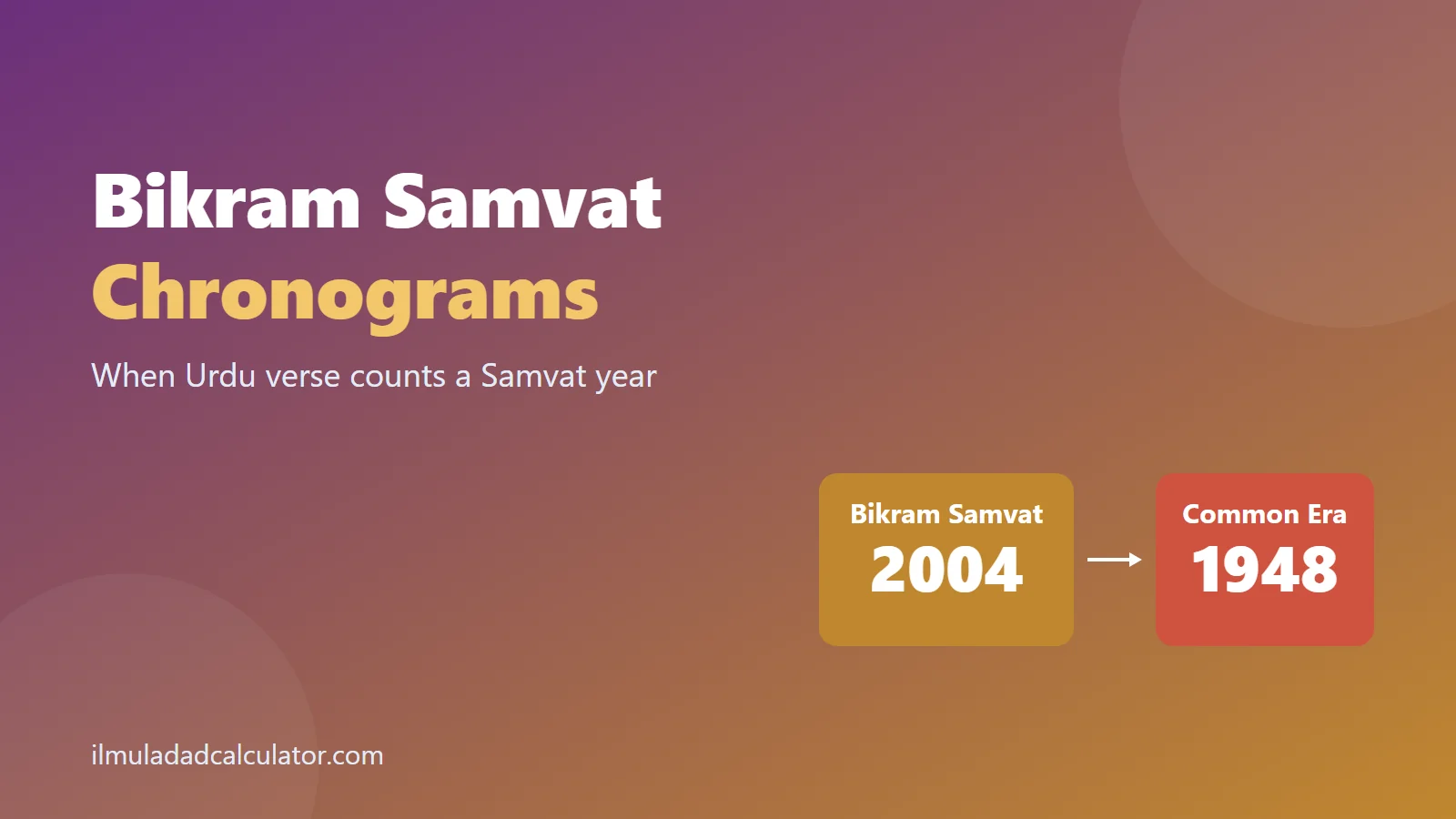
Most Urdu chronograms give a Hijri year. A few give a Bikram Samvat year, and the number on the page then looks about 600 years too high.
What Is a Bikram Samvat Chronogram?
A Bikram Samvat chronogram is a verse whose letter values add up to a year in the Vikram Samvat era. It uses the same Abjad addition as any other chronogram. Only the calendar behind the answer is different.
Most chronograms in Urdu give a Hijri year, as the guide to tarikh goi explains. A reader who assumes Hijri will get a wrong date for a Samvat verse. The error is large, so it is easy to catch once you know to look.
The era is also written Vikrami or Bikrami. Wikipedia says it is named after King Vikramaditya, and calls that link apocryphal.
Short answer: add 57 to a Common Era year, or 56 from January to the spring new year. The verse total is not a Hijri year.
How Does the Samvat Year Relate to the Common Era?
Wikipedia states that the epoch is traditionally placed in 57 BCE. Year numbers run 57 years ahead of the Gregorian calendar. They run 56 years ahead from January to the spring new year.
The switch happens in spring because the Samvat year starts then. The exact day depends on the system, so the rule below is safest for dates outside March and April.
The table below checks that rule on four dated events listed or cited in the sources. Each gap comes out as stated.
| Event | Common Era year | Offset | Samvat year |
|---|---|---|---|
| Constitution adopted, 26 Nov 1949 | 1949 | +57 | 2006 |
| Gandhi assassinated, 30 Jan 1948 | 1948 | +56 | 2004 |
| Rana adoption, 1901 (after April) | 1901 | +57 | 1958 |
| Nepal solar year begins, mid-April 2026 | 2026 | +57 | 2083 |
One more entry fits the 56 pattern. A Dholpur inscription dated 898 in the Samvat count is listed as 842 CE, and 898 – 842 = 56.
Which Samvat Calendar Is Meant?
The name covers more than one calendar. The lunisolar form is used mainly for religious dates in India. The solar form is the civil calendar of Nepal.
The Lunisolar Samvat
In India the year begins with the Chaitra new moon. A leap month is added about seven times every 19 years to keep the seasons in step.
The northern purnimanta system and the southern amanta system differ in where a month starts. They agree on the bright fortnight, when most festivals fall.
The Solar Samvat
In Nepal the year begins on Baisakh 1, around 13 to 15 April. Punjab marks the solar new year at Vaisakhi, usually on 13 or 14 April.
Wikipedia says the Rana rulers made it the official calendar in 1901 CE, when it began as 1958. This page does not claim which variant any given poet used.
The Twelve Month Names
The lunisolar months in order, starting from Vaisakha, are:
- Vaisakha, Jyeshtha, Ashadha and Shravana
- Bhadrapada, Ashvin, Kartika and Agrahayana
- Pausha, Magha, Phalguna and Chaitra
Wikipedia lists rough Gregorian equivalents that run from April to May for Vaisakha through to March to April for Chaitra.
How Does a Poet Add a Samvat Year?
The process is the same as for a Hijri year, and the craft is the same too. The poet picks the Samvat year and finds words that fit the event. Then the poet checks that the letters add up to it.
The Common Era year gives a quick check on the target. Add 57, or 56 for an early-year event, and you have the number the letters must reach.
- Find the Gregorian date of the event.
- Add 56 or 57 to get the Samvat year.
- Compose a phrase whose Abjad total equals that number.
- State the calendar in the verse or the note beside it.
Step 4 matters most. A verse that does not name its calendar leaves a reader to guess between Hijri and Samvat.
What Is a Real Example From 1948?
Rekhta’s article on tarikh nigari quotes a couplet by Hamid Hasan Qadiri. It was written for the death of Mahatma Gandhi, who was assassinated on 30 January 1948.
The page says the verse follows the Hindu calendar and adds up to Bikram 2004. We checked the totals below with the site engine, which uses the Mashriqi values.
- The phrase بلاد عالم is worth 178, from 37 + 141.
- The second line is worth 1826 across its eight words.
178 + 1826 = 2004
The total is 2004, which matches the Samvat year Rekhta gives. Only the marked phrase in the first line counts.
The same couplet is also an example of two halves adding to one year. See adding and subtracting devices for that device, and death-date chronograms for the genre.
Why 2004 and Not 2005?
The event fell on 30 January 1948. That is before the spring new year, so the offset is 56, and 1948 + 56 = 2004.
Had the same verse been written for an event in November 1948, the answer would be 2005.
What Hijri Year Was It?
In the tabular civil calendar, 30 January 1948 falls on 18 Rabi I 1367 AH. Sighting can differ by a day.
So the Hijri year was 1367 and the Samvat year was 2004. A reader who tried to read 2004 as Hijri would land far in the future.
Why Would an Urdu Poet Use a Samvat Year?
The sources do not explain the poets’ reasons, so this page can only describe the setting. Wikipedia places the Samvat new year in Punjab and parts of northern, eastern and central India.
It also notes that older texts from the region carry Samvat dates. Punjabis commonly write the era as Bk. A poet writing for readers who counted that way could reasonably give the year in their count.
Rekhta’s 1948 example fits that pattern, but Rekhta does not state the poet’s motive. We leave the motive open.
What the Sources Do Not Show
We found one verse that a source both quotes and dates in this era. We did not find a second one that we could verify, so we do not list one.
That is a limit of the sources we opened. It is not a claim that the practice was rare or common.
How Do You Read a Samvat Date in an Old Text?
Start from the number on the page, then work back to the Common Era year. Subtract 57, and subtract 56 only if the event fell early in the year.
- 2006 Samvat: 2006 – 57 = 1949, the year of the Indian constitution in November.
- 1958 Samvat: 1958 – 57 = 1901, the year the Rana rulers adopted it, after April.
- 2004 Samvat: 2004 – 56 = 1948 for January, and 2004 – 57 = 1947 for the months after the new year.
The last line shows why a single Samvat year can span two Common Era years. The year runs from spring to spring.
Keep a note of the month whenever the source gives it. A date in January and a date in November of the same Common Era year belong to different Samvat years.
The Hijri gap behaves the same way. In 1 AH the Samvat year was 679, a gap of 678. By 1400 AH the gap had narrowed to 636.
The lunar year is about 11 days shorter, so Hijri years pile up faster. That is why the gap shrinks with time and cannot be a fixed number.
How Do You Convert Hijri and Samvat Years?
Do not subtract one from the other. The two years differ by a number that changes over time. One calendar is lunar and the other follows the sun.
Convert through the Gregorian year instead. The Hijri to Gregorian formula gives the Gregorian year, and then you add 56 or 57.
| Hijri year | Start date | Sum | Samvat year |
|---|---|---|---|
| 1 AH | 19 Jul 622 (Julian 16 Jul 622) | 622 + 57 | 679 |
| 900 AH | 11 Oct 1494 (Julian 2 Oct 1494) | 1494 + 57 | 1551 |
| 1100 AH | 26 Oct 1688 | 1688 + 57 | 1745 |
| 1300 AH | 12 Nov 1882 | 1882 + 57 | 1939 |
| 1367 AH | 15 Nov 1947 | 1947 + 57 | 2004 |
| 1400 AH | 21 Nov 1979 | 1979 + 57 | 2036 |
All six start dates fall between July and December. That is after the spring new year, so the offset is 57 in each row.
The start of 1367 AH is 15 Nov 1947. The verse above came about two and a half months later.
For dates before 1582 the Julian label matters. The page on Julian or Gregorian dates shows how to convert them.
What Mistakes Should You Avoid?
- Reading the total as Hijri. A figure near 2,000 is almost certainly a Samvat or other non-Hijri year.
- Using 57 all year. For January to the spring new year, the offset is 56.
- Ignoring the variant. The lunisolar and solar Samvat start the year at different times.
- Trusting a bare verse. Without a note on the calendar, a total is only a number.
The chronogram decoder gives the total for any line. Then use the rule here to place it. For another non-Hijri era, see the page on the Fasli calendar.
Always show the working when you publish a conversion. A reader can then see the Gregorian year you used, the offset you chose and the month that decided it.
This page is about arithmetic and history only. It makes no statement about any observance.
خلاصہ
اردو کی زیادہ تر تاریخیں ہجری سال دیتی ہیں، مگر کچھ تاریخیں بکرمی سمت کا سال بھی ظاہر کرتی ہیں۔ بکرمی سال تقریباً عیسوی سال سے ستاون سال آگے ہوتا ہے، اور جنوری سے بہار کے نئے سال تک چھپن سال۔ ۱۹۴۸ میں گاندھی کی وفات پر حامد حسن قادری کے شعر کا مجموعہ ۲۰۰۴ بکرمی بنتا ہے۔ اس لیے تاریخی مادّے کے ساتھ تقویم کا نام دیکھنا ضروری ہے۔ ہجری اور بکرمی سال براہِ راست گھٹائے نہیں جاتے، پہلے عیسوی سال نکالا جاتا ہے۔
Sources and Further Reading
- Vikram Samvat, Wikipedia. The 57 BCE epoch, the offsets, the new years, the month names and the dated anchors.
- Hindu calendar, Wikipedia. Vikram Samvat as a lunisolar system and its spring start.
- Tarikh Nigari: Numbers Speaking Through Words, Rekhta blog. Hamid Hasan Qadiri’s couplet for Gandhi, with the totals 178, 1826 and 2004 on the Bikram Samvat count.
- Assassination of Mahatma Gandhi, Wikipedia. The date of 30 January 1948.
- Islamic calendar, Wikipedia. The tabular civil calendar used for the Hijri start dates.
- Abjad totals come from the site engine and calendar arithmetic is asserted in code. See the methodology.
Frequently Asked Questions
What is the Bikram Samvat offset from the Gregorian year?
Wikipedia gives 57 years ahead, and 56 years ahead from January to the spring new year. For example, 2026 CE is 2083 after spring.
Do Urdu chronograms ever use Bikram Samvat?
A few do. Rekhta quotes a 1948 couplet by Hamid Hasan Qadiri for Gandhi whose letters add up to 2004 Bikram.
Is Vikram Samvat the same as Bikram Samvat?
Yes. The names are spellings of one era. Nepal uses the form Bikram Sambat as its civil calendar.
Can I subtract Hijri years from Samvat years?
No. One calendar is lunar and the other follows the sun, so the gap changes. Convert through the Gregorian year.
How do I know which calendar a chronogram uses?
Look for a note in the verse or its source. Without one, compare the total to the event: a Hijri year and a Samvat year differ by hundreds.