Madda-e-tarikh is the phrase in a poem whose letters add up to a year. The phrase is not the whole poem, and it is not the cue that points to it. This page defines the term, separates it from its neighbors and checks two sourced examples letter by letter.
What Is the Meaning of Madda Tarikh?
Rekhta Dictionary defines maada-e-taariikh as a set of words. The numbers of its letters are added to yield a certain year. The related entry maadda-e-taariikh nikaalnaa means to compose such a set of words.
So the madda is the working part of a chronogram. If you strip away the story, the praise and the cue, the madda is what remains. Our guide to what a chronogram is covers the wider idea.
What Do Madda and Tarikh Mean on Their Own?
Madda is an Arabic word with the root m-d-d. Rekhta Dictionary lists its meanings as essence, matter, substance and the root of a word.
Tarikh means a date. Put together, the term reads as the material of the date, the substance from which a year is drawn.
Mehr Afshan Farooqi uses the same picture. She says the word tarikh can name the chronogram phrase, which she calls its substance. It can also name the whole verse that holds the date.
Which Names and Spellings Do Sources Use?
The term appears in several spellings. Romanization varies, so you will see madda-e-tarikh, madda tarikh, maadda-e-taariikh and mādda tāriḵ. They are one phrase.
| Romanized term | Script | Meaning | Source |
|---|---|---|---|
| madda-e-tarikh | مادۂ تاریخ | A set of words whose letter numbers are added to give a year. | Rekhta Dictionary |
| madda-e-tarikh nikalna | مادۂ تاریخ نکالنا | To compose such a set of words. | Rekhta Dictionary |
| madda tarik, plural mawadd-e tawarikh | مادۂ تاریخ | A chronogram poem. It is also called simply tarikh. | Encyclopaedia Iranica (Losensky) |
| hesab al-jommal | حساب الجمل | The method of reckoning a date from the values of letters. | Iranica; Farooqi |
| tarikh-go | تاریخ گو | A person skilled at finding the date of an event by abjad. | Rekhta Dictionary |
| ramz | رمز | The word for a chronogram in Arabic and Turkish. | Farooqi (2003) |
Spelling note: in Persian, the connecting sound between two words is the ezafe. It is spoken but not written, so it adds no letter and no value.
How Is the Madda Different From the Cue Words?
The cue is a signal such as tarikh (date), sal (year) or talab (seek). It tells the reader that a date is hidden nearby. It is not part of the date.
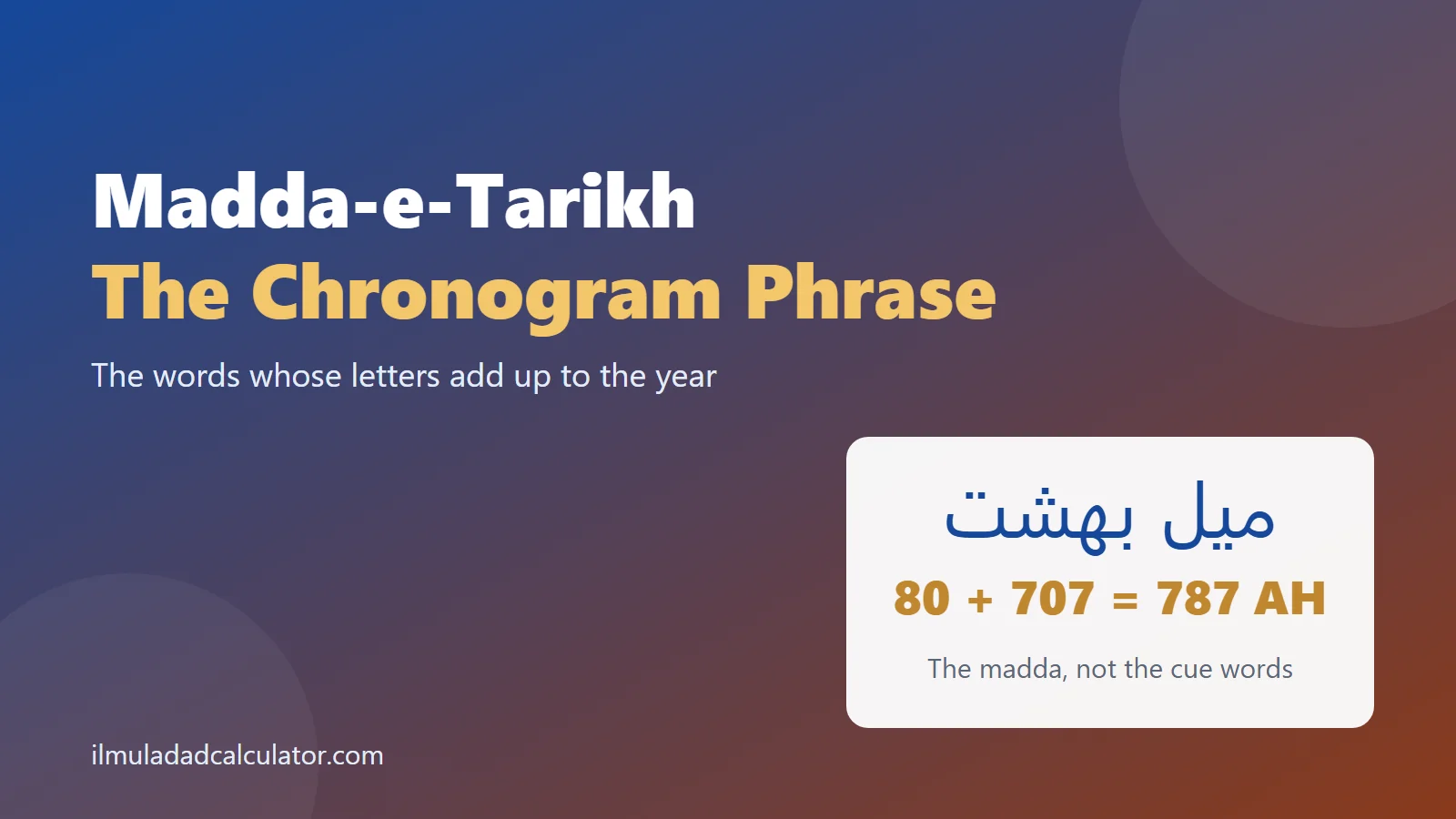
Encyclopaedia Iranica shows this in a poem by Hafez on the death of a vizier. The last verse reads, in Roman letters, sal-e tarikh-e wafat-ash talab az meyl-e behesht.
It means: seek the year of the date of his death from the inclination to paradise. The first five words are the cue. Only the final two are the madda.
Here are the two words of the madda, counted with Mashriqi values.
م 40 + ی 10 + ل 30 = 80
ب 2 + ه 5 + ش 300 + ت 400 = 707
The total is 80 + 707 = 787. Iranica reads this as 21 Safar 787 AH.
In the tabular civil calendar, 21 Safar 787 falls on 3 April 1385 on the Julian calendar. That matches the date Iranica gives, so the reading holds.
Count the whole line and you get 2925. Including the cue words drifts far from the year, so isolate the madda first.
Why the Small Word “Az” Matters
The word az means “from.” It sits between the cue and the madda, and the sum leaves it out. Iranica adds only 80 and 707.
This is the most common slip. A short connecting word looks like part of the phrase, so check each one against the known year.
Is the Madda the Whole Poem or Only the Phrase?
Both uses exist, and sources keep them apart. Encyclopaedia Iranica treats mādda tāriḵ as a poem genre, with the plural mawādd-e tawāriḵ. It also notes that the genre is known simply as tarikh.
Rekhta Dictionary uses the narrower sense of a set of words. Farooqi covers both, since tarikh can mean the phrase or the whole verse.
| What is meant | What it is | Where the use is found |
|---|---|---|
| The phrase | The few words whose letters are added. | Urdu dictionary use |
| The poem | The whole short poem that carries the date. | Persian studies, and some Urdu writers |
| The year | The number the phrase gives. | Everyday speech, loosely |
This page uses the narrow sense. The madda is the counted phrase, and the poem is the poem.
How Did the Madda Develop?
Iranica traces three stages in Persian. The earliest poets wrote the year out in words. Next, they used single letters as number words.
Masud-e Sad-e Salman, who died in 1121, named a year as te, sin and three jim.
400 + 60 + 3 × 3 = 469
Iranica places that year in 1076 to 1077 CE.
Around the 14th century, poets began to build meaningful phrases from letter values. This method, hesab al-jommal, gave the madda its modern shape. Our history of abjad numerals page tells the longer story.
Why Not Just Write the Year in Digits?
Iranica says chronograms serve as a social memory aid. They record dates more securely than bare numbers can.
A phrase is hard to change by accident, and it fits the event it names. A mistaken digit is easy to miss. A broken phrase is easy to notice.
The same page notes that poets wrote such phrases for deaths, buildings, births and offices. The madda was the part people could remember and repeat.
That is also why the madda is chosen with care. A poet tests many phrases before one fits both the meaning and the sum. The finished phrase can then be carved in stone or copied into a book.
Do Other Languages Use the Same Idea?
Yes. Iranica says the genre passed from Persian into Ottoman Turkish, Arabic and Urdu, each adapting it to local needs. Farooqi notes that the tradition stayed popular into the present day mainly in Urdu.
The names change with the language. Arabic and Turkish use ramz, while Persian and Urdu use tarikh. For regional detail, see Urdu chronograms, Ottoman chronograms and Arabic chronograms.
Can a Single Word Be a Madda?
Yes. Iranica says chronograms may be short phrases or single words. Its example is lawd, “refuge,” which dates the death of the last Il-khanid ruler, Abu Said.
ل 30 + و 6 + ذ 700 = 736
The total is 736 AH, which Iranica gives as 1335 CE. One word is enough when its letters and its meaning both suit the event.
Where Does the Madda Sit in a Poem?
Iranica describes a steady layout that formed by the 14th century. A short qita opens with the occasion and signals the date with the word tarikh. It closes with the motto that gives the year.
The madda is therefore usually the final half-verse. In Safavid and Mughal poems, which ran from five to fifteen verses, it often fills the whole last half-line.
You can read more about the poem form in our guide to tarikh goi. The Persian chronograms page covers the classical poets in depth.
What Makes a Good Madda?
A madda has two jobs at once. Its letters must add up to the year, and its words must fit the event.
Iranica says that both the clue and the chronogram should carry verbal meanings that suit the occasion. It adds that mottoes grew more apt over the centuries.
Its example is a madrasa built in the 17th century. The poet Waez of Qazvin joined two public institutions in one phrase, a school and a clinic.
د 4 + ر 200 + د 4 + ج 3 + ه 5 + ل 30 + ر 200 + ا 1 + د 4 + ا 1 + ر 200 + ا 1 + ل 30 + ش 300 + ف 80 + ا 1 = 1064
The words mean “a clinic for the pain of ignorance.” Their letters give 1064. Under the tabular rules, 1064 AH ran from 12 November 1653 to 31 October 1654 Julian. Iranica reports it as 1654.
Does the Madda Always Equal the Year?
Not always. Sometimes the best phrase misses by a little. The poem then tells the reader to add or take away a value.
Momin’s verse on his daughter’s birth is the standard case. The madda دختر مومن totals 1340, and the word naal, worth 81, is cut away to reach 1259 AH.
In that poem the madda is still the phrase, but the year needs one more step. Our page on adding and subtracting devices explains the rules.
How Do You Find the Madda in a Line?
- Find the cue word, such as tarikh, sal or talab.
- Take the words after the cue, up to the end of the verse.
- Leave out linking words that sit between the cue and the phrase.
- Add the letter values of the phrase with one table.
- Compare the total with the known year of the event.
- If it misses, look for a signal to add or subtract a value.
For the adding itself, see how to read a chronogram or use the chronogram decoder. To write a madda of your own, start with how to write a chronogram.
Which Mistakes Are Common?
- Counting the cue. Words such as tarikh and sal are scenery. They do not belong in the sum.
- Calling the year the madda. The madda is the phrase, and the year is the result.
- Counting a linking word. A word such as az may sit outside the sum, as in the Hafez line.
- Reading the poem as the phrase. A long poem has many words, and only the madda is added.
- Trusting one spelling. Test both spellings of a word and keep the one that fits the year.
خلاصہ
مادۂ تاریخ وہ لفظ یا فقرہ ہے جس کے حروف کی ابجد قیمتیں جمع کرنے سے سال نکلتا ہے۔ اشارے کے الفاظ جیسے «تاریخ» اور «سال» اس میں شامل نہیں ہوتے۔ حافظ کے قطعے میں «میل بہشت» کے ۸۰ اور ۷۰۷ مل کر ۷۸۷ ہجری دیتے ہیں۔ بعض فارسی کتابیں پورے قطعے کو بھی مادۂ تاریخ کہتی ہیں۔
Sources and Further Reading
- Mādda tāriḵ, Encyclopaedia Iranica, by Paul E. Losensky (2006). The genre, its plural and short name, its layout, the Hafez line (787) and the Waez madrasa line (1064).
- Chronograms, Encyclopaedia Iranica, by J. T. P. de Bruijn (1991). The Persian term mādda(-ye) tārīḵ, the clue that precedes the chronogram, and the one-word example lawd.
- maada-e-taariikh, Rekhta Dictionary. The set of words whose letter numbers give a year.
- maadda-e-taariikh nikaalnaa, Rekhta Dictionary. To compose such a set of words.
- maadda, Rekhta Dictionary. The Arabic word with the root m-d-d and its meanings.
- taariiKH-go, Rekhta Dictionary. A person skilled at finding dates by abjad.
- The Secret of Letters: Chronograms in Urdu Literary Culture, Mehr Afshan Farooqi, Edebiyat 13(2), 2003. The uses of tarikh and the word ramz.
- Tarikh Nigari: Numbers Speaking Through Words, Rekhta blog (2020). Momin’s verse, with the phrase value 1340 and the naal value 81.
Frequently Asked Questions
What does madda-e-tarikh mean?
It is the set of words whose letters add up to a year. Madda means substance, and tarikh means date.
Is madda tarikh the same as a chronogram?
Close, but not identical. In Urdu it is the counted phrase. Some Persian studies use it for the whole chronogram poem.
Do cue words like tarikh count in the sum?
No. They only signal that a date is hidden. Only the madda is added.
Does the madda always give the exact year?
Usually, but a poem may tell the reader to add or subtract a value, as Momin’s verse does.
How do you pronounce madda-e-tarikh?
Say mad-da-e-ta-rikh, with a short “e” linking the two words. It is the ezafe and is not written.