Some authors hid the year of a book inside the book itself. The title, or a few closing lines, adds up to the year the work was finished. This page explains the habit and checks three sourced titles letter by letter.
What Is a Book Chronogram?
A book chronogram is a title or verse whose letters add up to the year of a book’s completion. It uses the same letter values as any chronogram. Only the occasion is different, because the event being dated is the end of the writing.
The Encyclopaedia Iranica notes that titles of books sometimes contain the date of their completion. It places this beside dates of births, deaths, accessions and buildings.
That makes the book itself the monument. The reader holds the date in the name, so it travels with every copy.
Where Does the Date Hide in a Book?
There are three usual places, and they do not all date the same event.
The Title
The title is the neatest case. The author chooses a name that means something and also sums to the year. Nobody needs a separate verse to find it.
A Closing Verse
Many authors ended with a short poem instead. The Rieu catalog of Persian manuscripts in the British Museum often records such lines. It describes a versified chronogram at the end that gives the year of completion.
The Colophon
The colophon is the copyist’s note at the end of a manuscript. It usually dates the copy, not the original composition. A copy made fifty years later therefore carries a later date than the author’s own.
Why this matters: a year on a manuscript can mean three different things. It may be the author’s date, the copyist’s date or a later owner’s note. Always ask which one a source is giving.
Which Sourced Examples Can We Check?
Each title below is named in a library catalog or scholarly source with its year. We then added the letters with our engine, using Mashriqi values. Persian letters count as their Arabic base, so چ counts as ج.
| Title | Author | Kind of work | Total | Common Era |
|---|---|---|---|---|
| اخلاق محسنی | Husain Va’iz Kashifi | Persian ethics treatise | 900 AH | 1494 to 1495 |
| چراغ پنجاب | Ganesh Das | History of the Punjab | 1262 AH | 1846 |
| چار باغ پنجاب | Ganesh Das | Expanded history of the Punjab | 1265 AH | 1848 to 1849 |
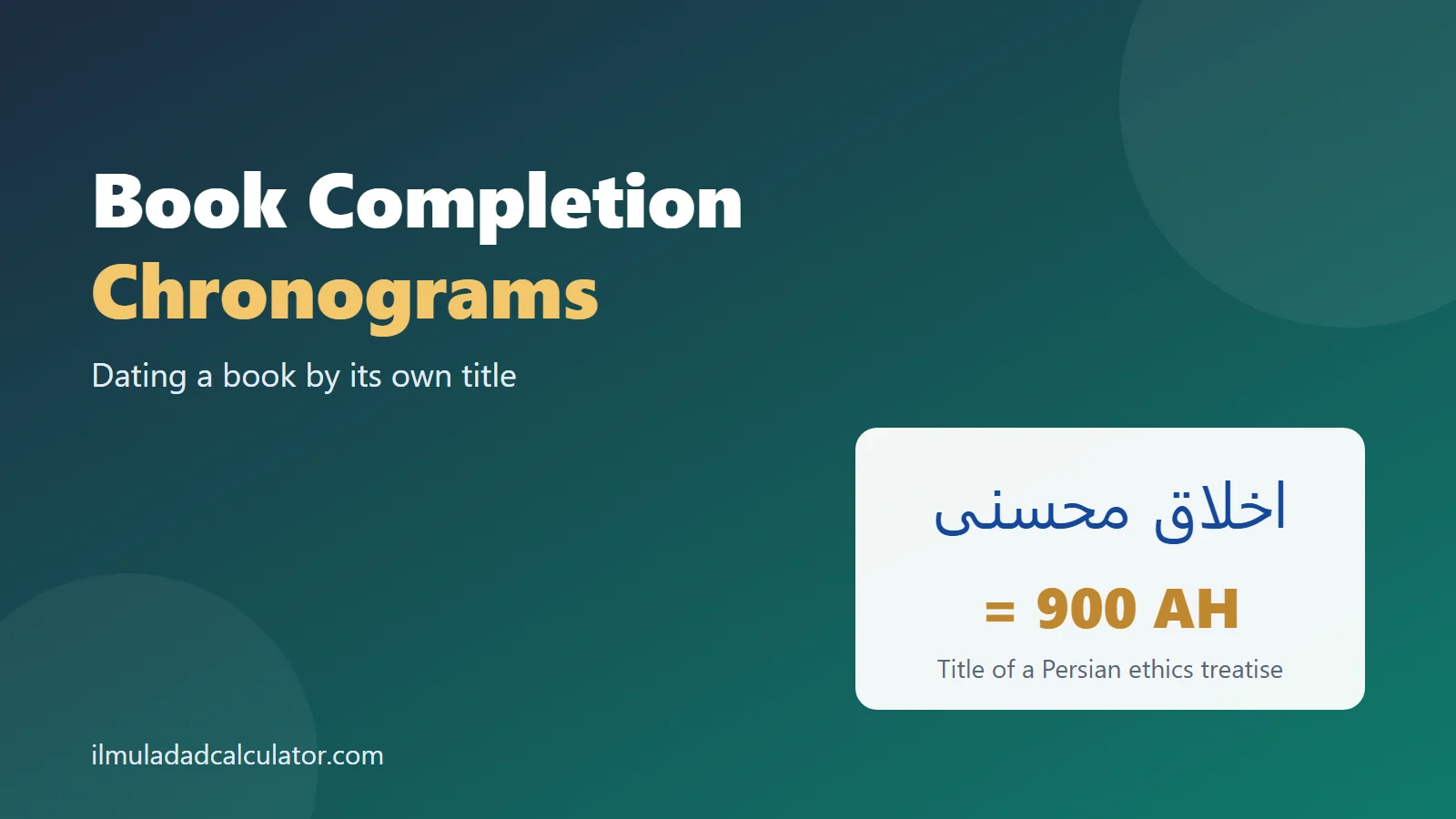
Akhlaq-i Muhsini (900 AH)
Husain Va’iz Kashifi wrote this treatise on ethics at the court of Sultan Husayn Bayqara in Herat. It is dedicated to the sultan’s son Abu’l-Muhsin. The St Andrews collection calls it one of the best known Persian ethical works.
The Rieu catalog describes a copy in the British Museum. It says a versified chronogram at the end gives the completion date. The date, it adds, is expressed by the title.
| Word | Letters added |
|---|---|
| اخلاق | ا 1 + خ 600 + ل 30 + ا 1 + ق 100 = 732 |
| محسنی | م 40 + ح 8 + س 60 + ن 50 + ی 10 = 168 |
The two words give 732 + 168 = 900. The catalog and the St Andrews record both give 900 AH, which is 1494 to 1495 CE.
Chiragh-i Panjab (1262 AH)
Ganesh Das was a Punjabi revenue officer and historian. His first history, Chiragh-i Panjab, is dated to 1846 or 1847 by Wikipedia’s account of his works.
The India Office catalog lists a chronogram for 1262 AH as the completion date of one of his works. The title we name adds up to exactly that number.
| Word | Letters added |
|---|---|
| چراغ | چ 3 + ر 200 + ا 1 + غ 1000 = 1204 |
| پنجاب | پ 2 + ن 50 + ج 3 + ا 1 + ب 2 = 58 |
Char Bagh-i Panjab (1265 AH)
Ganesh Das later expanded his history into Char Bagh-i Panjab. The same catalog gives 1265 AH, or 1849 CE, for the completion of the longer version. It says this was three years after the shorter one.
| Word | Letters added |
|---|---|
| چار | چ 3 + ا 1 + ر 200 = 204 |
| باغ | ب 2 + ا 1 + غ 1000 = 1003 |
| پنجاب | پ 2 + ن 50 + ج 3 + ا 1 + ب 2 = 58 |
The totals are 1262 and 1265, so the gap is 3. That matches the catalog’s three years, a small check that supports both readings.
What Do the Three Titles Have in Common?
All three titles are short. Two have two words and one has three, and together they hold 30 letters.
Every one is also a natural name. اخلاق محسنی means the ethics of Muhsin, after the prince it honors. چراغ پنجاب means lamp of the Punjab.
چار باغ پنجاب means four gardens of the Punjab, a garden image that suits a book about a land. Nothing in these names looks forced.
That is the mark of a good title chronogram. A reader can enjoy the name without ever noticing the sum, and a second reader can find the year later.
What Happens When Sources Disagree?
Book dates are often less settled than stone inscriptions. Akhlaq-i Muhsini shows how this works.
- The common date. Most sources give 900 AH, which the title supports.
- The later date. Maria Subtelny argues for 907 AH. A Berlin copy has 907 written below a chronogram on its last page.
- The lesson. A title can fit one date exactly and still be questioned by other evidence.
Daniel Halft, who discusses the dispute, says the date is mostly given as 900. He follows Subtelny for 907. A sum that matches is evidence, but it does not close the case.
The Ganesh Das books show a milder version. Wikipedia dates the longer history to 1854 or 1855, after an update presented to a British official.
The catalog’s 1265 AH belongs to the earlier text. Authors revised their works, and each version could carry its own date.
How Is a Hidden Date Different From a Plain One?
Not every dated book uses a chronogram. The Iranica article separates an explicit date from a hidden one. It says early verse romances were often dated in plain words, with the year named outright.
The hidden kind needs the reader to add letter values. It rewards the reader who checks, and it leaves the title free to say something about the book.
The two methods can sit side by side. A copyist might write 907 in numerals under a chronogram, as the Berlin copy of Kashifi’s treatise does. The numerals then act as a gloss on the verse.
A plain date is easy to read but easy to alter. A hidden date is harder to read. It is also harder to damage by accident, because one changed letter spoils the phrase.
How Does a Catalog Read a Closing Chronogram?
Rieu’s catalog gives a model for the habit. Entry after entry, he notes where the date comes from and checks it against other evidence.
For a treatise on poetical figures, he reports completion in 1060 AH, the twenty-fourth year of Shah Jahan’s reign. He adds that a versified chronogram in the preface fixes the same date.
For other works, he records closing chronograms that give 732, 920, 940 and 950 AH. The printed Persian is not reproduced here, so we do not add those lines.
The method is worth copying. A chronogram is one witness, and a reign year, a colophon or a second chronogram is another.
Why Did Authors Date Their Books This Way?
The sources do not give one reason, so we should be careful. We can still say what the habit did.
- It fixed a date in a form that survives copying. A year written as numerals can be changed by a careless copyist more easily than a title.
- It showed skill. The title had to mean something, suit the book and sum to the year.
- It gave catalogers a check. Rieu notes the date expressed by a title again and again, and a sum can confirm a reading.
The same craft appears when poets date buildings. See building chronograms for that side of the art.
How Can You Check a Book Title Yourself?
- Write the title exactly as the source gives it, in the original script.
- Check the spelling against the catalog. A single article or a doubled letter can change the total.
- Add the values with the chronogram decoder or the phrase value calculator.
- Compare the total with the year in your source. If it is off by a few units, look for a cue word or a count rule.
- Convert to the Common Era only after the sum matches. Use a range if the source gives no month.
For the cue words that point to a date line, read about signal words. The madda-e-tarikh page explains the phrase that holds the year.
Persian and Urdu letters add a few extra shapes. The Urdu and Persian letters guide shows how each one counts.
What Should a Reader Remember?
A book chronogram is a date that the author built into the work. It is strongest when a catalog or a colophon backs it and the sum matches exactly.
It is weakest when the spelling is uncertain or when scholars date the work another way. In both cases the arithmetic is only the first step.
The same method dates other occasions. See death-date chronograms and building chronograms.
خلاصہ
کتاب کا مادۂ تاریخ وہ نام یا چند اشعار ہیں جن کے حروف جمع کرنے پر تکمیلِ کتاب کا سال نکلتا ہے۔ کبھی نام ہی تاریخ بتاتا ہے، کبھی آخر میں قطعہ ہوتا ہے، اور کاتب کا خاتمہ عموماً نقل کی تاریخ دیتا ہے۔ «اخلاق محسنی» ۹۰۰ ہجری دیتا ہے، «چراغ پنجاب» ۱۲۶۲ ہجریاور «چار باغ پنجاب» ۱۲۶۵ ہجری۔ ہر مثال کا حساب حرف بہ حرف جانچا گیا ہے، اور جہاں مآخذ میں اختلاف ہے وہاں اس کی نشاندہی کی گئی ہے۔
Sources and Further Reading
- Chronograms, Encyclopaedia Iranica. Titles of books and the occasions that chronograms mark.
- Catalog of the Persian Manuscripts in the British Museum, Volume II, Charles Rieu. The entry on Akhlaq-i Muhsini and its title chronogram for 900 AH.
- Akhlaq-i Muhsini, University of St Andrews collections. Composition in 900 AH, 1495 CE, and the dedication.
- A Hitherto Unknown Persian Manuscript of Husayn Va’iz Kashifi, Daniel Halft, Journal of Islamic Manuscripts. The debate between 900 and 907 AH.
- Husayn Kashifi, Wikipedia. The author and his works.
- Catalog of Persian Manuscripts in the Library of the India Office, additional manuscripts and index. Chronograms for 1262 and 1265 AH by Ganesh Das.
- Ganesh Das, Wikipedia. The titles Chiragh-i Panjab and Char Bagh-i Panjab and their dates.
- The Char Bagh-i Panjab: Socio-Cultural Configuration, J. S. Grewal, International Journal of Punjab Studies.
Frequently Asked Questions
What is a book chronogram?
It is a title or verse whose letters add up to the year a book was finished.
Is the title always the date?
No. Some authors used a closing verse instead, and a colophon usually dates the copy.
Which book title is a well-known example?
Akhlaq-i Muhsini by Husain Va’iz Kashifi totals 900 AH, the date usually given for it.
Why can a title total differ from the catalog year?
The spelling may differ, or the book may exist in more than one version, as with the Ganesh Das histories.
Do scholars always agree on the date?
No. Some argue for 907 AH for Akhlaq-i Muhsini, so a matching sum is evidence, not proof.