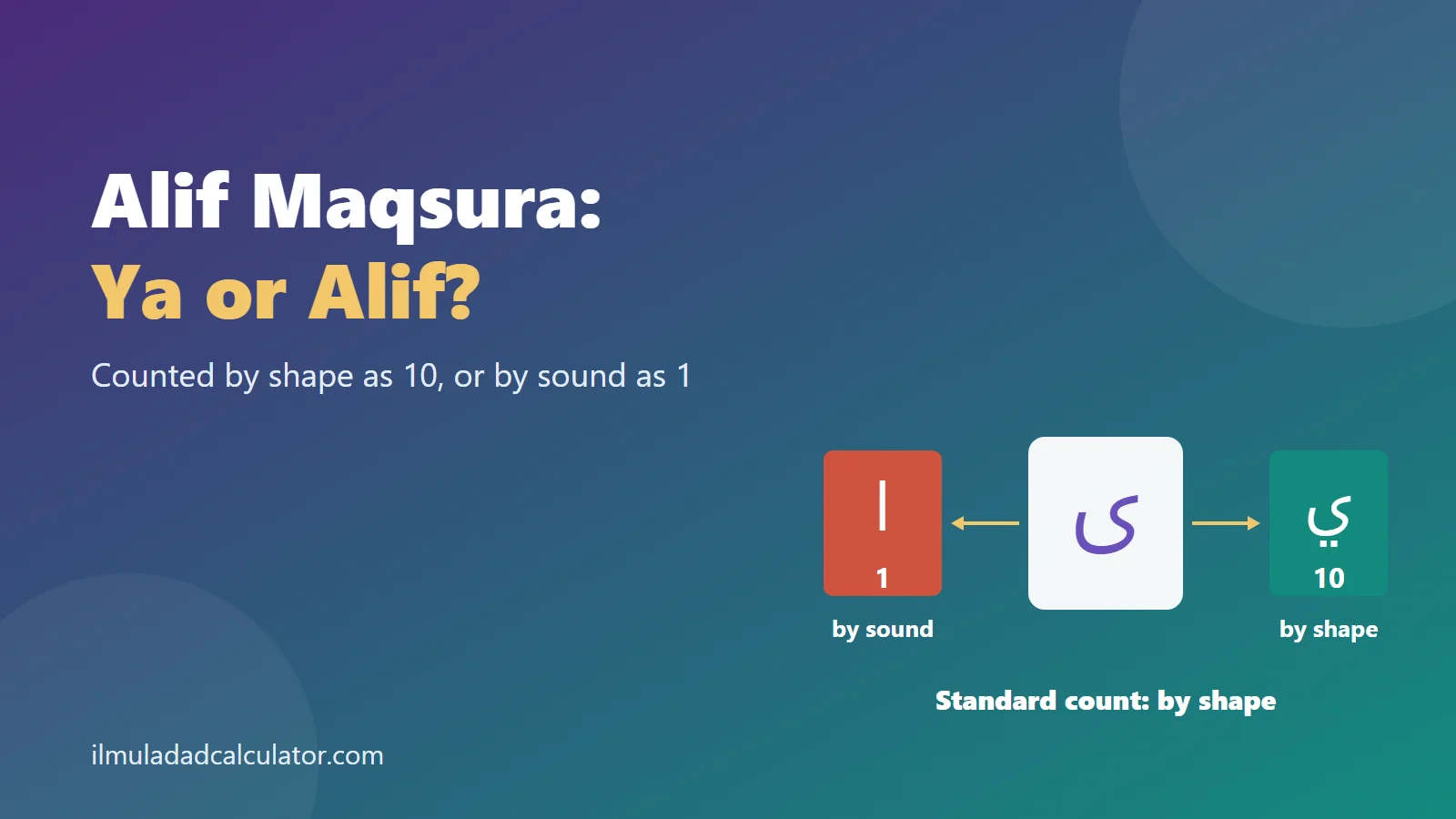
Alif maqsura (ى) is counted as 10 in Ilm-ul-Adad, the same as ya (ي). The standard rule follows its written shape, which is a ya without dots. Some writers count it as alif, worth 1, because it sounds like a long a.
What Is Alif Maqsura?
Its name means the shortened alif. It is written like a ya with no dots, and it only appears at the end of a word.
It sounds like a long a, as in Musa or Layla. It is also called alif layyina, the “soft alif.”
So the letter looks like one thing and sounds like another. That is the whole reason two counts exist.
It is not a new letter with its own place in the abjad order. It is a special way of writing the end of a word, much like ta marbuta.
How Is Alif Maqsura Counted in Ilm-ul-Adad?
The usual rule counts what is written, not what is heard. Since ى has the shape of ya, it takes the value of ya, which is 10.
This is the same idea behind the ta marbuta value, where the shape of ha decides the count. Here is Mustafa, counted by shape:
م 40 + ص 90 + ط 9 + ف 80 + ى 10 = 229
Every calculator on this site uses this rule. The letter values page lists ya at 10 in both the Mashriqi and Maghribi systems.
The shape rule has one big strength. Anyone who sees the written word gets the same total, even without knowing how it is said.
It also keeps the count simple. You never have to guess how a word was said in another region or another century.
Why Do Some Writers Count It as 1?
Some writers count by sound instead of shape. To them, the ending of Musa is an a sound, so they give it the value of alif.
This reading is less common in letter tables, but you will meet it in some books and websites. It always gives a total that is exactly 9 lower for each alif maqsura.
Neither count is a mistake in arithmetic. They are two counting choices, so always say which one you used next to the total.
This site uses 10 as the default. If you follow a source that counts 1, write a short note such as “alif maqsura counted as alif.”
Can You Mix the Two Readings?
No, pick one reading and use it for every word you count. A phrase counted half by shape and half by sound gives a total no one can repeat.
Take the story title Layla and Majnun, written ليلى ومجنون. By shape it gives 235, and by sound it gives 226.
The phrase has only one alif maqsura, so the gap is 9 again. A phrase with three of them would differ by 27.
How Do Common Names Compare Under Both Readings?
Many familiar names end in alif maqsura. The table shows each one in Arabic spelling, counted both ways in the Mashriqi system.
| Name | Arabic | By shape | By sound |
|---|---|---|---|
| Musa | موسى | 116 | 107 |
| Isa | عيسى | 150 | 141 |
| Huda | هدى | 19 | 10 |
| Yusra | يسرى | 280 | 271 |
| Layla | ليلى | 80 | 71 |
| Mustafa | مصطفى | 229 | 220 |
| Salma | سلمى | 140 | 131 |
| Murtaza | مرتضى | 1450 | 1441 |
| Yahya | يحيى | 38 | 29 |
The gap is 9 in every row, because only the last letter changes. Yahya is a good test, since it has a dotted ya in the middle and alif maqsura at the end.
ي 10 + ح 8 + ي 10 + ى 10 = 38
Only the final letter has a second reading. The middle ya stays 10 under both rules, so Yahya gives 38 or 29.
How Does Urdu Write These Endings?
Urdu has no separate key or letter for alif maqsura. It uses choti ye (ی), which also has no dots at the end of a word.
To show the long a sound, Urdu often adds a small standing alif (ٰ) above the ye. You see it in موسیٰ, عیسیٰ and مصطفیٰ.
Does the Small Alif Add Anything?
No, the small alif is a reading mark, like a vowel sign. It adds 0, and the ye under it counts 10.
| Name | Urdu | Total |
|---|---|---|
| Musa | موسیٰ | 116 |
| Isa | عیسیٰ | 150 |
| Mustafa | مصطفیٰ | 229 |
| Layla | لیلیٰ | 80 |
| Murtaza | مرتضیٰ | 1450 |
Each Urdu total matches the Arabic total by shape. So moving a name between Arabic and Urdu script does not change its value.
Not every Urdu writer adds the small alif. A name such as موسی without it still gives 116, because the mark never counted.
What If the Name Is Typed With a Plain Alif?
Some people type Yusra as يسرا instead of يسرى. That is a different spelling, not a different counting rule.
The first gives 271 and the second gives 280. The value comparison tool already shows this pair side by side.
Does Alif Maqsura Appear in Everyday Words?
Yes, it is common in short Arabic words, not only in names. You will see it in phrases, book titles and old letters.
- إلى (to) gives 41 by shape and 32 by sound.
- متى (when) gives 450 by shape and 441 by sound.
- مستشفى (hospital) gives 890 by shape and 881 by sound.
These small words matter most in long phrases. One title can hold several of them, and each one moves the total by 9.
Which Arabic Words Take ى and Which Take ا?
Arabic spelling decides which ending a word gets, so you cannot choose it freely. Both endings sound like a long a.
- Many words and names end in ى, such as هدى (guidance) and ليلى (Layla).
- Others end in a tall alif, such as دعا (he called) and عصا (stick).
- After a ya, the ending is usually a tall alif, as in دنيا (world). Yahya (يحيى) is a well-known exception.
So two words that rhyme can still count differently. Look up the standard spelling before you add the letters.
A good dictionary or a published book is the safest guide. Avoid copying a spelling from a social media post or a quick phone message.
Why Do English Spellings Not Help?
English spellings show the ending as a plain a, so they hide which letter was used. Mustafa, Layla and Huda all end in a. So does Raza, whose Arabic form رضا ends in a tall alif.
Some names also have several English forms, such as Laila and Layla, or Hoda and Huda. Library catalogs may even write the ending as á.
So never count from the English form. Find the Arabic or Urdu spelling first, and only then add the letters.
How Can You Tell ى From ي?
The quick test is the dots. Ya has two dots under it, and alif maqsura has none.
| Letter | Name | Where you see it | How to spot it | Value |
|---|---|---|---|---|
| ى | Alif maqsura | Arabic, end of a word only | No dots, sounds like a long a | 10 |
| ي | Ya | Arabic, any place in a word | Two dots below, sounds like y or ee | 10 |
| ی | Choti ye | Urdu and Persian | No dots at the end, dots in the middle | 10 |
| ے | Bari ye | Urdu, end of a word | A long tail that runs back to the right | 10 |
| ا | Alif | Any language, any place | A straight upright stroke | 1 |
Why Do Egyptian Books Drop the Dots?
In Egypt and Sudan, printers often write a final ya without dots. So the name Ali (علي) may appear as على, which looks like the word for “on.”
For the standard count this makes no difference, since both forms give 110. But a sound-based reader could wrongly count it as 101, so check how the word is said.
The same habit shows up in older books from other regions. When a final letter has no dots, ask whether it sounds like ee or like a.
How Do Computers Store These Letters?
Each form has its own code. Alif maqsura is U+0649, the Arabic ya is U+064A, and the Urdu choti ye is U+06CC.
A word copied from a website may use any of the three. The calculators here count all three as 10, so the total stays the same.
Other tools may not treat them the same way. If a calculator skips a letter it does not know, your total will come out 10 too low.
How Should You Count a Word Ending in ى?
Use these steps whenever a word ends in a dotless ya shape. They keep your total clear and easy to repeat.
- Check the real spelling. Make sure the word ends in ى and not in a tall alif.
- Check the sound. If it ends in ee, it is a ya written without dots.
- Count ى as 10, the standard rule, unless your source says otherwise.
- If you use the sound reading, subtract 9 for each alif maqsura.
- Write the rule next to the total, such as “Mashriqi, alif maqsura as ya.”
A hamza at the end of a word has its own rules. See hamza in Ilm-ul-Adad before you count words like شفاء.
Can You Solve These Alif Maqsura Practice Problems?
Find the Mashriqi total of each word by shape. For words that end in ى, find the sound reading as well.
- منى, Muna, a woman’s name
- مجتبى, Mujtaba, a man’s name
- حتى, hatta (until)
- دنيا, dunya (world)
Show the answers
- منى gives 100 by shape and 91 by sound.
- مجتبى gives 455 by shape and 446 by sound.
- حتى gives 418 by shape and 409 by sound.
- دنيا gives 65 by shape. It already ends in a real alif, so there is only one count.
How Do the Calculators Handle It?
The Abjad value calculator counts ى, ي and ی as 10. It skips the small alif, so Urdu spellings match their Arabic forms.
Paste a word and read the letter list under the total. If the last letter shows 10, the engine read your ending as alif maqsura or ya.
To see the sound reading, retype the ending as ا and compare both spellings in the value comparison tool. For other reasons totals disagree, read why calculators give different values.
خلاصہ
الف مقصورہ (ى) عربی میں لفظ کے آخر میں آتا ہے۔ اس کی شکل بغیر نقطوں والی یا جیسی ہوتی ہے، مگر آواز لمبے الف کی ہوتی ہے۔ علم الاعداد میں عام قاعدہ شکل کے مطابق گننے کا ہے، اس لیے اس کی قیمت دس مانی جاتی ہے۔ بعض لکھنے والے آواز کے مطابق اسے الف یعنی ایک گنتے ہیں، جس سے کل عدد نو کم ہو جاتا ہے۔ اردو میں یہی آخر چھوٹی ی اور کھڑے الف سے لکھا جاتا ہے، جیسے موسیٰ اور عیسیٰ، اور کھڑا الف کوئی عدد نہیں بڑھاتا۔
Sources and Further Reading
- Alif maqsura, Wikipedia (section of the Aleph article). Its shape, sound, the name alif layyina, and dotless final ya in Egypt and Sudan.
- Yodh, Wikipedia, sections on Arabic ya and Persian and Urdu ye. Dotless final forms and Urdu bari ye.
- ى, Wiktionary. The letter name, its use at the end of words, and its code point U+0649.
- Abjad numerals, Wikipedia. Ya is worth 10 and alif is worth 1.
- All values on this page come from this site’s tested engine. See the methodology.
Frequently Asked Questions
Is alif maqsura one of the 28 abjad letters?
No. It is an ending form of ya, so it borrows the value of ya, 10.
Does the Maghribi system change alif maqsura?
No. Ya is 10 and alif is 1 in both systems, so both readings stay the same.
Does the small alif in موسیٰ count as 1?
No. The small standing alif is a reading mark and adds nothing.
Why does one website give my name a total 9 lower?
It probably counts alif maqsura as alif, or it spells the name with a plain alif. Ask which rule it used.
Is bari ye (ے) the same as alif maqsura?
No. Bari ye is an Urdu letter for an e sound. It is also worth 10.
Should I change my name’s ending to get a different total?
No. Count the spelling you really use. A total only describes that written form.