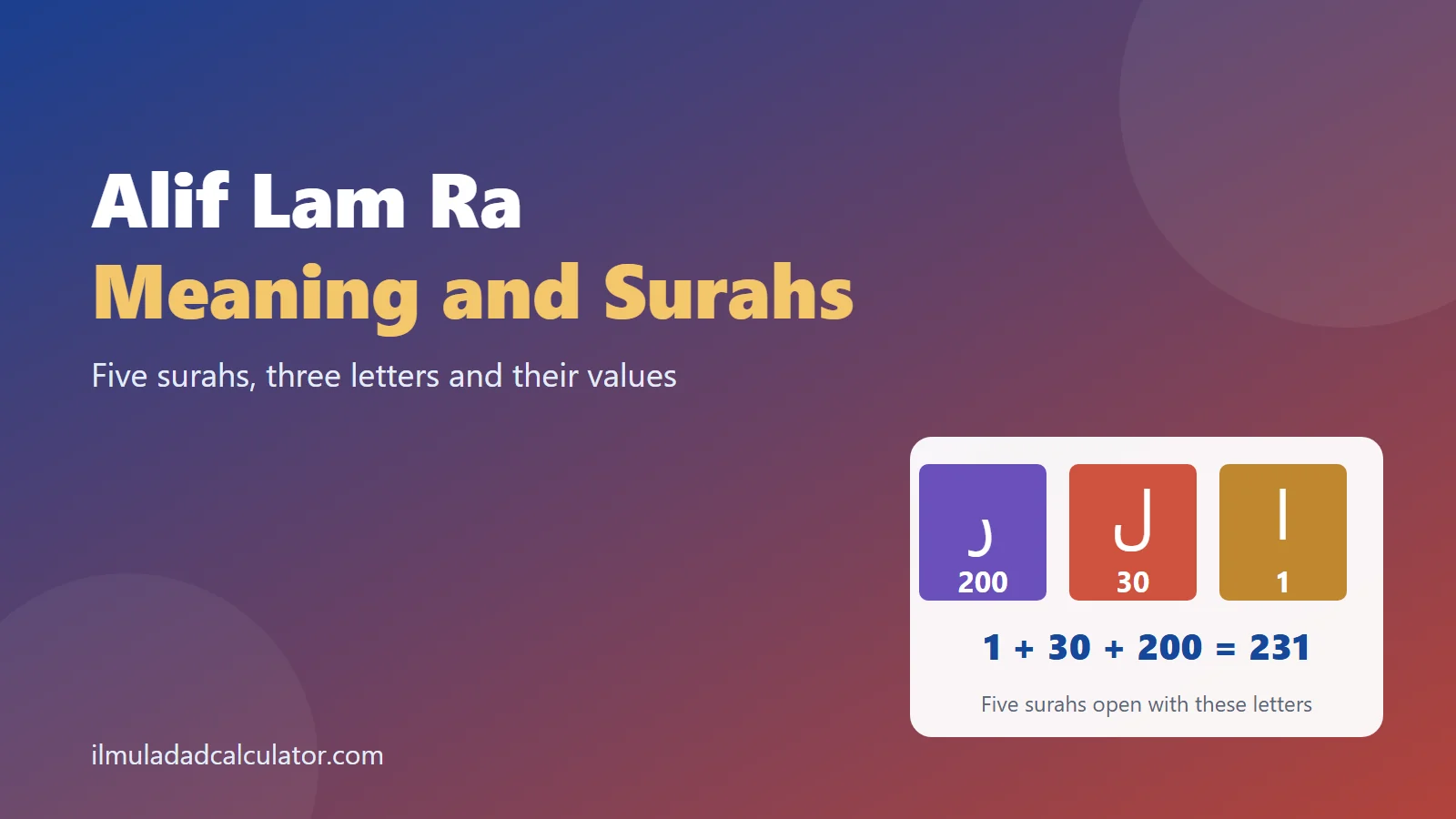
Alif Lam Ra (الر) is the opening of five surahs of the Quran: Yunus, Hud, Yusuf, Ibrahim and al-Hijr. The three letters are alif, lam and ra. Their Abjad values are 1, 30 and 200, and the sum is 231.
What Does Alif Lam Ra Mean?
The most widely held position is that its meaning is known with certainty only to God. This is a statement about the majority view, and it is the usual answer in classical commentary.
Alif Lam Ra belongs to the huruf muqattaat, the disjointed letters that open 29 surahs. Commentators have proposed several explanations over the centuries. The huruf muqattaat overview sets out that range neutrally, so it is not repeated here.
This page is a reference, not a commentary. It reports where the letters occur and how they are written and counted. It does not choose between views.
Quick answer: Alif Lam Ra opens five surahs: 10, 11, 12, 14 and 15. Surah 13 sits between them with a longer opening. Most hold the meaning to be known only to God.
Which Five Surahs Open With Alif Lam Ra?
The five surahs are Yunus (10), Hud (11), Yusuf (12), Ibrahim (14) and al-Hijr (15). All five are listed as Meccan. The table gives the verse count and the ruku count for each.
| Surah # | Name | Title refers to | Verses | Rukus | Place |
|---|---|---|---|---|---|
| 10 | Yunus | The prophet Yunus (Jonah) | 109 | 11 | Meccan |
| 11 | Hud | The prophet Hud | 123 | 10 | Meccan |
| 12 | Yusuf | The prophet Yusuf (Joseph) | 111 | 12 | Meccan |
| 14 | Ibrahim | The prophet Ibrahim (Abraham) | 52 | 7 | Meccan |
| 15 | Al-Hijr | The place Al-Hijr (Hegra) | 99 | 6 | Meccan |
Two independent lists agree on every verse count and every place in this table. Both are named in the sources below.
What Are the Surahs Named After?
Four of the five names belong to prophets who are mentioned in the Quran. These are Yunus, Hud, Yusuf and Ibrahim, known in English as Jonah, Hud, Joseph and Abraham.
Al-Hijr is different, because it names a place. The reference is to Hegra, an ancient site in northern Arabia.
A surah title is a label for finding the surah. It does not say what the opening letters mean.
Why Does Surah 13 Sit in the Middle of the Run?
Surah 13, ar-Ra’d, has a different opening. It reads المر, which is Alif Lam Mim Ra. That is the same three letters plus mim, placed before the ra.
So the six surahs from 10 to 15 all open with letters, but not all with the same group. Five use الر and one uses the longer form. The page on Alif Lam Mim Ra covers surah 13 in detail.
The run has clear edges. Surah 9, at-Tawbah, has no opening letters, and neither has surah 16, an-Nahl. Six surahs in a row therefore form one block.
One more detail comes from the same list. Ar-Ra’d has 43 verses and is marked Medinan there, while the other five are marked Meccan.
Do the Letters Form a Verse on Their Own?
In these surahs, no. The letters are followed by more words in the same first verse. The Wikipedia table on the muqattaat marks Alif Lam Ra as not a complete verse.
This is a point of difference with Alif Lam Mim. In al-Baqarah and Al Imran, the three letters stand alone as the first verse. The table marks those two as complete.
The verse counts in this article follow the standard count of each surah. They do not change this point.
How Do the Five Surahs Compare in Length?
The five surahs differ a great deal. Hud has 123 verses and is the longest of the group. Ibrahim has 52 and is the shortest.
Together the five hold 494 verses. They are divided into 46 rukus in the printed layout. Yusuf has the most rukus with 12, and al-Hijr has the fewest with 6.
Do the Printed Order and the Order of Revelation Match?
No. The printed order runs 10, 11, 12, 14, 15. The order of revelation is a separate list, and scholars have proposed more than one.
The table gives two such lists, with ar-Ra’d included for reference. The first is the Egyptian standard order. The second is the scheme of the scholar Nöldeke.
| Surah # | Name | Egyptian standard order | Nöldeke order |
|---|---|---|---|
| 10 | Yunus | 51 | 84 |
| 11 | Hud | 52 | 75 |
| 12 | Yusuf | 53 | 77 |
| 13 | Ar-Ra’d | 96 | 90 |
| 14 | Ibrahim | 72 | 76 |
| 15 | Al-Hijr | 54 | 57 |
In the Egyptian list, Yunus, Hud and Yusuf come one after another at 51, 52 and 53. Al-Hijr follows at 54. Ibrahim sits much later, at 72.
The Nöldeke list is different again. It places al-Hijr earliest of the five, at 57, and Yunus latest, at 84. So the two lists do not agree.
How Is Alif Lam Ra Written and Read?
In the printed text the three letters form one cluster, الر. Alif does not join the letter after it, so it stands a little apart. Lam joins ra, so those two are linked.
Many printed copies add a small prolongation mark above the letters, which gives الٓر. These marks guide the reciter and are not extra letters. The engine ignores them, so both forms give 231.
The cluster is read as three letter names: alif, lam, ra. It is not read as one word. In Urdu the names are written الف, لام and رے.
English spellings vary. You may see Alif Lam Ra or Alif Laam Raa. They all point to the same three Arabic letters.
The muqattaat pronunciation page explains the sounds in more detail.
What Are the Letter Values of Alif Lam Ra?
Each letter has a value in the Abjad system. Alif counts as 1 and lam counts as 30. Ra counts as 200, which makes it the largest value of the three.
ا 1 + ل 30 + ر 200 = 231
This is only addition. You can reproduce it by hand in three steps.
- Take each letter in turn: ا, ل, ر.
- Look up each value in the letter values chart: 1, 30 and 200.
- Add the three values to get 231.
Ra is the 20th letter in the Abjad order and the second one in the hundreds group. In the everyday alphabet order it is the 10th letter. The Abjad and hijai order page explains why the two places differ.
The Mashriqi and Maghribi systems give the same total here. All three letters keep one value in both. The page on why values differ shows where the systems do part ways.
How Does the Sum Compare With Alif Lam Mim?
Alif Lam Ra and Alif Lam Mim share their first two letters. Only the third letter changes, which is ra in one and mim in the other. The gap between their totals is therefore 200 minus 40, which is 160.
The table lists the four related openings that begin with alif and lam, with their totals. The Alif Lam Mim page covers the three-letter group in full. The Alif Lam Mim Sad page covers surah 7.
| Opening | Name | Total | Surahs |
|---|---|---|---|
| الم | Alif Lam Mim | 71 | Surahs 2, 3, 29, 30, 31, 32 |
| المص | Alif Lam Mim Sad | 161 | Surah 7 |
| الر | Alif Lam Ra | 231 | Surahs 10, 11, 12, 14, 15 |
| المر | Alif Lam Mim Ra | 271 | Surah 13 |
The longer opening differs from the shorter one by one letter. Alif Lam Mim Ra totals 271, and 271 minus 231 is 40, the value of mim. That is simple arithmetic about two spellings.
Please note: these sums describe how letters are counted in the Abjad system. They do not describe what the letters mean, and this site makes no claim of hidden meaning.
How Often Does Ra Appear Among the 29 Openings?
Alif and lam are the most frequent muqattaat letters. Each appears in 13 of the 29 openings. Ra appears in only 6.
Those six openings are the five Alif Lam Ra surahs and the Alif Lam Mim Ra surah. Ra is not part of any other opening. So wherever you meet this letter among the muqattaat, you are inside surahs 10 to 15.
The muqattaat list places every opening side by side, so you can see how these six fit among the 29.
What Do the Letter Names Add Up To?
Each letter has a name that is itself written with letters. Historically, some writers also counted the spelled-out name. The table shows both values.
| Letter | Name | Written name | Letter value | Name value |
|---|---|---|---|---|
| ا | alif | ألف | 1 | 111 |
| ل | lam | لام | 30 | 71 |
| ر | ra | راء | 200 | 201 |
The three written names add up to 383. The Arabic name of ra is written here as راء, and spellings of letter names can vary between books. The total is shown as an example of the method, not as a fixed figure.
How Can You Find the Opening in a Printed Quran?
A printed copy makes the opening easy to spot. Follow these steps for the first of the five surahs.
- Turn to surah 10, Yunus, which follows at-Tawbah. At-Tawbah is the one surah that has no Basmala before it.
- Find the Basmala at the top of Yunus.
- Read the three letters, الر, which come right after it.
The other four surahs follow the same layout. Each one has the Basmala, then the three letters, then the rest of the first verse.
How Does Alif Lam Ra Connect to Abjad?
The connection is only through counting. Alif, lam and ra are ordinary letters with standard values. People in earlier centuries added up such openings, and the muqattaat and Abjad page gives that wider background.
You can check the sum yourself with the Abjad value calculator or the phrase value calculator. The method is described on the methodology page. The words and phrases section has more reference pages like this one.
خلاصہ
الف لام را قرآن کی پانچ سورتوں کے شروع میں آتا ہے: یونس، ہود، یوسف، ابراہیم اور الحجر۔ ان کے درمیان سورۂ رعد کا آغاز الف لام میم را سے ہوتا ہے۔ ان تینوں حروف کو الگ الگ نام لے کر پڑھا جاتا ہے۔ ابجد میں ان کی قدریں ایک، تیس اور دو سو ہیں اور مجموعہ دو سو اکتیس بنتا ہے۔ سب سے مشہور رائے یہ ہے کہ ان کا یقینی مطلب صرف اللہ جانتا ہے۔ یہ صفحہ صرف حقائق اور گنتی بیان کرتا ہے۔
Sources and Further Reading
- List of chapters in the Quran, Wikipedia. Surah numbers, verse and ruku counts, place of revelation, the two revelation-order lists and what each title refers to.
- Muqattaʿat, Wikipedia. The five Alif Lam Ra surahs, the Alif Lam Mim Ra opening, the complete-verse column and the majority view.
- Al Quran Cloud metadata. Verse count and Meccan or Medinan label for each surah, used to cross-check the first list.
- Letter values and sums come from this site’s tested engine. See the methodology.
Frequently Asked Questions
What does Alif Lam Ra mean?
The most widely held view is that its meaning is known with certainty only to God. Commentators have also proposed several explanations.
Which surahs start with Alif Lam Ra?
Five surahs: Yunus, Hud, Yusuf, Ibrahim and al-Hijr, numbered 10, 11, 12, 14 and 15.
Why is surah 13 not on the list?
Ar-Rad opens with Alif Lam Mim Ra, a longer opening. It sits between Yusuf and Ibrahim.
What is the Abjad value of Alif Lam Ra?
Alif is 1, lam is 30 and ra is 200, so the sum is 231. This is arithmetic only.
How is الر pronounced?
It is read as three letter names, alif, lam and ra, one after the other. It is not read as one word.
Does the sum 231 have a hidden meaning?
No. It is the total of three letter values, and this site makes no claim of any hidden meaning.