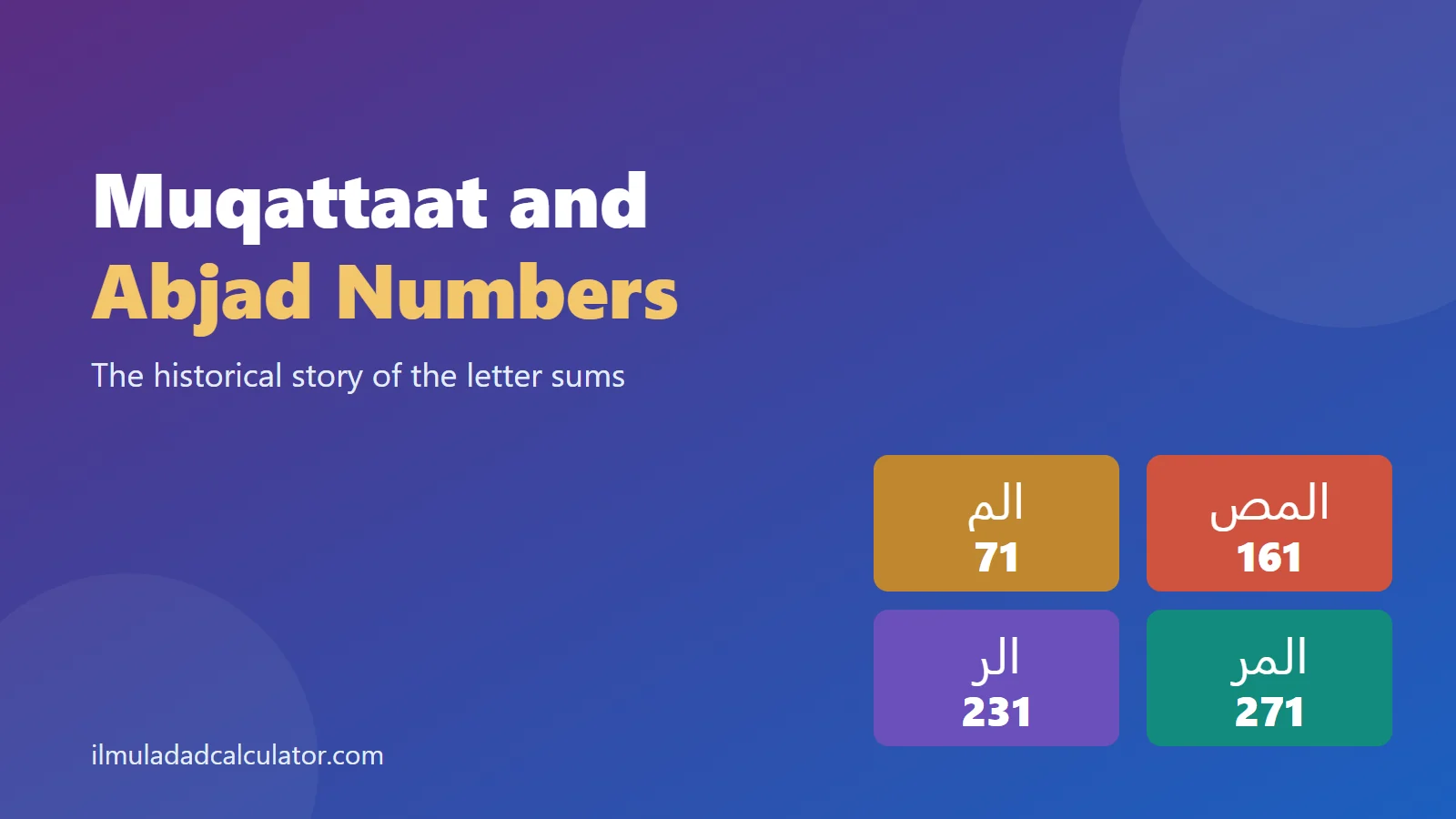
The best known account of counting the opening letters is a report in the commentaries of al-Tabari and Ibn Kathir. In it, the opening الم is counted as 71. This page tells that history as arithmetic and as reception, with no numerical reading of its own.
Why Could the Opening Letters Be Counted at All?
The opening letters are ordinary Arabic letters. In the abjad system each letter carries a fixed number, so any group of letters has a sum. That is the whole basis for the counting described below.
The table gives four openings and their sums. The values come from this site’s engine and use the standard Mashriqi chart.
| Opening | Letters read aloud | Letter-value sum |
|---|---|---|
| الم | alif, lam, mim | 71 |
| المص | alif, lam, mim, sad | 161 |
| الر | alif, lam, ra | 231 |
| المر | alif, lam, mim, ra | 271 |
A sum is only a count. It tells you what the letters add up to, and nothing more. For the general overview of the letters and the views about them, see the huruf muqattaat guide.
What Does the Classical Account Say?
The account appears in al-Tabari’s commentary on the first verse of al-Baqarah. Ibn Kathir also records it, and he comments on it at length.
Two men are named, the brothers Abu Yasir and Huyayy ibn Akhtab. In the account they hear the opening letters recited and then count them. A modern reference work notes that Huyayy is said to have discussed these letters with the Prophet.
The Four Openings in the Report
The report counts four openings, one after another. As each new set of letters is mentioned, the figure grows. The totals in the Tabari edition cited below are listed here.
- الم is counted as 71.
- المص is counted as 161.
- الر is counted as 231.
- المر is counted as 271.
The speakers then add the four figures together. That total reads 734 in that Tabari edition. The account ends with the men saying that the matter had become confused for them.
What the Report Is About
The report is about people counting, and the sources present it as a challenge put to the Prophet. It does not say that the numbers hold a message. In the account, the counting leads to confusion, not to a result that anyone accepts.
The report is also linked in the sources to the verse that speaks of clear and unclear verses. This page only notes the link and does not discuss that verse.
Why Do the Totals Differ Between Editions?
The totals are not the same everywhere. The Tabari edition cited below gives 734. The Ibn Kathir text cited below gives a total of seven hundred and four, which is 704.
The gap is exactly 30. It comes from one letter, sad. Sad is worth 90 in the Mashriqi chart and 60 in the Maghribi chart.
| Opening | Mashriqi | Maghribi |
|---|---|---|
| الم | 71 | 71 |
| المص | 161 | 131 |
| الر | 231 | 231 |
| المر | 271 | 271 |
| Total | 734 | 704 |
This is arithmetic only. It is a possible explanation, not a claim about what the narrators used. Copyists may also have changed a figure by hand.
The same issue affects any modern count. Read why Abjad values differ for the full list of causes.
Who Were the Two Commentators Behind the Report?
Al-Tabari lived from 839 to 923 CE. His commentary, called Jami’ al-Bayan, gathers earlier traditions on a large scale. It became a standard reference for later commentators.
Ibn Kathir died in 1373 CE, about four and a half centuries later. His commentary is commonly called Tafsir Ibn Kathir. Ibn Taymiyya was one of his teachers, and his method largely follows that of Ibn Taymiyya.
Why the Gap in Time Matters
The report was already old when Ibn Kathir wrote. Each man worked from earlier tradition, and each had to decide what to do with it. Collecting a report is not the same as endorsing it.
This is why a counting story can sit inside a commentary and still be doubted by the same tradition. The commentary preserves what was said, and the commentator then weighs it.
How Did Scholars Respond to the Report?
The reception was cautious. Ibn Kathir points out that the report depends on one narrator, Muhammad ibn al-Sa’ib al-Kalbi. He says that what this narrator reports alone is not used as proof.
Ibn Kathir also raises a practical problem with the method. If it were sound, every one of the fourteen letters would need counting, and the total would grow far larger.
In his view, that shows the method does not hold together. He therefore does not use the report as proof.
- A modern editor of the Tabari text adds a footnote that grades this chain as weak.
- A modern Hanafi answer on islamqa.org reaches the same grading and says the report should not be quoted.
- In the sources cited here, al-Tabari gives his own view of the openings. He does not treat the counting as settled.
The Majority View
Ibn Kathir notes that the scholars did not agree on one explanation. Some early figures are reported to have held that the letters are known only to God. These include Abu Bakr, Umar, Uthman, Ali and Ibn Masud.
The most widely held position is the same: their certain meaning is known only to God. This is a statement about what most scholars hold, and this page does not rank any other view.
In short: the counting story is a record of what some people did with the letters. It is not a teaching about their meaning, and the commentators who report it do not present it as one.
How Can You Recheck These Sums Yourself?
You do not need to trust any total on a page, including this one. Each sum can be rebuilt in a minute. Take المص as an example:
ا 1 + ل 30 + م 40 + ص 90 = 161
The same steps work for المر:
ا 1 + ل 30 + م 40 + ر 200 = 271
- Write the opening letter by letter, with no spaces.
- Choose one chart, Mashriqi or Maghribi, and keep to it.
- Look up each letter in the chart and add the numbers.
If your total differs from a source, check the chart first. In this history, a single letter changed the grand total by 30. See how to calculate by hand for a longer worked method.
Did Other Writers Link the Letters to Numbers?
Yes, in different ways and at different times. In 1888 the scholar Otto Loth suggested a link between the openings and gematria, the Hebrew system of letter numbers. The Wikipedia article on the muqattaat records this suggestion.
Later writers have proposed other numerical readings, and new ones still appear. This page does not list or judge them. Each would need its own careful source, and the same cautions about sums apply.
The history, then, has two layers. One is the old account of counting years, with the objections raised against it. The other is the modern study of how and why people have tried to count.
Why the Letters Invite Counting
The openings are short, fixed and written in letters that all have numbers. Anyone can add them in a few seconds, with no interpretation at all. That ease explains why counting is so common.
Ease is not evidence, though. Two people with different charts will reach different totals from the same letters. That is why the history above matters more than any single number.
What Should a Reader Take From This History?
Three points stand out. A letter sum is a fact of arithmetic. A report that uses sums should be read with its chain and its critics.
And the widely held view is that the meaning is known to God.
- Check the letters you are counting, and the chart you are using.
- Treat every sum as a number, not as a message.
- Read the classical comment on any report before repeating it.
To see every opening and its surah, use the list of all 29 surahs. To check a sum yourself, try the phrase value calculator. The compare tool shows the Mashriqi and Maghribi totals side by side.
The words section gathers the rest of this series. The chronograms hub covers the other long tradition of counting letters for dates.
خلاصہ
تفسیر طبری اور تفسیر ابن کثیر میں ایک روایت نقل ہوئی ہے جس میں حروفِ مقطعات کو ابجد کے حساب سے گن کر مدت نکالی گئی، مثلاً الم کا مجموعہ اکہتر بنتا ہے۔ ابن کثیر نے اس روایت کی سند پر کلام کیا اور اسے دلیل نہیں مانا۔ جمہور کی رائے یہی ہے کہ ان حروف کا یقینی مطلب اللہ ہی جانتا ہے۔ یہ صفحہ صرف تاریخ اور حساب بیان کرتا ہے، کوئی تعبیر پیش نہیں کرتا۔
Sources and Further Reading
- Tafsir al-Tabari (Jami’ al-Bayan), vol. 1, on the opening of al-Baqarah. The report of Abu Yasir and Huyayy, the four figures and the total of 734.
- Tafsir Ibn Kathir, on the opening of al-Baqarah. The same report, the objection about al-Kalbi and the objection about counting all fourteen letters.
- Tafsir Ibn Kathir on 2:1, English. That scholars did not agree on one explanation, and the views attributed to early figures.
- Validating a hadith: Alif Laam Meem and the duration of the ummah, islamqa.org. The chain through al-Kalbi and its weak grading.
- Muqattaʿat, Wikipedia. The 1888 suggestion by Otto Loth about gematria.
- Huyayy ibn Akhtab, Wikipedia. The note about his discussion of the opening letters.
- Al-Tabari and Ibn Kathir, Wikipedia. Their dates and the names of their commentaries.
- Abjad values come from this site’s tested engine. See the methodology.
Frequently Asked Questions
What is the muqattaat numerical value of الم?
Its letter-value sum is 71: alif 1, lam 30 and mim 40. This is arithmetic only, not a claim of meaning.
Who counted the muqattaat letters in history?
A report in al-Tabari and Ibn Kathir names Abu Yasir and Huyayy ibn Akhtab as counting the letters for years.
Did scholars accept that report?
Ibn Kathir did not use it as proof, since its chain rests on al-Kalbi. Modern graders also call the chain weak.
Why do some totals read 734 and others 704?
The gap of 30 matches sad being worth 90 in the Mashriqi chart and 60 in the Maghribi chart.
What is the most widely held view of the letters?
Their certain meaning is known only to God. Several other explanations exist and are covered in the pillar guide.
Does this page give a meaning for the numbers?
No. It reports history and arithmetic only and does not endorse any numerical reading.