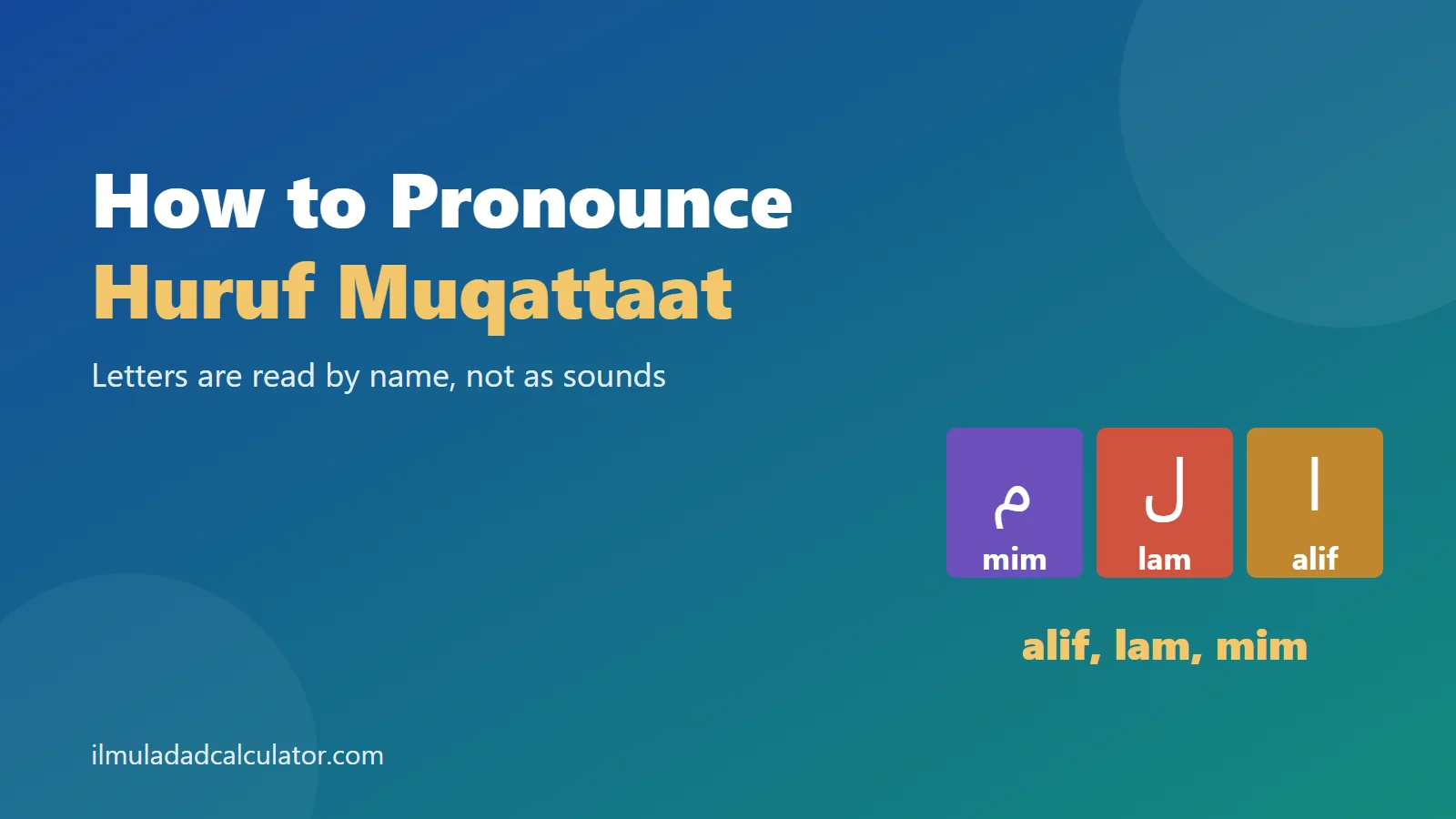
The huruf muqattaat are recited by letter names, not by the sounds the letters make in a word. So الم is said as alif, lam, mim. This page lists all 14 names and what sources report about prolongation, as a description and not a ruling.
Are the Muqattaat Read as Names or as Sounds?
Reference sources agree on the basic point. Each letter is pronounced separately, by its name, even though the letters are written side by side like a word.
A reader who treated الم as a word might say “alam”. That is not how it is recited. The reader says the three names in order, with a pause between them.
This is why the openings sound so different from the text around them. Elsewhere, letters join into words. Here, the letters stand alone and are voiced one at a time.
A name also tells the listener exactly which letter is meant. A bare sound can point to more than one letter. Sin and sad, for example, both give an s sound to many ears.
For the wider picture, such as which surahs use these openings, see the overview of the huruf muqattaat. This page stays with the question of how they are said.
What Are the Names of the 14 Letters?
The names below are the ordinary names of the Arabic letters. The table gives each name in Arabic script, in simple Roman letters, and in the Urdu name Pakistani learners use.
| # | Letter | Arabic name | Simple spelling | Urdu name | Roman Urdu | Value |
|---|---|---|---|---|---|---|
| 1 | ا | ألف | alif | الف | alif | 1 |
| 2 | ح | حاء | hha | بڑی حے | bari he | 8 |
| 3 | ر | راء | ra | رے | re | 200 |
| 4 | س | سين | sin | سین | sin | 60 |
| 5 | ص | صاد | sad | صاد | suad | 90 |
| 6 | ط | طاء | ta | طوئے | toe | 9 |
| 7 | ع | عين | ayn | عین | ain | 70 |
| 8 | ق | قاف | qaf | قاف | qaf | 100 |
| 9 | ك | كاف | kaf | کاف | kaf | 20 |
| 10 | ل | لام | lam | لام | lam | 30 |
| 11 | م | ميم | mim | میم | mim | 40 |
| 12 | ن | نون | nun | نون | nun | 50 |
| 13 | ه | هاء | ha | چھوٹی ہے | chhoti he | 5 |
| 14 | ي | ياء | ya | چھوٹی یے | chhoti ye | 10 |
The Arabic names follow the standard transliteration listed on the Wikipedia article for the muqattaat. The Roman spellings here are simplified so they are easy to read.
Note on spelling: English spellings of these names vary a great deal. You may see “haa”, “ha” or “hha” for the same letter. The Arabic script is the fixed reference.
How Do the Urdu Names Compare With the Arabic Names?
Most names are the same in both languages. Alif, lam, mim, nun, qaf and kaf sound alike whether a speaker says them in Arabic or in Urdu.
A few names differ because Urdu has its own alphabet teaching. Urdu calls ح bari he and ه chhoti he, which means big he and small he. The Arabic names are hha and ha.
Pairs That Are Easy to Confuse
Two pairs cause the most trouble for new learners. The letters ح and ه both resemble an English h. The letters س and ص both resemble an s.
Knowing the full name of each letter helps tell them apart. The Urdu names bari he and chhoti he give a quick memory aid for the first pair.
In Pakistan, many readers meet the muqattaat first in the Arabic recitation heard in mosques and on recordings. The Urdu alphabet names are then a bridge to what they hear.
What Is Madd and Why Does It Appear Here?
Madd is the Arabic word for prolongation. In the science of recitation, it means holding a long vowel sound for a set length of time. Wikipedia’s article on tajwid describes this length in beats, called morae, and gives two as the standard count.
The same article says a prolongation sign over a letter is held longer. It gives four or five beats before a hamzah and six beats before a shaddah. Its example is the last verse of the first surah.
The muqattaat belong to this topic because several letter names contain a long vowel. The name لام has a long aa sound in the middle. The name صاد has one too.
The Name Used for These Letters
Teaching sites place the muqattaat under a type of madd they call lazim harfi. The word lazim means necessary, and harfi means of the letter. Sources describe this type as applying to the letters at the start of certain surahs.
The same sources split it into a heavy kind and a light kind. The heavy kind is where the long vowel meets a merged letter, as in the لام of الم. The light kind is where it meets a plain stop, as in ص.
How the Name of Lam Is Built
Tajweed Me gives a worked example from the opening of the second surah. It says the name لام is voiced in three parts: an l sound, a long aa, and an m sound.
That final m then runs straight into the m of the next letter, ميم. The site describes this merging as the reason for the heavy kind of letter madd.
What Do Reference Sources Report About Prolongation?
This section only reports what sources say. One teaching site, Tajweed Me, sorts the 14 letters into three groups by how long each is held. It counts the length in beats.
- Alif is not prolonged. It is said plainly as alif.
- Five letters are prolonged for two counts. The site gives them with the memory phrase hayy tuhr.
- Eight letters are prolonged for six counts. The site gives them with the phrase naqas asalukum.
- Ayn is listed as an exception. It is reported at two, four or six counts, with four preferred.
| Group | Letters | Reported detail |
|---|---|---|
| No stretch | ا | Alif is said plainly. |
| Two counts | ح ر ط ه ي | Five letters, remembered by the phrase hayy tuhr. |
| Six counts | ن ق ص ع س ل ك م | Eight letters, remembered by the phrase naqas asalukum. Ayn is the exception. |
The same site notes that these letters are not said exactly as they are in the alphabet. For example, the name of ya is said without the final hamza of its full name.
Why Do the Figures Differ Between Sources?
Not every source gives the same count. Quran Grace and Eaalim both state that the necessary madd is held for six counts. Tajweed.us says it is more proper to hold it for four or five counts.
This shows that teaching materials describe the matter in different ways. Some give a single figure, and some give a range with a preferred length.
This page does not choose among these figures. It also does not say which is correct. Counts can depend on the style of recitation a teacher follows, so a learner should ask a qualified teacher.
How Does the Written Mark Relate to the Recitation?
In many printed copies, the letters carry a small wavy sign above them. This is the prolongation sign, called maddah. The Wikipedia article on the muqattaat notes that lam and mim are joined and both carry this mark.
The mark is a written cue. It tells the eye that the letter name carries a long vowel. A learner still needs a teacher or a recording to hear how long the sound is held.
Writing the letters next to each other can also mislead the eye. Because المص looks like a short word, a newcomer may try to blend it. The sign over each letter is a reminder that they stand apart.
Which Letters Appear Most in the Openings?
There are 14 combinations, and together they use 36 letter slots. Mim leads with 5 appearances. Alif, lam and sin each appear 4 times.
Kaf, nun and hha each appear in only one combination. This means the names of alif, lam and mim are the ones a listener hears most often.
Hearing the common names first is a gentle way to begin. Once alif, lam and mim are familiar, the rest of the openings are mostly new orderings of known names.
Does the Way a Letter Is Read Change Its Abjad Value?
No. Abjad values attach to the written letter, not to how long it is held when recited. The value of ل is 30 whether it is read with a stretch or without one.
For example, الم is the sum of three letters:
ا 1 + ل 30 + م 40 = 71
This is arithmetic on written letters and nothing more. The page on the muqattaat and Abjad values covers the counting in detail. You can also check a sum with the Abjad value calculator.
How Can a Learner Approach These Letters?
Recitation is learned by listening and by correction. A written page can describe it, but it cannot replace a person who hears your reading. The steps below are only a general outline of how people usually begin.
- Learn the 14 letter names from the table above.
- Listen to a recording by a trained reciter of a surah that opens with these letters.
- Read the opening aloud, name by name, and compare it with the recording.
- Ask a qualified teacher to listen and correct the length of each letter.
The pace of a recitation can also change how long a stretch sounds. For that reason, a teacher is the right guide, not a chart. This page is a reference and does not set any rule.
For the surah-by-surah list, see the full list of the muqattaat. To see each letter shape with its value, visit the Arabic letters page.
خلاصہ
حروفِ مقطعات کو حروف کے ناموں سے پڑھا جاتا ہے، آوازوں سے نہیں، جیسے الم کو الف، لام، میم۔ ہر حرف الگ الگ پڑھا جاتا ہے۔ حوالہ جاتی ذرائع کے مطابق ان حروف میں مد کی مقدار مختلف بیان کی گئی ہے اور مختلف ذرائع مختلف گنتی دیتے ہیں۔ یہ صفحہ صرف بیان کردہ طریقے کا تعارف ہے، کوئی حکم نہیں۔ درست تلفظ کسی مستند استاد سے سیکھنا چاہیے۔
Sources and Further Reading
- Muqattaʿat, Wikipedia. The 14 letter names, that each letter is pronounced separately, and the prolongation mark on lam and mim.
- Tajwid, Wikipedia. Prolongation counted in morae, with two as the standard and six before a shaddah.
- Rules of madd, Tajweed Me. The three groups of letters and the counts reported for each.
- Rules of Madd in Tajweed, Quran Grace. Heavy and light letter madd, with alif lam mim and sad as examples.
- Complete Guide to Al-Madd in Tajweed, Eaalim Institute. Lazim harfi in the disjointed letters, held for six counts.
- Madd Al-Laazim, Tajweed.us. The muqattaat under necessary madd and the four or five count figure.
- Abjad values come from this site’s tested engine. See the methodology.
Frequently Asked Questions
How are the huruf muqattaat pronounced?
Each letter is said by its name, one at a time. The opening الم is read as alif, lam, mim.
Are the muqattaat read as a word?
No. The letters are written side by side but are not blended. Reference sources say each letter is pronounced separately.
Why do the names of some letters sound long?
Several letter names hold a long vowel, such as the aa in lam and sad. Recitation sources call the stretch of this vowel madd.
How many counts do these letters get?
Sources differ. One teaching site reports two or six counts by letter, while others give six, or four to five. A qualified teacher can explain the practice.
What are the Urdu names of ح and ه?
Urdu calls ح bari he and ه chhoti he. In Arabic they are called hha and ha.
Does the way a letter is read change its Abjad value?
No. The value belongs to the written letter, so lam is 30 however it is recited.