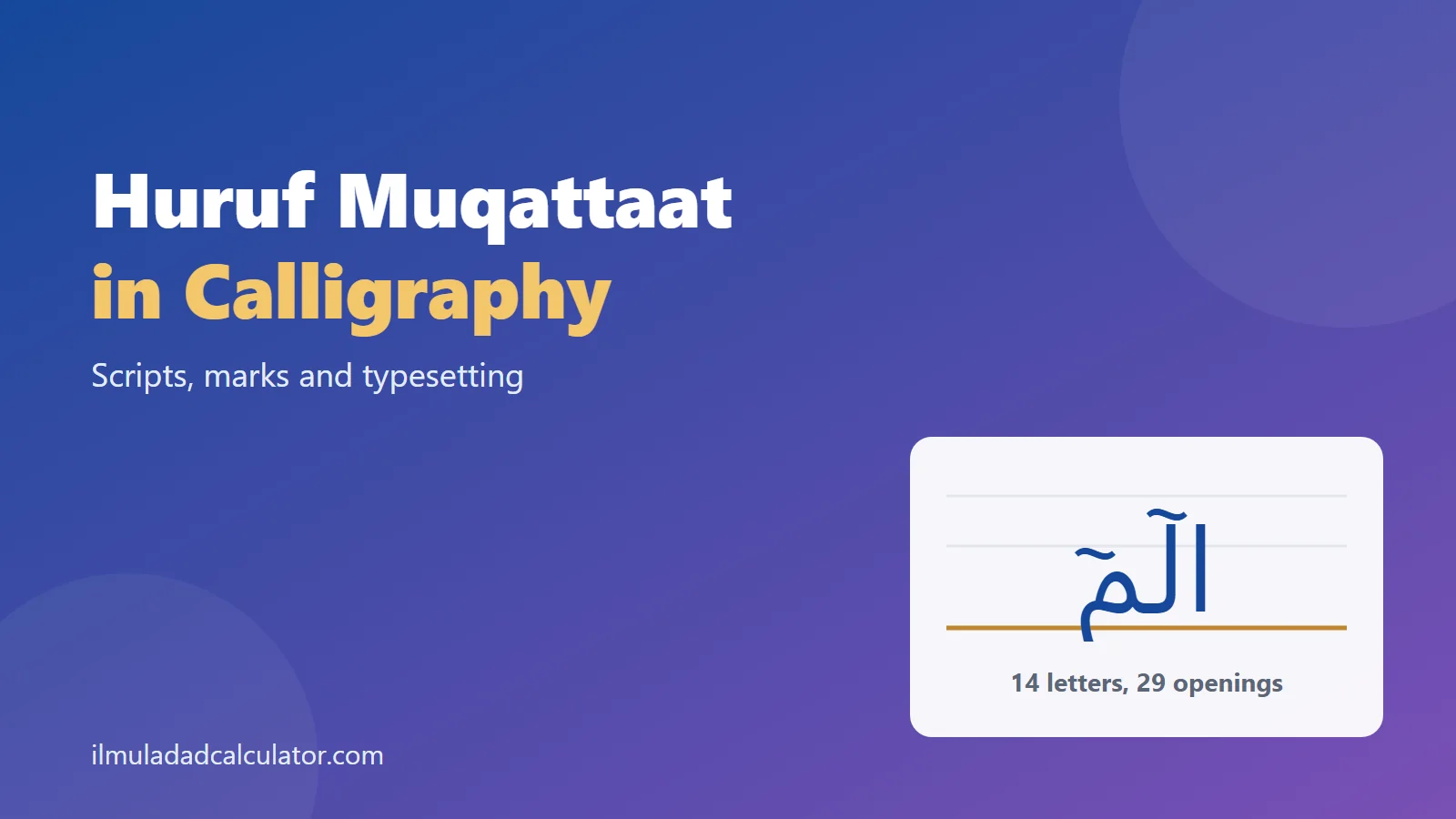
The huruf muqattaat are short clusters of letters that open 29 surahs. Each cluster is a small fixed text with its own joins, marks and spacing. This page covers how they are written, what is documented about each script, and how to set them in type.
What Should a Calligrapher Know Before Writing the Muqattaat?
The openings use 14 of the 28 Arabic letters, in 14 distinct combinations. Across the 29 surahs they run to 78 letters in total, and they sit right after the Bismillah.
This is a sacred text, so the letters must match a verified mushaf exactly. This page describes writing and typesetting only. It does not interpret the letters, and the huruf muqattaat overview covers the range of views.
Quick answer: the letters are written together like a word but read one by one. Alif stands apart while lam and mim join, and many printed copies add a prolongation mark. Copy from a verified mushaf source, and do not retype from memory.
Which Letters Are Used and How Are They Built?
The table lists the 14 letters in Abjad order. Most are plain letter skeletons with no dots. Wikipedia notes that they match the letters written without diacritics, plus ya.
| Letter | Name | Dots | Joins next letter | Mashriqi | Maghribi |
|---|---|---|---|---|---|
| ا | Alif | none | No | 1 | 1 |
| ه | Ha (soft h) | none | Yes | 5 | 5 |
| ح | Ha (throaty h) | none | Yes | 8 | 8 |
| ط | Ta (heavy t) | none | Yes | 9 | 9 |
| ي | Ya | 2 | Yes | 10 | 10 |
| ك | Kaf | none | Yes | 20 | 20 |
| ل | Lam | none | Yes | 30 | 30 |
| م | Mim | none | Yes | 40 | 40 |
| ن | Nun | 1 | Yes | 50 | 50 |
| س | Sin | none | Yes | 60 | 300 |
| ع | Ain | none | Yes | 70 | 70 |
| ص | Sad | none | Yes | 90 | 60 |
| ق | Qaf | 2 | Yes | 100 | 100 |
| ر | Ra | none | No | 200 | 200 |
Three letters carry dots in modern script: nun has one, while qaf and ya have two each. The Metropolitan Museum notes that early Qur’ans often left dots out altogether.
Two letters change value between the two orders. Sin is 60 in Mashriqi and 300 in Maghribi, and sad goes from 90 to 60. The page on why values differ explains the two orders.
How Are the Openings Laid Out on the Page?
Each opening forms the first verse of its surah. This is why the letters are also called fawatih, which means openers. The sections below cover what that means for line and marker placement.
One Verse or Part of a Longer Verse
In the verse numbering shown on Wikipedia, 19 of the 29 openings fill a whole verse by themselves. In the other 10 the verse carries on after the letters.
This decides where the verse marker sits. It follows the letters directly in the first case. In the second case it comes at the end of a longer line.
Ash-Shura is a special case. Its opening is two verses, حم and then عسق. Give each its own marker.
Verse Markers and Surah Headings
Early parchment copies used simple verse markers, made of stacked diagonal lines or rosettes. Later copies used medallions. Mamluk Qur’ans, described by the Library of Congress, used six-petalled rosettes.
Surah titles were often written in gold. Kufic copies of the ninth and early tenth centuries sometimes added a palmette in the margin. In Unicode, the end of ayah sign is a non-joining character, so it never fuses with the letter before it.
Are the Muqattaat Joined or Separate on the Page?
The name disjointed letters describes how they are read, not how they are drawn. Reference sources say the letters are written together like a word but pronounced separately. In print they appear joined.
Normal joining rules still apply. Alif and ra never join the letter that follows. The other 12 letters do, so each opening breaks into connected groups.
| Opening | Letters | Surahs | Groups | Groups shown apart |
|---|---|---|---|---|
| الم | 3 | 6 | 2 | ا + لم |
| المص | 4 | 1 | 2 | ا + لمص |
| الر | 3 | 5 | 2 | ا + لر |
| المر | 4 | 1 | 2 | ا + لمر |
| كهيعص | 5 | 1 | 1 | كهيعص |
| طه | 2 | 1 | 1 | طه |
| طسم | 3 | 2 | 1 | طسم |
| طس | 2 | 1 | 1 | طس |
| يس | 2 | 1 | 1 | يس |
| ص | 1 | 1 | 1 | ص |
| حم | 2 | 7 | 1 | حم |
| عسق | 3 | 1 | 1 | عسق |
| ق | 1 | 1 | 1 | ق |
| ن | 1 | 1 | 1 | ن |
10 of the 14 rows are one unbroken group. Alif and ra are the only letters that cut a cluster. Alif is also the first letter of 13 of the 29 openings.
Spacing tip: test any letter-spacing setting on a sample. Added spacing can pull a joined pair such as lam and mim apart. Wikipedia notes that lam and mim are conjoined, and the cluster should look that way.
What Marks Appear Over the Letters?
Printed copies commonly add a small wavy sign above lam and mim. Wikipedia describes it as a prolongation mark. It is the maddah, and its Unicode code is U+0653.
Marks differ between editions. In Wikipedia’s table, طه appears with no marks, while الم, حم and يس carry them. The same article notes that one letter is written in two styles across surahs 19 and 20.
Do not copy a pattern from another edition. Check each letter and mark against the mushaf you follow.
Unicode treats Quranic annotation marks as separate combining marks, yet verified texts can still encode the same sign differently. One text derived from Tanzil uses U+06E4, small high madda, instead of U+0653. Match your font to your text source.
Marks do not change the Abjad value. The engine ignores them, so الم and الٓمٓ both give 71.
How Do the Main Script Styles Treat the Openings?
The sources used here describe each script’s role in Quran copies. None of them describe the openings script by script. The notes below are general, and they apply because the openings are ordinary letters.
Kufic
Kufic is the oldest calligraphic form of Arabic script. It is angular, with a low vertical profile and a horizontal emphasis. It was the main script for copying the Quran until about the 11th century.
Kufic did not mark the difference between consonants such as t, b and th. In Abbasid copies, letters were often stretched to justify the margins. Alif and lam are in 13 of the 29 openings, so tall strokes dominate the cluster.
Naskh
Naskh is a small, round script used for documents and books. The Library of Congress calls it the principal script of Quran copies. It marks sounds with one to three dots above or below a letter.
Naskh uses a horizontal baseline. Where one letter starts inside the tail of the one before, the baseline is broken and raised. That matters for the joined lam and mim.
Thuluth
Thuluth is mainly used for surah headings and for writing in mosques. Later copies combined thuluth with naskh or muhaqqaq. After the 15th century, naskh came to be used exclusively.
Thuluth makes heavy use of vowel signs and stylistic marks, with placement rules that allow freedom of shape. This is where a maddah can be designed as part of the composition.
Maghribi
Maghribi script descends from Kufic. It has rounded forms, extended horizontals and open curves that fall below the baseline. A script called mabsout was used for body text and for writing the Quran.
Maghribi dots two letters differently. Qaf has one dot above and fa has one dot below. Qaf opens surah 50 and appears in the Ain Sin Qaf opening, so 2 openings are affected.
Nastaliq
Nastaliq is the usual hand for Urdu, and it is dominant in Pakistan. The Library of Congress notes that it was used in Qur’ans from the 14th century onward. Wikipedia calls the choice of nastaliq for a Quran copy unusual.
Nastaliq uses more than three forms for many letters. It is not separately encoded in Unicode, so a Nastaliq font supplies the shapes. One digital nastaliq system used over 20,000 ligatures.
What Should You Check Before Typesetting the Openings?
The steps below keep the text exact. They apply to print, web and app design alike.
- Use real characters. Type letters and marks as text, not as images or presentation-form glyphs. Presentation forms exist only for compatibility with older standards.
- Keep logical order. Text is stored in reading order and shaped right to left on screen. Set the paragraph direction to right to left.
- Do not swap letters. An Urdu keyboard produces different code points for kaf, ha and ya. The table below shows them.
- Choose a mushaf font. Tanzil lists KFGQPC Hafs Uthmanic Script, KFGQPC Uthman Taha Naskh, Scheherazade, me_quran and PDMS Saleem Quran Font. Check each font’s license before embedding it.
- Test the marks. Render each opening at the largest and smallest size you will use. Make sure the marks sit over the right letters and do not collide.
- Compare with a printed mushaf. Check every letter and mark against the edition you follow before the design goes out.
| Letter | Arabic form | Code | Urdu keyboard form | Code | Abjad value |
|---|---|---|---|---|---|
| Kaf | ك | U+0643 | ک | U+06A9 | 20 and 20 |
| Ha (soft h) | ه | U+0647 | ہ | U+06C1 | 5 and 5 |
| Ya | ي | U+064A | ی | U+06CC | 10 and 10 |
The two forms look alike in some fonts but are different characters. Even mushaf text projects choose differently. One derived text uses the Persian yeh, U+06CC, in every ya position.
Why Use a Verified Text Source?
Tanzil began in 2007 because wrong Quran texts had spread widely online. It checked its text against the Medina Mushaf, with a checksum for each letter and diacritic.
Copying from a source like this is safer than retyping. It also protects the small marks that a keyboard cannot always reach.
Some special mushaf editions add signs that Unicode does not yet encode. A 2025 proposal to the Unicode Consortium lists several from Indo-Pak mushafs. For plain openings, the standard characters are enough.
Do Letter Forms Change the Abjad Value?
No. The value belongs to the letter, not to its shape, mark or keyboard form. Here is كهيعص, the longest opening, as plain arithmetic:
ك 20 + ه 5 + ي 10 + ع 70 + ص 90 = 195
Typing it with the Urdu keyboard forms gives the same 195. You can check any opening with the Abjad value calculator. The muqattaat and Abjad page explains how these sums have been used in history.
For the sounds of each letter, see muqattaat pronunciation. The full set is in the words and phrases section and the list of all 29 openings. For one opening in depth, try Alif Lam Mim, Ha Mim or Ta Ha.
خلاصہ
حروفِ مقطعات چودہ حروف پر مشتمل ہیں اور انتیس سورتوں کے شروع میں آتے ہیں۔ لکھائی میں یہ حروف ایک لفظ کی طرح ملا کر لکھے جاتے ہیں مگر پڑھتے وقت الگ الگ پڑھے جاتے ہیں۔ الف اور راء اگلے حرف سے نہیں ملتے۔ خطاطی یا ٹائپ سیٹنگ کے لیے مستند مصحف کا متن اور موزوں فونٹ استعمال کریں، اور دوبارہ ٹائپ کرنے سے گریز کریں۔ نشانات سے ابجد کی قدر نہیں بدلتی۔
Sources and Further Reading
- Muqattaʿat, Wikipedia. The 14 letters, the table of openings, letters written together like a word, and the mark on lam and mim.
- Qur’anic Fragments, Library of Congress. Scripts, verse markers, gold headings and Mamluk rosettes.
- Early Qur’ans (8th to Early 13th Century), Metropolitan Museum of Art. Dotting, verse markers and the Maghribi script.
- Kufic, Naskh, Thuluth, Maghrebi script and Nastaliq, Wikipedia. Role, letter features and typesetting of each script.
- Chapter 9, Middle East-I, The Unicode Standard 17.0. Cursive joining, the maddah, Quranic annotation marks and presentation forms.
- U+0653 Arabic Maddah Above, Unicode Explorer. Its use in South Asian and Indonesian orthographies.
- Arabic Presentation Forms-A, Wikipedia. Presentation forms exist for compatibility.
- Urdu alphabet, Wikipedia. Urdu and Arabic code points for kaf, ha and ya, and Nastaliq forms.
- Tanzil Project and Quranic Fonts, Tanzil. How the text was verified and which fonts it lists.
- nuqayah/quran-text, GitHub. Encoding choices in a text derived from Tanzil.
- Proposal to Encode Arabic Characters from Indo-Pak Mushafs, Unicode Consortium document L2/26-125.
- Abjad values come from this site’s tested engine. See the methodology.
Frequently Asked Questions
Are the muqattaat written joined or separate?
Sources say they are written together like a word, but each letter is read separately. Normal joining rules apply, so alif and ra do not join the next letter.
Which script is used for the muqattaat?
They are written in whatever script the mushaf uses. The Library of Congress calls naskh the principal script of Quran copies, and other scripts appear in headings and decoration.
Can I type the muqattaat on an Urdu keyboard?
Yes, but the keys for kaf, ha and ya give different code points from the Arabic ones. Compare the result with a verified mushaf text.
Does the maddah sign change the Abjad value?
No. The engine ignores marks, so the opening Alif Lam Mim gives 71 with or without them.
Where can I get a verified text to copy?
Tanzil publishes a Unicode text checked against the Medina Mushaf. A printed mushaf from a trusted publisher is the other reliable reference.