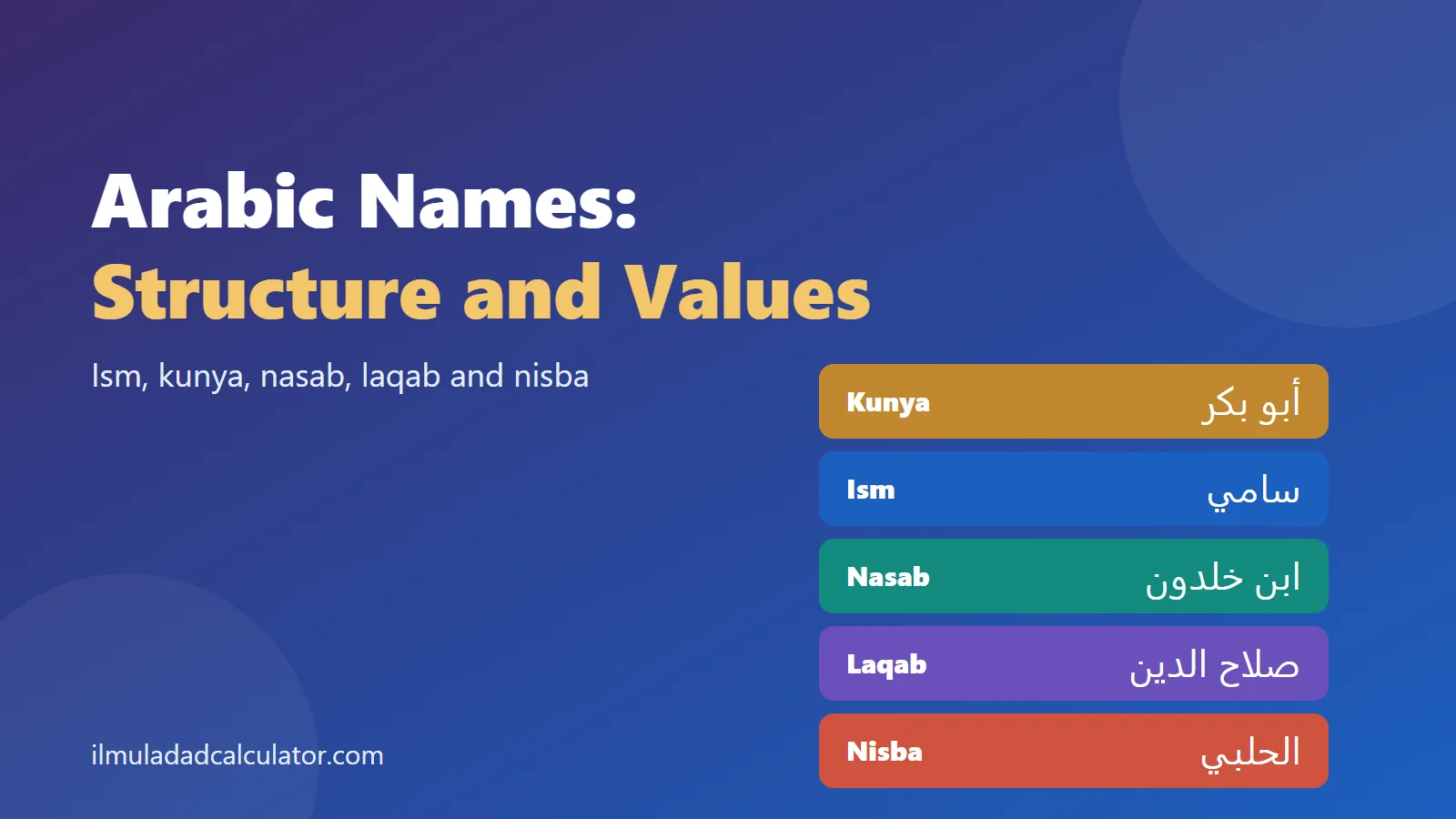
A traditional Arabic name can have five parts: the ism, kunya, nasab, laqab and nisba. Most people today use only some of them. Each part has its own Abjad value, so a full name’s total depends on the parts you count.
What Are the Five Parts of an Arabic Name?
Older Arabic names worked like a short biography. Each part answered a different question about the person.
| Part | Arabic | Meaning | Example | Value |
|---|---|---|---|---|
| Ism | اسم | given name | سامي Sami | 111 |
| Kunya | كنية | father or mother of | أبو بكر Abu Bakr | 231 |
| Nasab | نسب | son or daughter of | ابن خلدون Ibn Khaldun, son of Khaldun | 743 |
| Laqab | لقب | title or epithet | صلاح الدين Salah al-Din | 224 |
| Nisba | نسبة | origin, tribe or trade | الحلبي al-Halabi, of Aleppo | 81 |
What Is the Ism, or Given Name?
The ism is the personal name a child receives at birth, such as Sami or Fatima. Most Arabic given names are ordinary words with a meaning.
Muhammad means praiseworthy, and Ali means high or exalted. In a sentence, context shows whether a word is a name or a plain adjective.
Many names join abd (servant) with a word for God, such as عبد الله (Abdullah), which totals 142. These count as one name made of two words.
What Is a Kunya?
A kunya names a person as the father or mother of someone. It begins with abu (أبو, father) or umm (أم, mother), usually followed by the name of the first child.
Using a kunya is warm but respectful, a little like calling someone by a family title. Some kunyas are nicknames rather than real family links; Abu Bakr is the best-known example.
What Is a Nasab?
A nasab shows lineage. It uses ibn (ابن, son of), often shortened to bin, or bint (بنت, daughter of).
So Ibn Khaldun means son of Khaldun, the name of a distant ancestor. Long nasabs could list several generations.
Today ibn and bint are dropped in most Arab countries. A father’s name may still follow a person’s own name without them.
What Is a Laqab?
A laqab is a title, an epithet or a nickname. It can describe a quality, honor a person, or become a family name over time.
Many laqabs end with al-Din, such as Salah al-Din and Shams al-Din. Others describe a person, like al-Rashid, the rightly guided.
What Is a Nisba?
A nisba links a person to a place, a tribe, a family or a trade. It usually begins with al- and ends in -i.
Al-Halabi means from Aleppo, and al-Khayyat means the tailor. A nisba often passes down a family for generations.
Urdu writers often carried a nisba of their city. Names ending in Dehlvi (of Delhi) or Lahori (of Lahore) follow the same pattern.
What Does a Full Classical Name Look Like?
The historian Ibn Khaldun, who lived from 1332 to 1406, shows the full pattern in one name. His Arabic name reads:
أبو زيد عبد الرحمن بن محمد بن خلدون الحضرمي
Abu Zayd is his kunya, and Abd al-Rahman is his given name. Bin Muhammad bin Khaldun traces his line back through his father to an ancestor.
Al-Hadrami is his nisba, linking the family to Hadramawt in southern Arabia. History remembers him by one piece of the nasab: Ibn Khaldun.
How Are Names Used in Pakistan?
Pakistani names borrow freely from this tradition, but they follow their own habits. Two are especially common.
- Muhammad as a first name. Many boys are named Muhammad first, so people use the second name day to day. Forms are often shortened to Muhd., Mohd. or M.
- A family name at the end. Many families add a clan or family name, such as Qureshi or Khan. It takes the place of a nisba or laqab.
Urdu spelling also changes some letters. A name ending in ة in Arabic often ends in ہ in Urdu. Both count 5, so the total stays the same.
What Do Common Name Pieces Mean?
Many names are built from a few common pieces. Knowing them helps you read a name and split it correctly before you add it up.
| Piece | Meaning | Value | Found in |
|---|---|---|---|
| عبد abd | servant | 76 | Abdullah, Abdul Rahman |
| أبو abu | father of | 9 | Abu Bakr |
| أم umm | mother of | 41 | Umm Kulthum |
| ابن ibn | son of | 53 | Ibn Khaldun |
| بنت bint | daughter of | 452 | Fatima bint Ahmad |
| الدین -uddin | of the faith | 95 | Ziauddin, Salahuddin |
| الله -ullah | of God | 66 | Nasrullah, Abdullah |
Endings such as -uddin and -ullah include the article al-, which adds 31. That is why these endings carry fairly large values.
Does It Matter Whether Parts Are Joined?
No. Urdu often joins compound names into one word, such as عبدالله, while Arabic may write عبد الله with a space.
Spaces have no value, so both forms give 142. Only the letters matter, not how they are grouped.
How Do You Find the Abjad Value of a Full Name?
Add the value of each part, exactly as you would add the words of a phrase. The real question is which parts to include.
- Decide the parts. Count only the given name, or the full name as written on documents.
- Count the article. The al- in al-Halabi adds alif and lam, worth 31.
- Keep connectors. When a name includes ibn (53) or bint (452), count them as written.
- State your choice. Write which parts you added next to the total.
Good to know: different names can share a total by chance. Al-Khayyat (the tailor) and Khan both give 651, yet they share no meaning.
For the full method, see how to calculate Ilm-ul-Adad. The Ilm-ul-Adad calculator totals any name with a breakdown for each word.
How Should Arabic Names Be Spelled in English?
Arabic names have no single English spelling, because English letters cannot show every Arabic sound. Writers choose between spellings such as Muhammad and Mohammed.
The guide to Muhammad, Mohammed or Mohamed explains why one name has many spellings. To go the other way, see how to write your name in Arabic.
Guides in This Section
- How to Write Your Name in Arabic: match each sound to an Arabic letter.
- Muhammad, Mohammed or Mohamed?: why one name has many English spellings.
- How to Calculate Ilm-ul-Adad: the complete method with worked examples.
- Kunya: what a kunya is, and how Abu and Umm names work.
- Bin, Ibn and Bint: the nasab, when ibn drops its alif, and how each is counted.
- Why Arabic Names Have Several English Spellings: the reasons one name has many English forms.
- How to Write Your Name in Urdu: the Urdu-script method and the extra Urdu letters.
- How Spelling Changes the Value: which spelling to calculate, and what each choice changes.
خلاصہ
روایتی عربی نام پانچ حصوں پر مشتمل ہو سکتا ہے: اسم، کنیت، نسب، لقب اور نسبت۔ آج کل زیادہ تر لوگ ان میں سے چند حصے ہی استعمال کرتے ہیں۔ پورے نام کے اعداد نکالتے وقت پہلے طے کریں کہ کون سے حصے شامل کرنے ہیں، پھر ہر حصے کی قیمت جمع کریں۔
Sources and Further Reading
- Arabic name, Wikipedia. The five parts, examples and naming habits in South Asia.
- Ibn Khaldun, Wikipedia. His full Arabic name and dates.
- All values come from this site’s tested engine. See the methodology.
Frequently Asked Questions
Do all Arabic names have five parts?
No. The five parts are a traditional pattern. Most modern names use two or three of them.
Is bin the same as ibn?
Yes. Bin is the everyday form of ibn, and both mean son of.
Is Khan an Arabic name?
No. Khan began as a title in Central Asia and became a common family name in South Asia.
Should I count al- when I calculate a name?
Count it when it is part of the name as written. It adds 31.
Can two people with different names have the same total?
Yes. Totals often repeat by chance, so a total never identifies a person.