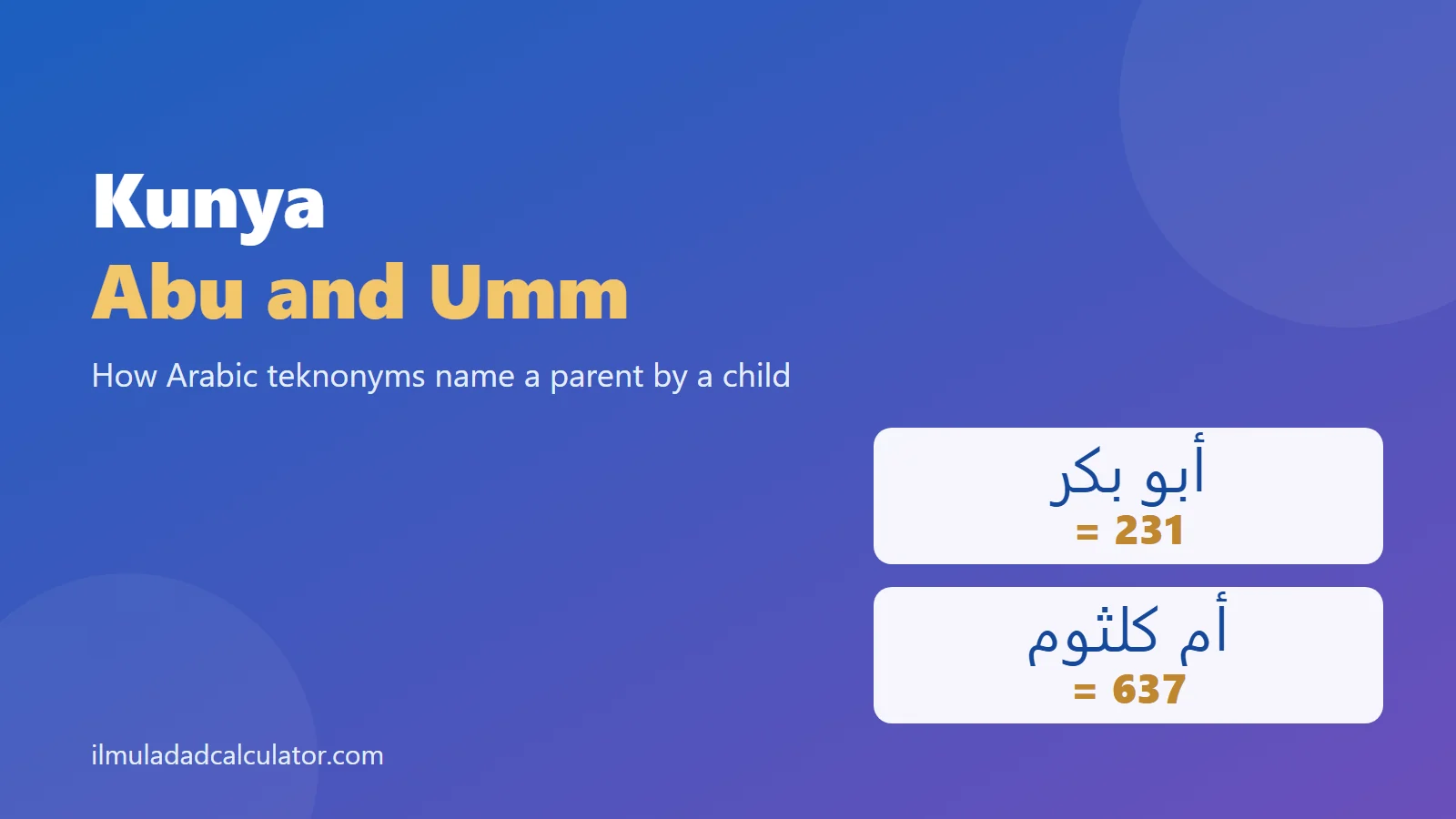
A kunya (كنية) is an Arabic nickname that names a person as a parent. It begins with abu (أبو, father of) or umm (أم, mother of), followed by a child’s name. So Abu Bakr means “father of Bakr.”
What Does Kunya Mean?
Kunya is the Arabic word for this kind of name. Scholars call it a teknonym, which means naming a parent after a child.
The idea is simple. Instead of using a person’s own name, you call them the father or mother of their child.
This is a warm but respectful way to address someone. It is common across the Arabic-speaking world and in many Muslim cultures.
The word is pronounced roughly “KOON-ya.” Its plural is kunan, though you rarely need the plural form.
How Is a Kunya Formed?
A kunya joins one of two words to a child’s name. The word abu means father of, and umm means mother of.
The child’s name usually comes from the eldest son. A daughter’s name can be used too, as in Umm Kulthum.
- Start with abu for a man or umm for a woman.
- Add the name of the person’s first child.
- Read the phrase as “father of” or “mother of” that child.
For example, a father whose eldest son is Khalid becomes أبو خالد (Abu Khalid). A mother whose daughter is Salma becomes أم سلمة (Umm Salma).
The two words stay separate, with a space between them. The space has no sound and no abjad value.
Do Both Men and Women Have Kunyas?
Yes. A man takes a kunya with abu, and a woman takes one with umm.
A man’s kunya usually names his eldest son, such as Abu Khalid. A woman’s kunya may name a son or a daughter.
Umm Kulthum is a well-known woman’s kunya built on a daughter’s name. The pattern is the same for both parents.
Children themselves do not carry a kunya. The name depends on being a parent, whether real or honorary.
Where Does a Kunya Sit in a Full Arabic Name?
A classical Arabic name can have five parts. The kunya is one of them, and most names use only a few.
The five parts are the ism, the kunya, the nasab, the laqab and the nisba. The ism is the given name, such as Sami.
When a kunya is used with the given name, the kunya comes first. The full structure and the other four parts are covered on the Arabic names page.
Good to know: many famous people are known mainly by their kunya. Over time, a kunya like Abu Bakr can become a common name on its own.
Can a Kunya Be Honorific or Figurative?
A kunya does not always point to a real child. Many are honorary or playful, chosen for their meaning rather than for a son or daughter.
This is one of the most interesting things about the kunya. The same form can be a family name, a title or a joke.
Kunyas Without a Child
Some kunyas belong to people who had no child of that name. The link is figurative, not a family record.
- Abu Bakr is the best-known example. It works as a standalone name today.
- Abu Hurayra, a well-known figure in early Islamic history, was named for a kitten he kept. The name means “father of a kitten.”
- A man with no children may still take a kunya, often borrowed from a famous namesake.
Kunyas That Describe a Trait
Other kunyas work like a title or a compliment. They name a quality the person is linked with.
- Abu al-Barakat means “father of blessings,” an honorary kunya.
- Umm Kulthum is read as “mother of a round, full face,” a poetic nickname.
- Leaders and artists are often addressed by a kunya as a mark of respect.
How Is a Kunya Used in Everyday Life?
A kunya can replace a person’s given name in speech. Friends, neighbors and coworkers may use it every day.
It signals warmth and respect at once. Using it feels friendlier than a title, yet more formal than a bare first name.
In many Arab countries, a kunya is a polite way to address an older person. You may hear it long before you learn the given name.
Parents are sometimes given a kunya as soon as their first child is born. The community adopts it quickly.
How Is a Kunya Different From Other Name Parts?
The kunya is easy to confuse with the other parts of an Arabic name. Each part answers a different question about the person.
Kunya Versus Ism
The ism is the given name, chosen at birth, such as Sami or Fatima. The kunya is added later and names the person as a parent.
Kunya Versus Nasab
A nasab shows descent. It uses ibn (ابن, son of) or bint (بنت, daughter of), as in Ibn Khaldun.
A kunya points down to a child, while a nasab points up to a parent. The two face opposite directions.
Kunya Versus Laqab and Nisba
A laqab is a title or epithet, and a nisba links a person to a place or trade. Neither one names a parent or a child.
The Arabic names page walks through all five parts side by side.
How Do Abu and Umm Change Grammatically?
In formal Arabic, the word abu shifts its ending with its role in a sentence. This is light grammar, and everyday speech often keeps one form.
The three forms are abu, aba and abi. They all mean the same thing, and only the final vowel changes.
| Form | Arabic | When it is used | Example |
|---|---|---|---|
| Abu | أبو | As a subject (nominative) | Abu Bakr spoke |
| Aba | أبا | As an object (accusative) | I met Aba Bakr |
| Abi | أبي | After a preposition (genitive) | a letter from Abi Bakr |
The word umm does not change in this way. In casual use, many speakers simply say abu for every case.
How Is a Kunya Written and Transliterated?
In Arabic, abu is written أبو and umm is written أم. Each is a separate word before the child’s name.
English has no single spelling for these words. The same name can look different from one writer to the next.
- Abu may appear as Abu, Abou or Abo. Umm may appear as Umm or Om.
- When the next word starts with al-, writers often join it, as in Abu’l-Fadl or Abul-Fadl.
- In English, the first letter is capitalized: Abu Bakr, not abu bakr.
- Pick one spelling and keep it the same everywhere you write the name.
To match English sounds to Arabic letters, see how to write your name in Arabic. Why one name has many spellings is explained in the Muhammad spellings guide.
What Is the Abjad Value of a Kunya?
Every Arabic letter has a fixed number in the abjad system. Add the letters of a kunya, and you get a total.
On its own, abu (أبو) is worth 9, and umm (أم) is worth 41. The child’s name adds the rest.
Take Abu Bakr as an example. Abu adds 9, and Bakr (بكر) adds 222, for a total of 231.
Arithmetic only: these totals are plain sums of letter values. A number says nothing about the person and carries no hidden meaning.
The table below shows a few kunyas and their totals. Spaces have no value, so only the letters count.
| Kunya | Arabic | Meaning | Value |
|---|---|---|---|
| Abu Bakr | أبو بكر | father of Bakr | 231 |
| Abu Khalid | أبو خالد | father of Khalid | 644 |
| Umm Kulthum | أم كلثوم | mother of Kulthum | 637 |
| Umm Salma | أم سلمة | mother of Salma | 176 |
| Abu Hurayra | أبو هريرة | father of a kitten | 429 |
How Do You Calculate a Kunya Yourself?
You can add any kunya in a few seconds with a calculator. Type the Arabic words and read the total.
The tool breaks the name into letters and shows each value. You can check the sum by hand if you like.
The English Name to Abjad Value tool takes an English name and suggests the Arabic spelling. It then adds it for you.
For a whole phrase, such as a full kunya with the child’s name, use the phrase value calculator. The full method is set out on the methods page.
What Are Some Well-Known Kunyas?
Many famous names in history and culture are kunyas. Learning a few makes the pattern easy to spot.
The singer Umm Kulthum was one of the most famous voices of the twentieth century. Her stage name is a classic kunya.
The poet Abu Nuwas is remembered across Arabic literature. His name shows the kunya used as a main name.
In each case, the name is read the same way. You take abu or umm, then add the following name.
Why Do People Still Use a Kunya Today?
The kunya is far from old-fashioned. It remains a living part of Arabic naming.
New parents often welcome a kunya as a sign of their new role. It marks a change in standing within the family.
Public figures are widely known by a kunya. The name can feel personal and dignified at the same time.
Learning the kunya also helps you read older books and inscriptions. Many authors are listed by their kunya first.
In short, the kunya is both old and current. It is a simple pattern with a long history behind it.
خلاصہ
کنیت ایک عربی نام ہے جو کسی شخص کو اس کے بچے کے حوالے سے پکارتا ہے۔ یہ «ابو» (باپ) یا «ام» (ماں) سے شروع ہوتی ہے، جیسے ابو بکر یعنی «بکر کے والد»۔ ہر کنیت حقیقی اولاد کی طرف اشارہ نہیں کرتی؛ کچھ کنیتیں اعزازی یا علامتی ہوتی ہیں۔ کنیت کے حروف کی ابجد قیمت محض جمع ہے اور اس کا کوئی پوشیدہ مطلب نہیں۔
Sources and Further Reading
- Kunya (Arabic), Wikipedia. The teknonym definition, the forms of abu, and figurative examples.
- Arabic name, Wikipedia. The five parts of a name and where the kunya fits.
- All abjad values come from this site’s tested engine. See the methodology.
Frequently Asked Questions
What does Abu mean in a name?
Abu means “father of.” Abu Bakr means “father of Bakr,” though it is now used as a name by itself.
What does Umm mean in a name?
Umm means “mother of.” Umm Salma means “mother of Salma,” naming the woman by her child.
Does a kunya always mean someone has that child?
No. Many kunyas are honorary or figurative. Abu Hurayra, for example, means “father of a kitten.”
Is a kunya the same as a first name?
No. A first name is the ism. A kunya is a separate part that names a person as a parent.
Do Abu and Umm change spelling in English?
Yes. Abu may be written Abou or Abo, and Umm may be written Om. Pick one form and keep it.