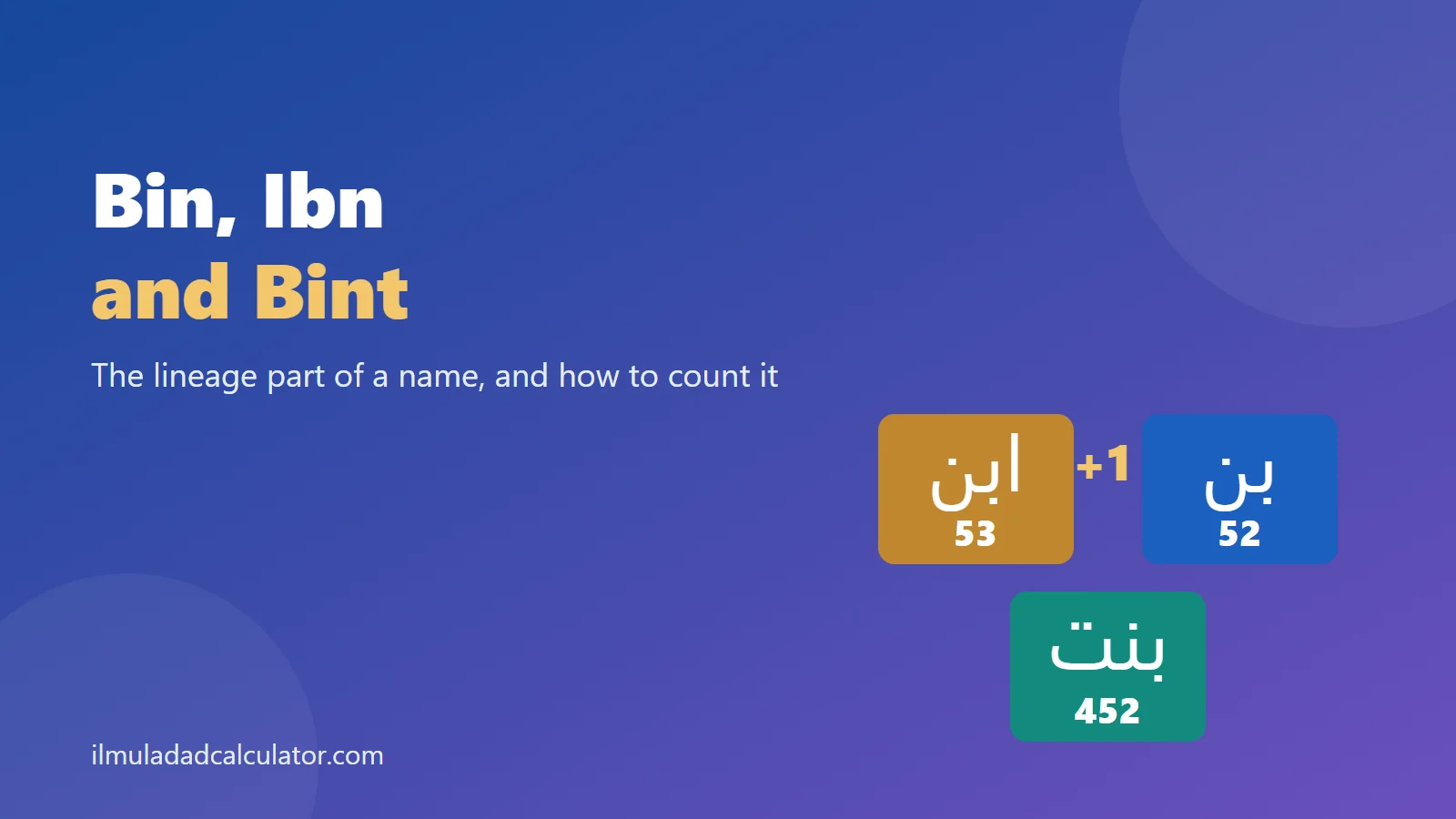
In Arabic names, ibn (ابن) means son of, and bint (بنت) means daughter of. This is the nasab, the lineage part of a name. Ibn is often written bin (بن) between two names, and that small change moves the Abjad total by one.
What Do Ibn, Bin and Bint Mean?
Ibn and bin are the same word, meaning son of. Bint is its pair, meaning daughter of. Each one links a person to a parent, almost always the father.
This linking word is called the nasab. In a long name it can repeat, naming a father, then a grandfather, then an older ancestor.
The nasab is only one piece of a classical Arabic name. The guide to Arabic name structure covers all five pieces in full.
This page stays on the nasab alone. It shows how to write ibn, bin and bint, and how to count each one.
Why Is Ibn Sometimes Written Bin?
Ibn begins with an alif that only helps you start the word. Teachers call this a joining alif. It drops out once the word is spoken inside a phrase.
So the spelling simply follows the sound. The alif stays when ibn starts a name or stands alone. The alif falls away when ibn sits between a person and a parent.
With the alif, the word is written ابن. Without it, the same word is written بن. Nothing else changes.
You can see both forms in famous names. Ibn Sina (ابن سينا) keeps the alif, because the name starts with it.
Abd Allah bin Umar (عبد الله بن عمر) drops the alif, because the word sits between two names. Both spellings are correct in their place.
How Much Does the Alif Change the Total?
The alif is worth 1 in the Abjad system. So the two written forms differ by exactly one.
- ابن ibn, with the alif, is 53: alif (1) plus ba (2) plus nun (50).
- بن bin, without the alif, is 52: ba (2) plus nun (50).
Bint keeps the same shape in every position. It is بنت, worth 452: ba (2) plus nun (50) plus ta (400).
That ta at the end is a full letter here, not a silent ending. It carries the whole value of 400 on its own.
The rule in one line: count the letters you actually write. If the alif is on the page, add 1 for it. If it is dropped, do not.
How Do You Count a Full Name With Bin?
Add each written word, just as you would for any phrase. Spaces have no value, so only the letters count.
The one question is whether the nasab shows the alif. That single letter is the only thing that can shift the total.
Take Tariq bin Ziyad, the general who crossed into Spain in 711. Written with bin, طارق بن زياد adds Tariq (310), bin (52) and Ziyad (22).
Those three parts come to 384. The figure above shows how a longer chain of fathers would stack up the same way.
Now spell the nasab with the alif, as طارق ابن زياد. The total rises by one, to 385, because the alif adds 1.
Bin or Ibn: Which Total Is Right?
Both totals are right, because they count different spellings. The honest number is the one that matches the form on the page.
The table below counts two well-known names each way. The gap between the two columns is always one.
| Name | About | With bin بن | With ibn ابن |
|---|---|---|---|
| عبد الله بن عمر Abd Allah bin Umar | a son named after his father Umar | 504 | 505 |
| طارق بن زياد Tariq bin Ziyad | the general, son of Ziyad | 384 | 385 |
You can line up the two spellings yourself with the compare tool. Put بن in one box and ابن in the other.
The tool shows the same gap of one every time. It is a quick way to prove the alif rule to yourself.
What Does Bint Mean, and How Is It Counted?
Bint is the nasab for a woman, meaning daughter of. It works just like bin, with one difference.
Bint never loses a letter between names. The ta at its end always stays, so its value never drops.
Take Sara bint Khalid, written سارة بنت خالد. It adds Sara (266), bint (452) and Khalid (635).
Those parts total 1353. The word bint keeps its value of 452 wherever it appears.
In older records, a woman often appears as her own name, then bint, then her father. Many families still use this form today.
What Are Banu and Bani?
Banu (بنو) means sons of, or children of. It names a whole tribe or clan, not a single parent.
You meet it in group names such as Banu Hashim (بنو هاشم) and Banu Umayya. These point to a shared ancestor far back in the line.
The form bani (بني) is the same word in a different grammatical case. You see it in names like Banu Tamim and Bani Israel.
Banu and bani share a root with ibn and bint. Count them letter by letter, like any word: بنو is 58, and بني is 62.
How Are Ibn, Bin and Bint Written in English?
English spellings vary because they copy the sound. You will see ibn, bin, and even ben, for the same word.
A daughter’s link appears as bint, and sometimes as the short form bte. None of these spellings change the Arabic underneath.
To total a name typed in English letters, use the English name tool. It matches each sound to an Arabic letter first.
| Roman | Arabic | Short form | When it is used |
|---|---|---|---|
| ibn | ابن | b. | Standalone or at the start of a name; the short form b. is common in scholarship. |
| bin | بن | b. | Between a person and a parent, as in Tariq bin Ziyad. |
| bint | بنت | bt. | Daughter of, for a woman; sometimes shortened to bte. |
| banu | بنو | B. | Sons of, for a tribe or clan, as in Banu Hashim. |
| bani | بني | B. | The same word in a different grammatical case. |
Scholars often shorten the nasab to save space. A name may read Ahmad b. Muhammad, where the letter b. stands for ibn or bin.
Easy to miss: bin and ibn are not middle names. They mark the link to a parent, so Tariq bin Ziyad means Tariq, son of Ziyad.
Where Does the Nasab Fit in a Full Name?
A classical name lists its parts in a set order. The given name comes first, and the nasab follows right after it.
So the pattern reads as the person, then bin or bint, then the parent. Extra fathers can follow, each joined by another bin.
This order is why bin seems to sit in the middle. It is not a middle name, though. It is the hinge that joins one generation to the next.
For the other parts, such as the kunya and the nisba, see the Arabic names guide. Knowing them helps you split a name before you count it.
Do People Still Use Ibn and Bint Today?
It depends on the country. Many Arab states dropped ibn and bint from official names. They simply place the father after the person.
Some countries still keep them, especially in formal or royal names. In South Asia, families often add a clan name instead, such as Khan or Qureshi.
Writers of history keep the nasab alive on the page. It is how we tell apart two people who share one given name.
Wherever the form appears, the counting rule stays the same. Add the letters you see, and note whether the alif is there.
What Mistakes Should You Avoid When Counting?
A few small slips are easy to make with the nasab. Each one shifts the total, so it is worth a quick check.
- Guessing the alif. Do not add or drop the alif from memory. Count the spelling in front of you.
- Mixing systems. Arabic and Urdu names use the Mashriqi values. Do not switch to Maghribi partway.
- Dropping the ta of bint. The final ta is a full letter worth 400. It is never silent here.
- Counting the link as a name. Bin and bint are not given names. They only join a person to a parent.
Keep these in mind and your totals will match other careful readers. A clear note of your spelling settles most disagreements.
How Is the Nasab Used in Ilm-ul-Adad?
In Ilm-ul-Adad, a name is just a string of letters to add up. The nasab is part of that string when you include it.
So the real choice is which parts of the name you count. You might total only the given name, or the given name with its nasab.
State your choice next to the total, and the number becomes easy to repeat. A reader can then rebuild it letter by letter.
Remember that a total is only arithmetic. The same number can land on many unrelated names, so it points to no one person.
Treat the value as a fact about the letters, nothing more. It carries no claim about luck, character, or the future.
How Do You Check the Value Yourself?
Pick the exact spelling first, then add the letters. The Ilm-ul-Adad calculator totals a full name and shows each word on its own.
- Write the name as it really appears, with or without the alif on ibn.
- Add each word, using the letter values if you count by hand.
- Note your spelling next to the total, so anyone can check it.
If two sources give totals one apart, the alif is almost always the reason. The page on why values differ covers the other common causes.
خلاصہ
عربی ناموں میں ابن کا مطلب ہے بیٹا اور بنت کا مطلب ہے بیٹی، اور یہی نام کا نسب کہلاتا ہے۔ جب ابن دو ناموں کے درمیان آتا ہے تو الف گر جاتا ہے اور اسے بن لکھا جاتا ہے۔ الف کی ابجد قیمت ایک ہے، اس لیے ابن اور بن کے اعداد میں صرف ایک کا فرق ہوتا ہے۔ ہمیشہ وہی ہجے گنیں جو کاغذ پر لکھے ہوں۔
Sources and Further Reading
- Arabic name, Wikipedia. The nasab, ibn and bint, modern usage, and the note that bin is not a middle name.
- ابن, Wiktionary. The construct form bin between names and the plurals banu and bani.
- All Abjad values come from this site’s tested engine. See the methodology.
Frequently Asked Questions
Is bin the same word as ibn?
Yes. Both mean son of. Bin is the form used between two names, where the alif is dropped.
Why do ibn and bin give different values?
Ibn keeps the alif, which is worth 1. Bin drops it, so bin is always one less than ibn.
What is the Abjad value of bint?
Bint (بنت) is 452: ba 2, nun 50 and ta 400. It keeps this value in every position.
Does bint ever lose a letter like ibn?
No. Only ibn drops its opening alif between names. Bint keeps all its letters everywhere.
What do banu and bani mean?
Both mean sons of, or children of, and name a tribe or clan, such as Banu Hashim.
Is bin a middle name?
No. Bin marks a link to a parent, so Tariq bin Ziyad means Tariq, son of Ziyad.