One name can add up to more than one number, and the reason is almost always spelling. A different ending, an extra letter, or a mark counted a second time will change the total. This guide shows which spelling choices change a value, so you can pick which form to calculate.
Why Does One Name Give Different Totals?
Ilm-ul-Adad adds the values of the written Arabic letters. So the total follows the exact letters on the page, not the sound of the name.
When two people spell the same name with different letters, they are really counting two different words. Each extra or changed letter moves the total.
This is why an English form on its own cannot be counted. You first turn it into Arabic or Urdu letters, and those letters carry the values.
The good news is that the changes follow clear rules. Once you know them, you can pick one spelling and get the same total every time.
What Changes a Name Value, and What Does Not?
The table lists the common spelling choices, each with one worked pair from the calculator. The last column shows the gap that choice can cause.
| Choice | Worked pair | First total | Second total | Gap |
|---|---|---|---|---|
| The English form | محمد (Muhammad or Mohammed) | 92 | 92 | 0 |
| A seated hamza | عائشة (Aisha) | 386 | 386 | 0 |
| Urdu vs Arabic letter | کریم / كريم (Karim) | 270 | 270 | 0 |
| A standalone hamza | دعاء (Dua) | 75 | 76 | 1 |
| A dagger alif vs a full alif | الرحمٰن / الرحمان (Rahman) | 329 | 330 | 1 |
| An added or dropped alif | عثمان / عثمن (Usman) | 661 | 660 | 1 |
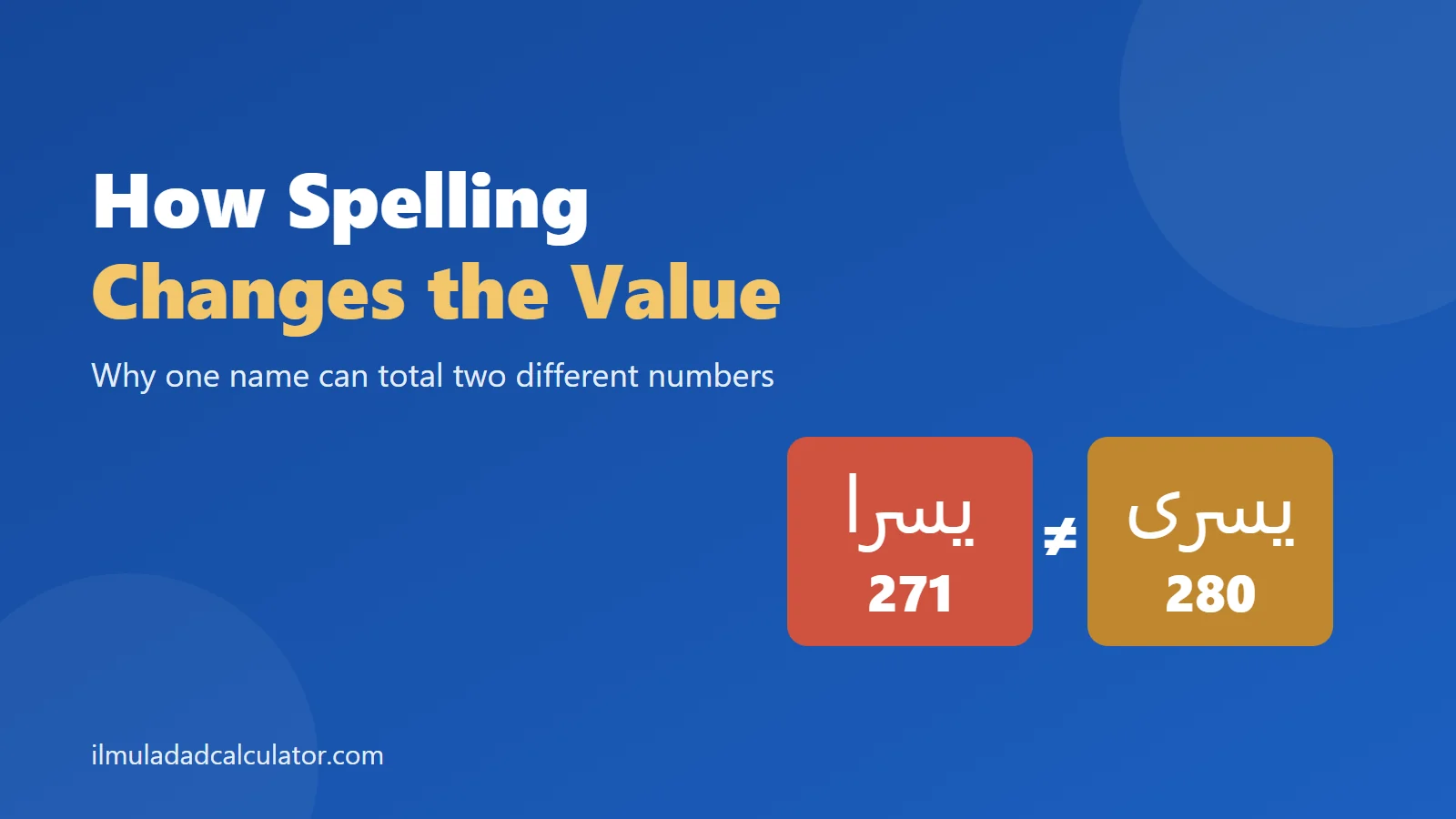
| Alif maqsura vs a final alif | يسرى / يسرا (Yusra) | 280 | 271 | 9 |
| A shadda counted twice | محمّد (Muhammad) | 92 | 132 | 40 |
| Ta marbuta vs an open ta | فاطمة / فاطمت (Fatima) | 135 | 530 | 395 |
The sections below take each choice in turn. Each one links to a full guide if you want the deeper rule.
Notice that many choices change nothing at all. The English form, a seated hamza, an Urdu letter and a dagger alif all leave the total where it was.
Does the English Spelling Matter?
No. The English form is only a guide to the sound, and it carries no Abjad value on its own.
Muhammad and Mohammed both stand for one Arabic name, محمد, which totals 92. The same holds for Khalid and Khaled, or Aisha and Ayesha.
So always find the Arabic or Urdu spelling first, then count. The guide to the many spellings of Muhammad shows this for one well-known name.
Short forms need the same care. Md., Mohd. and M. have no Arabic letters, so you spell out the full name before you add.
Does a Seated Hamza Count Differently From a Standalone One?
A hamza can sit on a carrier letter, or stand on its own. The two cases behave differently in a total.
- A seated hamza rides on an alif, waw or ya. That carrier letter counts as usual, so the total is steady. Aisha (عائشة) gives 386 whether or not you count the hamza.
- A standalone hamza (ء) is the only one affected by the hamza rule. Dua (دعاء) gives 75 with the hamza left out, or 76 if you count it as 1.
So the choice only matters when a name holds a standalone hamza. For the full rule, see the hamza in Ilm-ul-Adad.
This site leaves the standalone hamza out by default. You can turn it on in the calculators, which is why stating your hamza rule keeps a total clear.
Does the Ending Ta Change the Value?
Many names end in a soft t sound that can be written three ways. The choice can change the total by a lot.
Fatima written with ta marbuta (فاطمة) gives 135. The Urdu ending (فاطمہ) gives the same 135, since both count as 5.
But an open ta (فاطمت) is a full letter worth 400, so it gives 530. The guide to the ta marbuta value explains all three endings.
This is the largest gap in the table, since a 5 is swapped for a 400. Names like Aisha, Khadija and Hafsa all end this way, so the choice is worth checking.
Does Alif Maqsura Count Like a Final Alif?
No. Alif maqsura (ى) is written like a dotless ya, so it counts as 10. A final alif (ا) counts as 1.
Yusra spelled يسرى gives 280, while يسرا gives 271, a gap of 9. Both look like a long a in English.
So check whether the name really ends in ى or ا. The guide to the alif maqsura value lists common names both ways.
Some writers count alif maqsura by sound instead, as a 1. That is a counting choice, not a spelling change, and it also lowers the total by 9.
Does a Dagger Alif Change the Total?
The dagger alif (ـٰ) is a vowel mark, not a letter, so it adds nothing. Written as a full alif instead, it adds 1.
Rahman with the mark (الرحمٰن) gives 329. Typed with a full alif (الرحمان) it gives 330, one higher.
Keyboards and auto-correct sometimes add the full alif on their own. If a total is 1 higher than you expect, look for a tall alif where the small mark should sit.
A gap of exactly 1 often points to this swap. See the dagger alif for the words that carry it.
Is a Shadda Counted Once or Twice?
A shadda (ـّ) marks a doubled letter. The standard rule on this site counts that letter once, so the mark adds nothing.
Muhammad with a shadda (محمّد) still totals 92. A source that counts the doubled mim twice would report 132 instead.
The gap equals the value of the doubled letter, so it changes from name to name. Names like Abbas and Sayyid carry a shadda too, and each has its own gap.
Tip: if you follow a source that counts the doubled letter twice, write that choice next to the total. See the shadda value for the full rule.
Do Urdu Letters Change the Value?
No. Urdu and Persian letters take the value of the Arabic letter they are built from. So the keyboard you use does not change the total.
Karim typed with the Urdu kaf (کریم) gives 270. Typed with the Arabic kaf (كريم) it gives the same 270.
The same holds for pe as ba, che as jim, and gaf as kaf. The guide to Urdu and Persian letter values lists every pair.
This keeps Pakistani names steady across keyboards. A name typed on an Urdu phone and the same name typed in Arabic will reach the one total.
What If a Letter Is Added or Dropped?
This is the plainest change of all. An extra letter adds its value, and a missing letter removes it.
Usman spelled عثمان gives 661. Dropping the long alif to write عثمن gives 660, one lower.
So count the letters you actually see, one by one. A total always belongs to a single written spelling, not to the name in general.
Long vowels cause most of these gaps, since Arabic often leaves them unwritten. The same name may appear with or without an alif or a waw in the middle.
Does the Value System Change the Total Too?
Yes, but that is a separate choice from spelling. The system decides the value of each letter before you add.
This site uses the Mashriqi values by default. In the Maghribi system, six letters take different values, so the same spelling can give a different total.
So two totals can differ even when the spelling is identical. The guide to why values differ sorts the spelling gaps from the system gaps.
Which Spelling Should You Calculate?
There is no single correct spelling for most names. The best choice is the one you already use, counted in a steady way.
A total is not a score, so there is no reason to hunt for a higher one. Changing a spelling only changes which word you are counting.
- Start from your own spelling. Use the Arabic or Urdu form on your documents, or the one your family uses.
- Keep it consistent. Count the same spelling every time, so your total can be repeated.
- State your system. Note that you used the Mashriqi values, and say whether you counted a standalone hamza.
Then write the total with a short note on the rule you used. That one line removes almost every disagreement.
How Do You Check One Name From Start to Finish?
A short walk-through ties the rules together. Take the name Fatima as an example.
First fix the spelling. The form on most documents is فاطمة, ending in a ta marbuta, so that is the one to count.
Next add the letters in the Mashriqi system, which gives 135. There is no standalone hamza here, so the hamza rule does not apply.
Last, record it as Fatima فاطمة, 135, Mashriqi. Anyone who uses the same spelling and system will reach the same number.
How Do You Compare Two Spellings?
When two totals disagree, line up the two spellings letter by letter. The gap usually traces to one ending or one mark.
The compare tool puts two spellings side by side and shows the difference. To go from an English form to its Arabic letters, use the English name tool.
For the wider set of reasons totals differ, see why calculators give different values. To build a name from its sounds, read how to write your name in Arabic.
خلاصہ
ایک ہی نام کے مختلف اعداد اکثر املا کے فرق سے بنتے ہیں۔ انگریزی ہجے سے عدد نہیں بدلتا، کیونکہ عدد عربی حروف سے نکلتا ہے، اس لیے محمد اپنی ہر انگریزی املا میں 92 ہی رہتا ہے۔ اردو اور عربی حروف بھی ایک ہی قیمت رکھتے ہیں، اور بیٹھا ہوا ہمزہ، کھڑا زبر اور شَدّہ عدد میں اضافہ نہیں کرتے۔ البتہ آخر میں تاء مربوطہ کے بجائے کھلی تے، الف مقصورہ کے بجائے الف، یا کوئی زائد حرف عدد بدل دیتا ہے۔ بہتر یہی ہے کہ اپنی دستاویز والی املا کو ایک ہی طرح گنیں اور ساتھ نظام لکھ دیں۔
Sources and Further Reading
- Arabic name, Wikipedia. How names are spelled and transliterated.
- Romanization of Arabic, Wikipedia. Why one Arabic name has several English spellings.
- Abjad numerals, Wikipedia. The letters that carry a value.
- All values come from this site’s tested engine. See the methodology.
Frequently Asked Questions
Does my name have one correct Abjad value?
It has one value for each spelling. Pick the spelling you use, keep it steady, and that total is yours.
Why does an online tool give my name a different number?
It likely used a different spelling or a different rule, such as counting a standalone hamza. Compare the two spellings letter by letter.
Does the English spelling of my name change the value?
No. English letters carry no value. Muhammad and Mohammed both map to محمد, which totals 92.
Which ending changes the value the most?
An open ta instead of a ta marbuta. For Fatima it moves the total from 135 to 530.
Should I change my spelling to get a nicer number?
No. Count the spelling you really use. A total only describes that written form, and it says nothing about a person.
Do Arabic and Urdu spellings of a name agree?
Usually yes. Urdu letters take their Arabic base value, so Karim gives 270 on either keyboard.