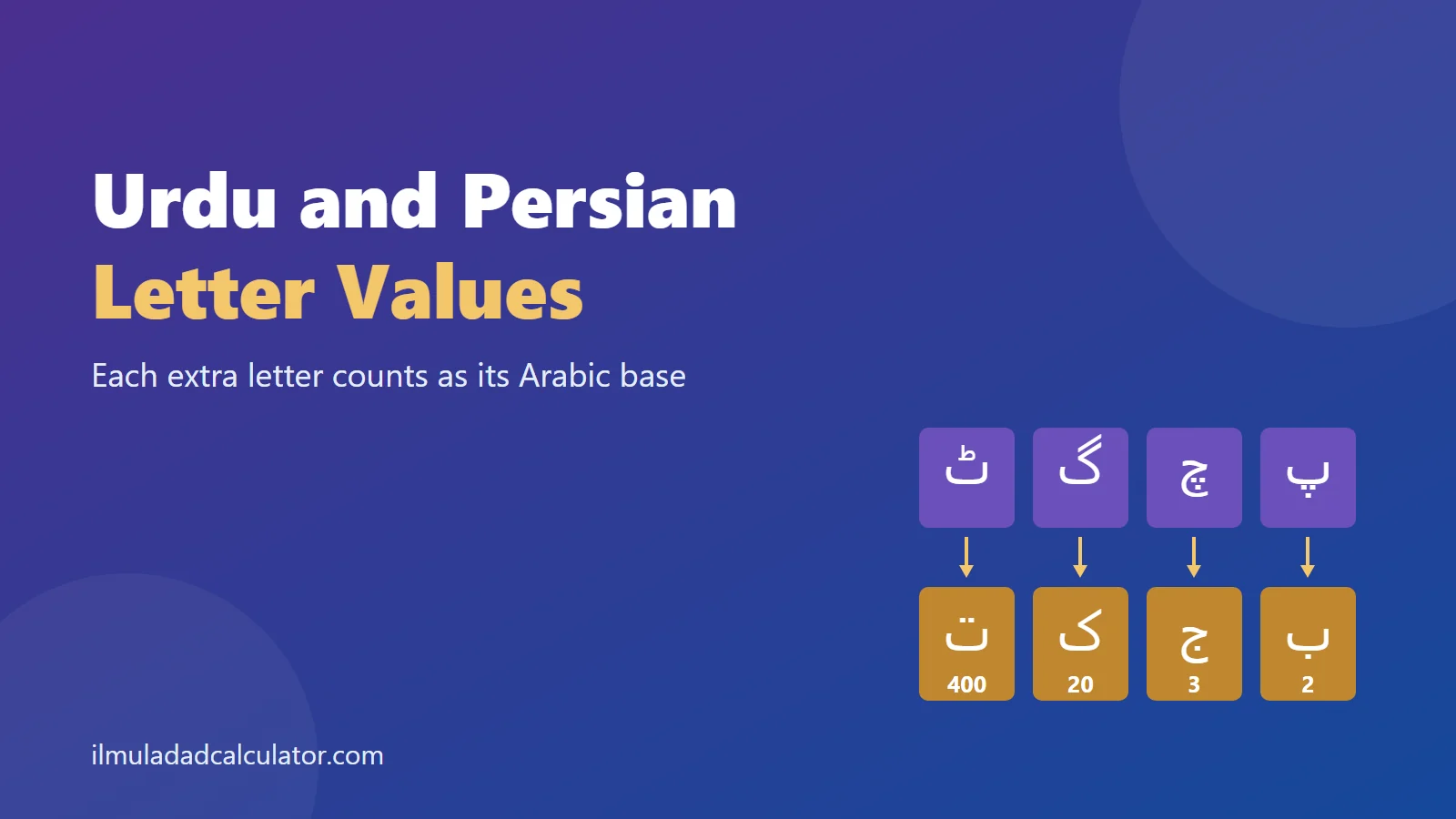
Urdu and Persian use letters that are not in the 28-letter Arabic alphabet. Each one counts as the Arabic letter it comes from, so پ is ب (2) and گ is ک (20). For example, پروین is 268.
| Letter | Name | Used in | Counted as | Mashriqi | Maghribi |
|---|---|---|---|---|---|
| پ | Pe | Persian, Urdu | ب | 2 | 2 |
| چ | Che | Persian, Urdu | ج | 3 | 3 |
| ژ | Zhe | Persian, Urdu | ز | 7 | 7 |
| گ | Gaf | Persian, Urdu | ك | 20 | 20 |
| ک | Kaf (Persian form) | Persian, Urdu | ك | 20 | 20 |
| ی | Ye (Persian form) | Persian, Urdu | ي | 10 | 10 |
| ٹ | Tte | Urdu | ت | 400 | 400 |
| ڈ | Ddal | Urdu | د | 4 | 4 |
| ڑ | Rre | Urdu | ر | 200 | 200 |
| ں | Noon ghunna | Urdu | ن | 50 | 50 |
| ے | Bari ye | Urdu | ي | 10 | 10 |
| ۓ | Bari ye with hamza | Urdu | ي | 10 | 10 |
| ہ | Gol he | Urdu | ه | 5 | 5 |
| ھ | Do-chashmi he | Urdu | ه | 5 | 5 |
| ۀ | He with hamza | Persian, Urdu | ه | 5 | 5 |
| ڤ | Ve | Modern Arabic | ف | 80 | 80 |
| ڨ | Gaf (North African) | Algeria, Tunisia | ق | 100 | 100 |
| ڭ | Gaf (Moroccan) | Morocco | ك | 20 | 20 |
Check an Urdu or Persian Word
| As written | Counted as | Value |
|---|
All calculations run in your browser. Nothing you type is sent to a server.
اردو اور فارسی حروف کی ابجد قیمت
اردو اور فارسی کے اضافی حروف اپنے اصل عربی حرف کی قیمت لیتے ہیں: پ = ب (2)، چ = ج (3)، ژ = ز (7)، گ = ک (20)، ٹ = ت (400)، ڈ = د (4)، ڑ = ر (200)۔ ی، ے، ک اور ہ عربی حروف ہی کی طرح گنے جاتے ہیں۔
How to Use This Tool
- Type or paste an Urdu or Persian word in the box. You can use any Urdu keyboard.
- Read the total at the top of the result.
- Check the breakdown table. It shows each letter as written, the Arabic letter it counts as, and its value.
- Tick Maghribi values if your source uses the Western system.
The table at the top lists every extra letter in one place. Use it to check a value by hand.
Why Extra Letters Take a Base Value
The Abjad values were fixed for the 28 Arabic letters long ago. Persian and Urdu came later and needed sounds that Arabic did not have.
Writers made the new letters by adding dots or a small mark to an existing letter. In Ilm-ul-Adad, the new letter keeps the value of that base letter. The extra dots change the sound, not the number.
Three Families of Extra Letters
- Persian letters with three dots. پ, چ and ژ add dots to ب, ج and ز. گ adds a second stroke to ک.
- Urdu retroflex letters. ٹ, ڈ and ڑ carry a small ط sign on top. They count as ت, د and ر.
- Urdu shapes of Arabic letters. ں is a form of ن, and ے is a form of ي. ہ and ھ are both forms of ه.
Aspirated Letters With Do-Chashmi He
Urdu writes aspirated sounds with a second letter, the do-chashmi he ھ. For example, بھ is the sound bh, as in بھائی.
This tool counts every written ھ as ه, which is 5. That follows the common rule of counting the letters as written.
| Pair | Parts | Written-form value | Without ھ |
|---|---|---|---|
| بھ | 2 + 5 | 7 | 2 |
| پھ | 2 + 5 | 7 | 2 |
| کھ | 20 + 5 | 25 | 20 |
| گھ | 20 + 5 | 25 | 20 |
Some writers leave the ھ out because it only marks a breath. Both rules appear in print. When you quote a value, say which rule you used.
Urdu and Arabic Spellings Give the Same Value
Urdu keyboards type their own shapes of some Arabic letters. Urdu uses ک for ك, ی for ي and ہ for ه.
For counting, these are the same letters. So کریم typed in Urdu and كريم typed in Arabic both give 270. The name فاطمہ gives 135 in either script.
A value only changes when the spelling itself changes. Adding or dropping a letter, such as an extra ا, changes the total.
Worked Examples
| Word | Meaning or name | Extra letters | Total |
|---|---|---|---|
| پروین | Parveen | پ counts as ب | 268 |
| چاند | chand (moon) | چ counts as ج | 58 |
| گلاب | gulab (rose) | گ counts as ک | 53 |
| ٹیپو | Tipu | ٹ counts as ت, پ as ب | 418 |
| ڈھاکہ | Dhaka | ڈ as د, ھ and ہ as ه | 35 |
Type any of these words above to see the full breakdown. Each extra letter shows the Arabic letter it counts as.
Letters From Other Scripts
Some modern Arabic writing adds letters for foreign sounds. ڤ often writes a v sound. ڨ and ڭ write a g sound in parts of North Africa.
The same rule applies. ڤ counts as ف (80), ڨ as ق (100) and ڭ as ك (20).
Common Mistakes
- Giving پ or گ a new value of its own. Extra letters never get new numbers.
- Treating ٹ as ط because of the small sign on top. It counts as ت, which is 400.
- Counting ں as zero because it is not fully pronounced. It is still a written ن, worth 50.
- Mixing the two rules for ھ in one list. Pick one rule and use it for every word.
To compare a whole name, use the Ilm-ul-Adad Calculator. To learn the full alphabet, read how many letters the Urdu alphabet has.
Sources and Further Reading
Frequently Asked Questions
What is the Abjad value of پ?
پ (pe) takes the value of ب (ba), which is 2.
What is the value of گ?
گ (gaf) counts as ک (kaf), which is 20.
What is the value of ٹ, ڈ and ڑ?
They count as ت (400), د (4) and ر (200). The small sign on top does not add value.
Is the do-chashmi he counted in pairs like بھ?
This tool counts every written ھ as 5. Some writers leave it out because it only marks a breath, so state your rule when you quote a value.
Do Urdu and Arabic spellings of a name give the same value?
Yes, when the letters are the same. ی and ي, ک and ك, and ہ and ه count the same. Only a change in spelling changes the total.
What about letters like ڤ?
ڤ counts as ف (80). ڨ counts as ق (100) and ڭ counts as ك (20).
Author: Shakeel Muzaffar
Reviewer: Moulana Haji Abdul Basit (Islamic Scholar and Mentor)