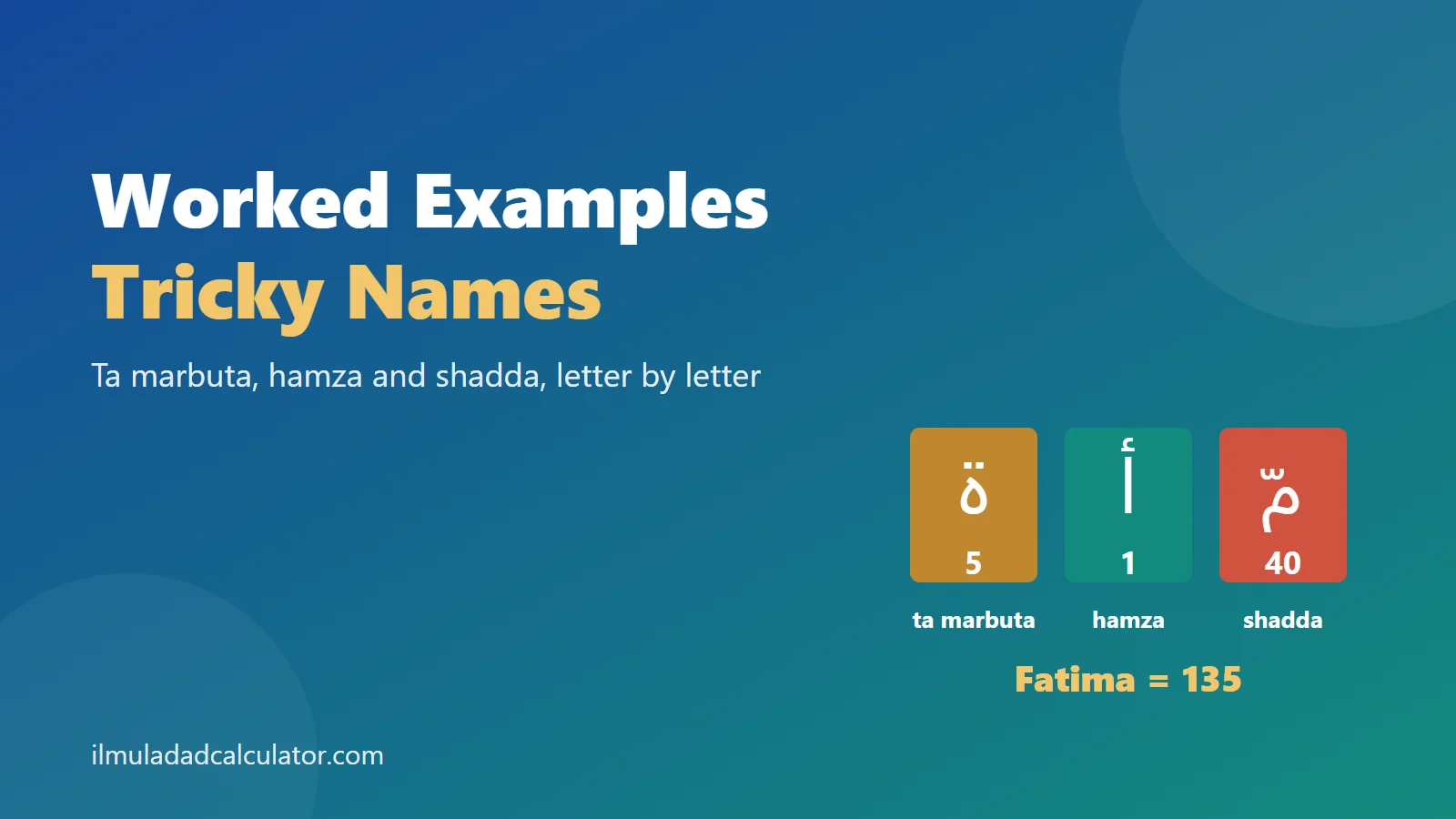
These worked examples count names with ta marbuta, hamza and shadda one letter at a time. Fatima gives 135, Asma gives 102 and Muhammad gives 92 in the Mashriqi system. Every table lists each letter, its value and a running total, so you can check your own working.
What Rules Do the Examples Follow?
All totals use Mashriqi values and the conventions of this site. The reasoning lives on its own pages, so this page only applies the rules.
| Feature | Rule used | Full explanation |
|---|---|---|
| Ta marbuta ة | Counts 5, like ha | Ta marbuta value |
| Hamza أ إ ؤ ئ | A seated hamza takes the value of its seat | Hamza in Ilm-ul-Adad |
| Standalone hamza ء | Counts 0 by default, 1 with the option | Hamza in Ilm-ul-Adad |
| Shadda ّ | A mark worth 0, so the letter counts once | Shadda value |
| Spelling | The written letters decide the total | Spelling changes value |
If your source follows a different rule, write that rule next to the total. Then anyone can repeat your result.
Why Were These Names Chosen?
Each name tests one clear feature, and a few test several at once. They are common names in Pakistan and the Arab world, so you are likely to meet similar spellings.
The names appear here as spelling and arithmetic examples only. The totals say nothing about a person, and they carry no meaning beyond the letters themselves.
Arabic spellings are shown first. Where Urdu writes the same name differently, the page adds the Urdu form and its total.
How Do You Read the Letter Tables?
Each table lists the letters in the order they are written, which is right to left on the page. The last running total is the value of the name.
- Find the step number, which counts letters and marks in reading order.
- Read the value of that letter in the fourth column.
- Check the running total against your own addition.
Tip: if your final total differs from a calculator, compare the running totals row by row. The first row that disagrees shows the letter that caused the gap.
Worked Examples With Ta Marbuta
Ta marbuta appears only at the end of a word. So in these tables it is always the last row, and it always adds 5.
Fatima (فاطمة)
Fatima has five letters, and the ending is a ta marbuta.
| Step | Letter | Name | Value | Running total |
|---|---|---|---|---|
| 1 | ف | Fa | 80 | 80 |
| 2 | ا | Alif | 1 | 81 |
| 3 | ط | Ta (emphatic) | 9 | 90 |
| 4 | م | Mim | 40 | 130 |
| 5 | ة | Ta marbuta | 5 | 135 |
The Urdu spelling فاطمہ ends in choti he instead. Choti he also counts 5, so the total stays 135.
Talha (طلحة)
Talha is a short name, so the ending makes up a larger share of the total.
| Step | Letter | Name | Value | Running total |
|---|---|---|---|---|
| 1 | ط | Ta (emphatic) | 9 | 9 |
| 2 | ل | Lam | 30 | 39 |
| 3 | ح | Ha | 8 | 47 |
| 4 | ة | Ta marbuta | 5 | 52 |
Notice that the first letter, ta, is the emphatic ط worth 9. It is not the open ta ت worth 400, and the two are easy to confuse.
The ta marbuta supplies 5 of the 52. The Urdu spelling طلحہ gives 52 for the same reason.
Worked Examples With Hamza
The next three names show a hamza on alif, a hamza on waw and a hamza standing alone. In each case, the seat carries the value.
Asma (أسماء)
Asma has both kinds of hamza. The first sits on an alif, and the last stands alone on the line.
| Step | Letter | Name | Value | Running total |
|---|---|---|---|---|
| 1 | أ | Alif with hamza above | 1 | 1 |
| 2 | س | Sin | 60 | 61 |
| 3 | م | Mim | 40 | 101 |
| 4 | ا | Alif | 1 | 102 |
| 5 | ء | Standalone hamza | 0 or 1 | 102 or 103 |
The default total is 102. With the standalone hamza option on, the total is 103. State which one you used.
Ismail (إسماعيل)
Ismail starts with a hamza below the alif. The alif in the middle is a separate letter, so the name holds two alifs.
| Step | Letter | Name | Value | Running total |
|---|---|---|---|---|
| 1 | إ | Alif with hamza below | 1 | 1 |
| 2 | س | Sin | 60 | 61 |
| 3 | م | Mim | 40 | 101 |
| 4 | ا | Alif | 1 | 102 |
| 5 | ع | Ain | 70 | 172 |
| 6 | ي | Ya | 10 | 182 |
| 7 | ل | Lam | 30 | 212 |
Both alifs count 1, and the mark below the first one adds nothing. The total is 212.
Names with a long alif in the middle are easy to miscount. Say the name slowly and count the alif that you hear as a separate letter.
Rauf, Written Two Ways (رؤوف and رءوف)
Rauf is written in two accepted ways. The common spelling seats the hamza on a waw, while the other leaves it standing alone before one waw.
| Step | Letter | Name | Value | Running total |
|---|---|---|---|---|
| 1 | ر | Ra | 200 | 200 |
| 2 | ؤ | Waw with hamza | 6 | 206 |
| 3 | و | Waw | 6 | 212 |
| 4 | ف | Fa | 80 | 292 |
| Step | Letter | Name | Value | Running total |
|---|---|---|---|---|
| 1 | ر | Ra | 200 | 200 |
| 2 | ء | Standalone hamza | 0 or 1 | 200 or 201 |
| 3 | و | Waw | 6 | 206 |
| 4 | ف | Fa | 80 | 286 |
The first spelling gives 292 and the second gives 286, or 287 with the option. The gap of 6 is the value of one waw. For more spelling gaps, see how spelling changes a value.
Worked Examples With Shadda
In these tables the shadda gets its own row, with a value of 0. You can see that it is noted and then skipped.
Muhammad (محمّد)
The shadda sits on the second mim. That mim is a single letter on the line, so it counts once.
| Step | Letter | Name | Value | Running total |
|---|---|---|---|---|
| 1 | م | Mim | 40 | 40 |
| 2 | ح | Ha | 8 | 48 |
| 3 | م | Mim | 40 | 88 |
| 4 | ّ | Shadda (a mark) | 0 | 88 |
| 5 | د | Dal | 4 | 92 |
The total is 92, the same as the spelling محمد without the mark. This is why many printed charts never write the shadda at all.
Abbas (عبّاس)
Here the shadda sits on the ba, which is worth 2.
| Step | Letter | Name | Value | Running total |
|---|---|---|---|---|
| 1 | ع | Ain | 70 | 70 |
| 2 | ب | Ba | 2 | 72 |
| 3 | ّ | Shadda (a mark) | 0 | 72 |
| 4 | ا | Alif | 1 | 73 |
| 5 | س | Sin | 60 | 133 |
The total is 133. A source that counted the ba twice would report 135, and the shadda page explains that minority practice.
Worked Examples That Combine Features
Many names carry more than one feature. Each feature is handled by its own rule, and the running total simply keeps going.
Safiyya (صفيّة)
This name has a shadda on the ya and a ta marbuta at the end.
| Step | Letter | Name | Value | Running total |
|---|---|---|---|---|
| 1 | ص | Sad | 90 | 90 |
| 2 | ف | Fa | 80 | 170 |
| 3 | ي | Ya | 10 | 180 |
| 4 | ّ | Shadda (a mark) | 0 | 180 |
| 5 | ة | Ta marbuta | 5 | 185 |
Aisha (عائشة)
Aisha has a hamza on a ya seat, followed by a ta marbuta ending. The seat counts 10.
| Step | Letter | Name | Value | Running total |
|---|---|---|---|---|
| 1 | ع | Ain | 70 | 70 |
| 2 | ا | Alif | 1 | 71 |
| 3 | ئ | Ya with hamza | 10 | 81 |
| 4 | ش | Shin | 300 | 381 |
| 5 | ة | Ta marbuta | 5 | 386 |
The Urdu spelling عائشہ gives the same 386.
Ayyub (أيّوب)
Ayyub pairs a hamza on alif with a shadda on ya.
| Step | Letter | Name | Value | Running total |
|---|---|---|---|---|
| 1 | أ | Alif with hamza above | 1 | 1 |
| 2 | ي | Ya | 10 | 11 |
| 3 | ّ | Shadda (a mark) | 0 | 11 |
| 4 | و | Waw | 6 | 17 |
| 5 | ب | Ba | 2 | 19 |
Muassasa (مؤسّسة), a Word With All Three
The word muassasa means an institution. It has a hamza on waw, a shadda on sin and a ta marbuta. Treat it as a stress test rather than a name.
| Step | Letter | Name | Value | Running total |
|---|---|---|---|---|
| 1 | م | Mim | 40 | 40 |
| 2 | ؤ | Waw with hamza | 6 | 46 |
| 3 | س | Sin | 60 | 106 |
| 4 | ّ | Shadda (a mark) | 0 | 106 |
| 5 | س | Sin | 60 | 166 |
| 6 | ة | Ta marbuta | 5 | 171 |
Notice that the word has two sin letters in a row, and the shadda sits on the first one. Each sin is counted, so the pair gives 120.
Only five letters carry value here. The shadda row is zero, so the total is 171.
What Do All the Examples Add Up To?
This table collects every total from the page. Use it as a quick check after you work a name by hand.
| Name | Arabic | Feature | Total |
|---|---|---|---|
| Fatima | فاطمة | Ta marbuta | 135 |
| Talha | طلحة | Ta marbuta | 52 |
| Asma | أسماء | Hamza on alif, standalone hamza | 102 |
| Ismail | إسماعيل | Hamza below alif | 212 |
| Rauf | رؤوف | Hamza on waw | 292 |
| Muhammad | محمّد | Shadda | 92 |
| Abbas | عبّاس | Shadda | 133 |
| Safiyya | صفيّة | Shadda and ta marbuta | 185 |
| Aisha | عائشة | Hamza on ya and ta marbuta | 386 |
| Ayyub | أيّوب | Hamza and shadda | 19 |
| Muassasa | مؤسّسة | Hamza, shadda and ta marbuta | 171 |
What Would Change Under Another Rule?
A total only has meaning together with its rules. The table shows what five examples would give if a source followed a different convention.
| Name | This page | Alternative rule | Other total |
|---|---|---|---|
| Fatima فاطمة | 135 | Ending counted as open ta | 530 |
| Aisha عائشة | 386 | Ending counted as open ta | 781 |
| Asma أسماء | 102 | Standalone hamza counted as 1 | 103 |
| Muhammad محمّد | 92 | Shadda letter counted twice | 132 |
| Safiyya صفيّة | 185 | Shadda letter counted twice | 195 |
The size of each gap equals the value of the letter in question. A change at the ending can move a total by hundreds, while a hamza option moves it by 1.
That pattern is useful when you compare your answer with a printed one. Measure the gap, and it points to the feature that differs.
How Do You Work Out a New Name the Same Way?
You can reuse the table layout for any name. These steps keep the three features from slipping past you.
- Write the name in Arabic or Urdu letters, using the spelling your source uses.
- Circle any ending that looks like ha with two dots, any hamza and any shadda.
- Give the shadda its own row with a value of 0.
- Give each seated hamza the value of its seat, and decide your rule for a standalone one.
- Add down the column, then compare the last total with a calculator.
Practice with a name you already know the total of. When your table matches the calculator, try a name you have never counted.
Keep a short note of the spelling and the rules beside each result. A page of totals with no notes is hard to trust a month later.
Can You Try Three Names Yourself?
Work each name on paper with Mashriqi values. Then open the answer to compare your running totals.
خديجة (Khadija), ta marbuta
خ 600 + د 4 + ي 10 + ج 3 + ة 5 = 622
مؤمن (Mumin), hamza on waw
م 40 + ؤ 6 + م 40 + ن 50 = 136
سيّد (Sayyid), shadda on ya
س 60 + ي 10 + د 4 = 74
Which Slips Do These Examples Reveal?
- Counting ة as 400. Fatima would jump from 135 to 530, because an open ta is worth 400.
- Dropping the seat. A seated hamza is not extra. Its alif, waw or ya still counts.
- Counting the shadda row. The mark is worth 0, and the letter under it counts once.
- Mixing spellings. Rauf has two spellings and two totals, so pick one before you add.
Does the Order of the Letters Change the Total?
No. Addition gives the same answer in any order. Reading right to left or left to right makes no difference.
The order only helps you keep your place. A running total shows exactly where a slip happened, which is why the tables use it.
Grouping works too. Some people add the hundreds first, then the tens, then the ones. Use whichever way keeps your numbers clear.
How Does the Calculator Show the Same Work?
The Abjad value calculator breaks a name into the same rows as these tables. Type أسماء and you will see each letter and its value.
It also has the standalone hamza option, so you can reproduce both totals for Asma. For several spellings at once, the value comparison tool shows them side by side.
What Should You Remember From These Examples?
- The ending is worth 5. Ta marbuta and choti he give the same total, so Arabic and Urdu endings agree.
- The seat carries the hamza. A name such as عائشة needs its ya counted as 10.
- The shadda is a mark. It earns a row of its own and adds 0 to the running total.
- One name can have two spellings. The total belongs to the spelling, so record the letters you counted.
With these four habits, most names can be counted correctly on the first try. The rest is careful addition.
If a total still looks wrong, return to the table and check the spelling first. Most mistakes start with a letter that was typed differently from the one you meant.
Where Should You Go Next?
These tables follow the same steps as the complete method. For more practice, try one of these guides:
- How to calculate by hand covers working on paper from the start.
- How to calculate Urdu names covers Roman spellings and Urdu letters.
- The Excel formula covers totals for a whole list of names.
خلاصہ
اس صفحے پر ۃ، ہمزہ اور شدّہ والے ناموں کی مثالیں حرف بہ حرف حل کی گئی ہیں۔ ۃ کی قیمت ۵ ہے، ہمزہ اپنی کرسی کی قیمت لیتا ہے، اور شدّہ کوئی قیمت نہیں رکھتا۔ ہر جدول کا آخری مجموعہ نام کی قیمت ہے، اور اپنا حساب اسی سے ملا کر دیکھیں۔
Sources and Further Reading
- Hamza, Wikipedia. The seats of hamza on alif, waw and ya, and the standalone form.
- Shadda, Wikipedia. The mark for a doubled consonant.
- Ta marbuta, Wikipedia. Where the letter is written and how it sounds.
- Abjad values come from this site’s tested engine. See the methodology.
Frequently Asked Questions
Why does Fatima give 135 and not 530?
Ta marbuta counts 5, like ha. Only a written open ta counts 400, which would give 530.
Does the hamza on a seat add to the seat?
No. The hamza mark adds nothing, and the alif, waw or ya under it keeps its own value.
Do I count a doubled letter twice for a shadda?
Not by the convention used here. The letter is written once, so it is counted once.
Why do my totals differ from another site?
A different spelling, system or hamza rule is the usual cause. Compare running totals to find the first row that differs.
Can I use these tables for Urdu spellings?
Yes. Urdu choti he counts 5, like ta marbuta, so names such as Fatima keep the same total.