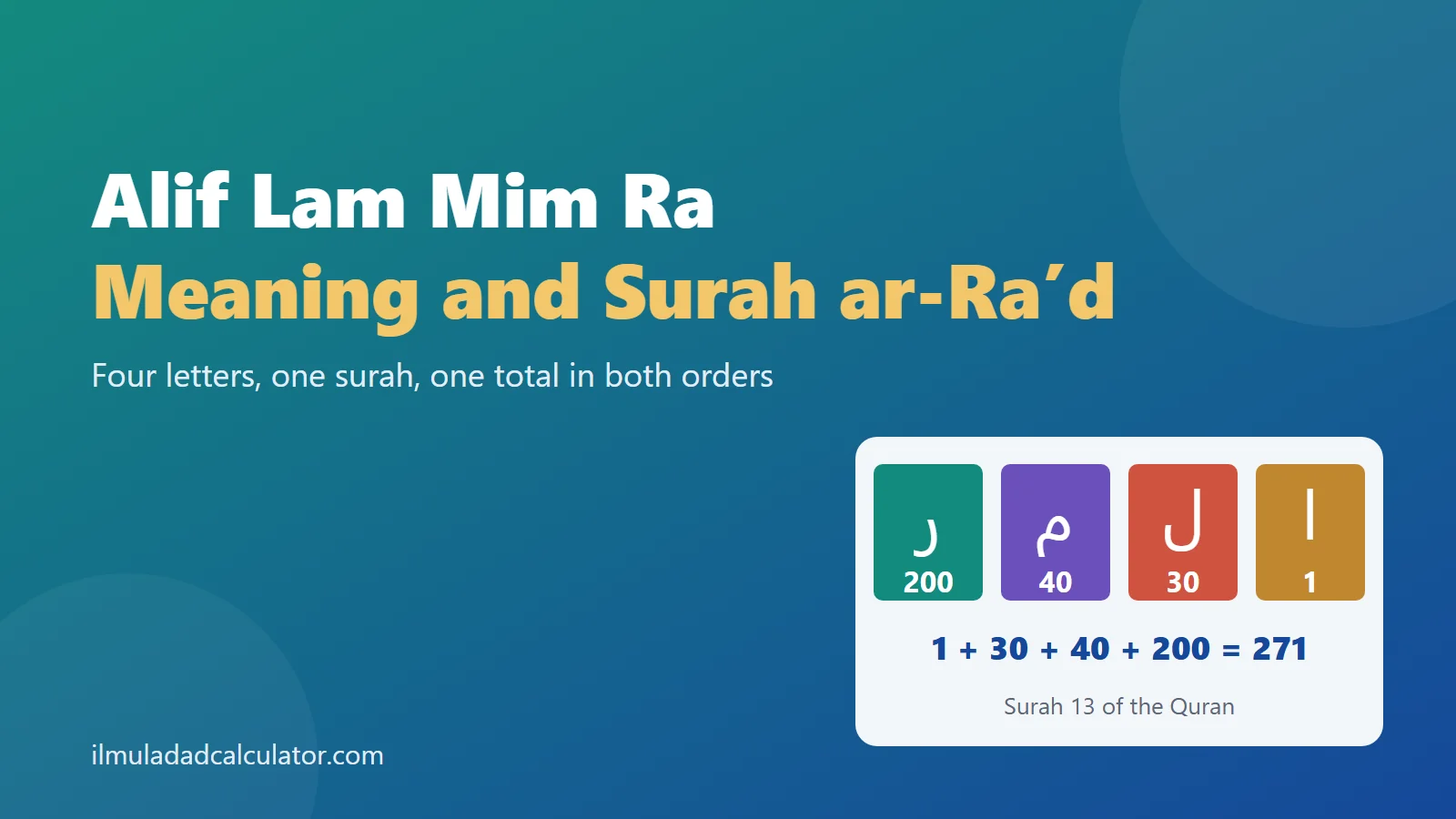
Alif Lam Mim Ra (المر) is the opening of Surah ar-Ra’d, the thirteenth surah of the Quran. It has four letters: alif, lam, mim and ra. Their Abjad values add up to 271, and the total is the same in both major orders.
What Does Alif Lam Mim Ra Mean?
The most widely held position is that its meaning is known with certainty only to God. This is the general belief of most Muslims.
Alif Lam Mim Ra is one of the huruf muqattaat, the disjointed letters at the start of 29 surahs. Many commentators have proposed explanations for them. The huruf muqattaat overview sets out the range of those views, and this page does not choose among them.
Quick answer: المر opens one surah, ar-Ra’d (13). Its letters total 271 in both the Mashriqi and the Maghribi order. Sources differ on whether the surah is Meccan or Medinan.
Which Surah Opens With Alif Lam Mim Ra?
Only Surah ar-Ra’d opens with this group. The name means The Thunder in English. Quran.com notes that the surah is named for the mention of thunder in verse 13.
The surah stands between Surah Yusuf (12) and Surah Ibrahim (14). Both neighbors also open with letters, but with a shorter group. That placement is the main reason this opening is easy to confuse with another one.
Is the Opening Counted as a Verse?
Not as a complete verse of its own, according to Wikipedia’s inventory of the muqattaat. Its table marks المر with a no in the column for a complete verse. The letters run into the text that follows them.
This is a difference from Alif Lam Mim Sad, which is marked yes. The Alif Lam Mim Sad page covers that case.
Is Surah ar-Ra’d Meccan or Medinan?
Sources differ on this point, and the difference is old. Wikipedia’s article and its chapter list label ar-Ra’d as Medinan. Quran.com carries the same Medina label, yet its own commentary note says most authorities held it to be Makkan.
The Dorar tafsir site states that there was a difference of scholarly opinion. It reports one view that the surah is Madani, and another that it is Makki. Some reports are credited to Ibn Abbas on both sides.
What Do the Two Labels Mean?
A Meccan surah is one counted as revealed before the move to Madinah. A Medinan surah is one counted as revealed after it. The labels are about timing in the tradition.
They are also used as a rough guide to style and length. So a label for one surah can shift if a scholar weighs the reports differently.
Why Do the Sources Disagree?
The classification was worked out by scholars from reports and from the style of each surah. It was not fixed by one agreed list, and a few surahs, ar-Ra’d among them, were judged differently.
Wikipedia’s article on Meccan surahs notes that most surahs with opening letters are Meccan. It names three exceptions: surahs 2, 3 and 13. Those three are the ones that the printed lists label Medinan.
Some sources also mention that individual verses of a surah may belong to the other period. Quran.com names verses 12 and 13 and verse 43 in this context. Dorar mentions verse 31 in one report.
This site does not decide the question. It reports that both classifications appear, and that a reader should check the source in use.
What Are the Basic Facts About Surah ar-Ra’d?
Ar-Ra’d is a short surah by the standards of the long ones. It has 43 verses in the Kufan count, which is the figure used in most printed copies.
| Item | Fact |
|---|---|
| Number and name | 13, ar-Ra’d, The Thunder |
| Classification | Listed as Medinan by Wikipedia, disputed in the sources |
| Verses | 43 (Kufan count), with 6 rukus |
| Other verse counts | 44 (Madinan count) and 45 (Shami count) |
| Position in the text | Juz’ 13, after surah 12 and before surah 14 |
| Prostration verse | One, at verse 15 |
| Words and letters | 854 words and 3,450 letters |
| Egyptian standard revelation order | 96 |
| Nöldeke revelation order | 90 |
The revelation numbers are not the same as the printed number 13. The Egyptian list places the surah at 96, and Nöldeke’s scheme places it at 90. The two lists are close, and both put it in the later part of their sequence.
The different verse counts come from old counting traditions. They split the same text into a slightly different number of verses. The total is not a disagreement about the words.
How Does Ar-Ra’d Sit Beside the Alif Lam Ra Surahs?
Surahs 10 to 15 form an unbroken run of six surahs that all open with letters. Five of them open with الر. Ar-Ra’d is the one that adds mim.
Put another way, the opening of ar-Ra’d is the Alif Lam Ra group with a mim in the middle. The Alif Lam Ra page describes the five surahs that use the shorter form.
How Do the Verse Counts Compare?
The five Alif Lam Ra surahs together have 494 verses. Ar-Ra’d has only 43, which is fewer than any of them. Ibrahim is the next smallest with 52.
- Hud has the most verses in the run, with 123.
- Yusuf follows with 111, then Yunus with 109.
- Al-Hijr has 99, and Ibrahim has 52.
- Ar-Ra’d is shortest at 43.
The verse counts come from Wikipedia’s list of chapters. They use the standard count of the printed text.
What Are the Letter Values of Alif Lam Mim Ra?
Alif is 1, lam is 30, mim is 40 and ra is 200. Each value comes from the Abjad chart, and the total is a simple sum.
ا 1 + ل 30 + م 40 + ر 200 = 271
| Letter | Name | Mashriqi place | Maghribi place | Mashriqi value | Maghribi value |
|---|---|---|---|---|---|
| ا | alif | 1 | 1 | 1 | 1 |
| ل | lam | 12 | 12 | 30 | 30 |
| م | mim | 13 | 13 | 40 | 40 |
| ر | ra | 20 | 20 | 200 | 200 |
All four letters sit in the same places in both orders and keep the same values. That is why the total is 271 in both. The page on why values differ explains where the two systems do split.
How Does 271 Compare With the Related Openings?
Four openings share the letters alif and lam. They differ only in what follows. The table shows each one with the surahs it opens.
| Opening | Name | Surahs | Mashriqi | Maghribi |
|---|---|---|---|---|
| الم | Alif Lam Mim | 2, 3, 29, 30, 31, 32 | 71 | 71 |
| المص | Alif Lam Mim Sad | 7 | 161 | 131 |
| الر | Alif Lam Ra | 10, 11, 12, 14, 15 | 231 | 231 |
| المر | Alif Lam Mim Ra | 13 | 271 | 271 |
Only Alif Lam Mim Sad differs between the two orders, because sad changes its value there. The other three give one total in both. The mim adds 40 to Alif Lam Ra, and the step from 231 to 271 is exactly that.
Please note: these totals are arithmetic only. They show how the letters are counted, and this site does not read meaning into them.
How Often Do Its Four Letters Appear Across the Openings?
Each letter of المر is used in other openings too. The count below is the number of the 29 openings that contain the letter.
| Letter | Name | Value | Openings with it |
|---|---|---|---|
| ا | alif | 1 | 13 |
| ل | lam | 30 | 13 |
| م | mim | 40 | 17 |
| ر | ra | 200 | 6 |
Ra is the rarest of the four letters. It appears only in the Alif Lam Ra openings and in this one.
Ar-Ra’d is also the seventh surah on Wikipedia’s inventory of the 29 openings. Surahs 2, 3, 7, 10, 11 and 12 come before it. The surahs after it in the list are 14, 15 and 19.
How Is Alif Lam Mim Ra Written and Read?
In print the four letters form one cluster, المر. Alif and ra do not join the letter that follows them, so they stand slightly apart. Lam and mim join in the usual way.
Many copies add small prolongation marks, as in الٓمٓر. They guide the reciter and are not extra letters. The engine ignores them, so the value stays at 271.
The group is read as four separate letter names: alif, lam, mim, ra. It is not read as a word. The name of ra is written راء, and the muqattaat pronunciation page has the sounds in full.
In Urdu the four names are often written الف لام میم را. Pakistani readers may say alif laam meem raa. All of these point to the same four letters.
Which Names and Openings Are Easy to Mix Up?
Several nearby names look alike in English, so a short list of look-alikes may help.
- المر and الر: the first has a mim and opens surah 13. The second opens five other surahs.
- المر and المص: both start with alif, lam and mim. The first ends in ra and the second in sad.
- Ar-Ra’d and ar-Rahman: these are different surahs, numbered 13 and 55. Ar-Rahman has no opening letters.
Keep the opening and the surah name apart as well. The name الرعد is a word with its own spelling, while the opening is a group of four letters.
How Can You Check the Total Yourself?
- Open the Abjad value calculator.
- Type the four letters المر.
- Read the total. It is 271 for the Mashriqi order.
- Switch to the Maghribi order with the multi-system calculator and see that it stays 271.
For the full list of 29 openings, see the muqattaat list. The background on how writers counted these letters is on the muqattaat and Abjad page. It is context only and does not endorse any numerological reading.
خلاصہ
الف لام میم را سورۃ الرعد کے شروع میں آتا ہے، جو قرآن کی تیرہویں سورت ہے۔ یہ چار حروف ہیں اور انہیں الگ الگ نام لے کر پڑھا جاتا ہے۔ ابجد میں ان کی قدریں ایک، تیس، چالیس اور دو سو ہیں، اور مجموعہ دو سو اکہتر بنتا ہے، جو مشرقی اور مغربی دونوں ترتیبوں میں ایک ہی رہتا ہے۔ ماخذ میں اس بات پر اختلاف ہے کہ سورۃ الرعد مکی ہے یا مدنی۔ سب سے مشہور رائے یہ ہے کہ ان حروف کا یقینی مطلب صرف اللہ جانتا ہے۔
Sources and Further Reading
- Ar-Ra’d, Wikipedia. Verse count, classification, juz’, rukus, prostration verse and the note on disagreement about the time of revelation.
- List of chapters in the Quran, Wikipedia. Names, verse counts of surahs 10 to 15, place of revelation and both revelation orders.
- Muqattaʿat, Wikipedia. The inventory of openings, the complete-verse column and the majority view.
- Meccan surah, Wikipedia. The note that surahs 2, 3 and 13 are the exceptions among the surahs with opening letters.
- Ar-Ra’d, introduction of the sura, Dorar. The scholarly difference of opinion on Makki or Madani.
- Surah Info: Ar-Ra’d, Quran.com. Ayah counts in three traditions and the note on the place of revelation.
- Letter values and sums come from this site’s tested engine. See the methodology.
Frequently Asked Questions
What does Alif Lam Mim Ra mean?
The most widely held view is that its meaning is known with certainty only to God. Commentators have also proposed several explanations.
Which surah starts with Alif Lam Mim Ra?
Surah ar-Ra’d, the thirteenth surah, which has 43 verses in the Kufan count.
Is Surah ar-Ra’d Meccan or Medinan?
Sources differ. Some lists label it Medinan, and many authorities are reported to have held it Meccan.
What is the Abjad value of Alif Lam Mim Ra?
It is 271, from 1 plus 30 plus 40 plus 200. The value is the same in the Mashriqi and Maghribi orders.
How is it different from Alif Lam Ra?
It adds the letter mim. Alif Lam Ra opens five other surahs, and only ar-Ra’d has the longer form.
Does the number 271 hold a hidden meaning?
No. It is the sum of four letter values, and this site makes no claim of a hidden meaning.