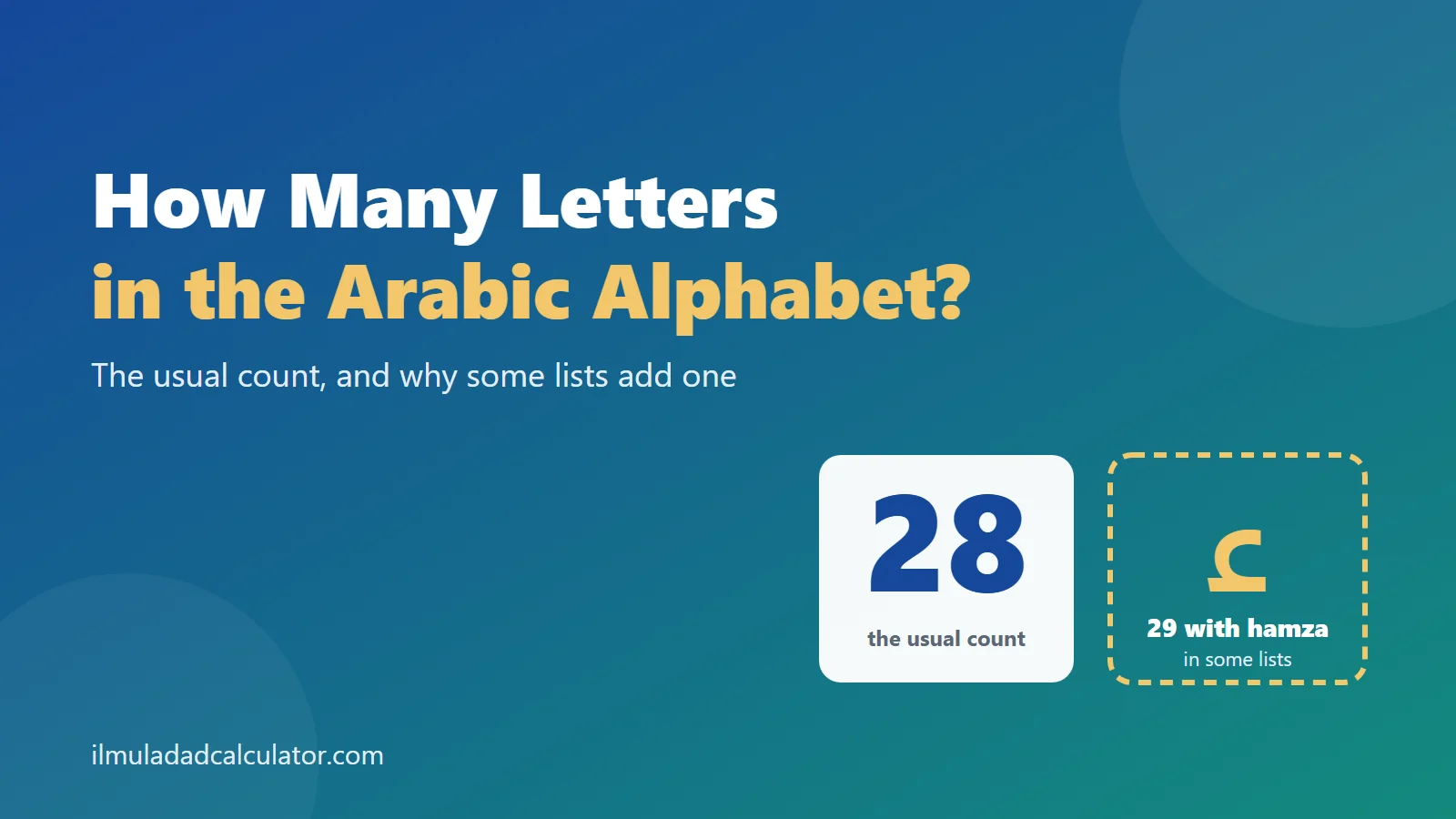
The Arabic alphabet has 28 letters in the standard count. Some lists give 29, because they add hamza (ء) as a letter of its own. The signs لا, ة and ى look like extra letters, but they are not counted as separate ones.
How Many Letters Does the Arabic Alphabet Have?
The usual answer is 28. Reference works, school books and language courses agree on this number for the basic alphabet.
The 28 letters run from alif (ا) to ya (ي) in the everyday order. Here they are, written from right to left.
ا ب ت ث ج ح خ د ذ ر ز س ش ص ض ط ظ ع غ ف ق ك ل م ن ه و ي
Each of these letters also has a fixed Abjad value, from 1 to 1000. The full list is on the letter values page.
What Counts as a Letter, a Form or a Mark?
Most of the confusion comes from four words that sound alike. It helps to separate them before you count.
- Letter: a basic unit of the alphabet, such as ب or م.
- Form: a different shape of a letter, used at the start, middle or end of a word.
- Ligature: one joined shape that stands for two letters written together.
- Mark: a small sign, such as a dot or a vowel sign, that is not a letter.
Under these meanings, a count of letters should not count forms or ligatures twice. That one rule explains why the standard answer stays at 28.
Why Do Some Lists Count 29 Letters?
The extra letter is almost always hamza (ء). It stands for a catch in the voice, which linguists call a glottal stop.
Hamza is unusual because it can be written alone or with a carrier. The carriers are أ إ ؤ ئ, and each is a separate character on a computer. Because of this, writers disagree on whether hamza is a letter or a mark.
The disagreement is old. Madina Arabic reports two classical answers, and modern works give a third.
The table shows how a few references count. Notice that most of them keep to 28.
| Source | Count | What it says |
|---|---|---|
| Wikipedia, Arabic alphabet | 28 | Lists hamza last in its table, yet states 28. Calls lam-alif a ligature. |
| Wikipedia, Hamza | 28 | Says hamza is generally not one of the letters, though some argue it is. |
| Madina Arabic, alphabet lesson | 28 or 29 | Reports classical views that give 28 and 29. |
| Ulum Al-Azhar, alphabet guide | 28 | Lists 28 basic letters. |
In short: 28 and 29 are both honest answers. They differ only in whether hamza is listed as a letter.
What Is the Lam-Alif Ligature?
Lam-alif (لا) is the joined shape you get when lam (ل) is followed by alif (ا). In Arabic script this joining is required, so the two are never written apart in the plain way.
Many beginners see it in an alphabet chart and think it is the 29th letter. It is not, because it is only a way of writing two letters that are already in the list.
In Unicode, you type lam and alif as two separate characters. The computer draws the ligature for you, and a special presentation form exists only for fonts that need it.
That is why a text search for ل still finds the lam inside لا. The text still holds both letters.
Are Ta Marbuta and Alif Maksura Extra Letters?
No. Both signs look like separate letters, but references treat them as forms of letters that are already counted.
- Ta marbuta (ة) appears only at the end of a word. It marks many feminine nouns, such as مدرسة (school).
- Alif maksura (ى) also appears only at the end of a word. Its shape is close to ya without the two dots.
Wikipedia puts both in a group called modified letters. It describes them as contextual variants and not as individual letters.
Each has its own Unicode code point, which is why they appear in some charts. The table lists the four signs that most often cause confusion.
| Sign | Name | Unicode | Counted as a letter? | Abjad value |
|---|---|---|---|---|
| ء | Hamza | U+0621 | Sometimes | 0 or 1 |
| ة | Ta marbuta | U+0629 | No | 5 |
| ى | Alif maksura | U+0649 | No | 10 |
| لا | Lam-alif | U+0644 + U+0627 | No | 31 |
For the Abjad rules on a standalone and seated hamza, see hamza in Ilm-ul-Adad. The other signs take the value of the shape that is written.
Do Persian and Urdu Add More Letters?
Yes, but that is a different question. Persian and Urdu borrowed the Arabic script and added letters for their own sounds.
This page counts the Arabic alphabet only. The longer lists are in the guide to Urdu and Persian letters.
The Urdu count has its own page, how many letters Urdu has. It shows why even that list has more than one answer.
Does the Count Change the Abjad Value?
Only a little. The 28 base letters always carry their values, and the extra signs follow simple rules.
- Lam-alif counts as its two letters, so لا gives 30 + 1 = 31.
- Ta marbuta counts as 5, the value of ha.
- Alif maksura counts as 10, the value of ya.
- A standalone hamza counts as 0 by default, or 1 when you turn the option on.
So the 29th letter changes a total only when hamza stands alone. Take the word ماء (water). It gives 41 by default and 42 with the hamza option.
م 40 + ا 1 = 41
You can check any word in the Abjad value calculator. If you share a total, say which hamza choice you used.
How Can You Count the Letters Yourself?
You can test the count with a few lines of code. The steps are short.
- Write the 28 base letters in a list, from alif to ya.
- Check that no letter appears twice. The list has 28 different letters.
- Add hamza if you want the 29-letter count. That gives 28 + 1 = 29.
- Leave out lam-alif, ta marbuta and alif maksura, since they are forms of letters you already have.
If you added every sign as its own item, you would reach 32. No reference uses that number for the alphabet, so it works only as a warning.
What Mistakes Do Beginners Make When Counting?
Most wrong counts come from the same few slips.
- Counting each letter shape. A letter keeps its place in the alphabet even when its shape changes.
- Counting lam-alif as a letter, because it appears in many charts.
- Counting the four hamza carriers as four new letters. They are hamza on alif, waw or ya.
- Mixing up Arabic with Urdu or Persian lists, which are longer.
Hamza carriers are the trickiest. A chart with the base letters, hamza and the carriers shows 33 characters. No one calls that the alphabet.
How Does Unicode Treat These Letters?
Unicode gives each letter one code point in its main Arabic block. Alif is U+0627, and hamza is U+0621.
The shaped forms live in a separate block called Arabic Presentation Forms-B. Wikipedia says text normally does not need them, because fonts choose the right shape by position.
This is why one letter can look different in a word yet stay one character in your file. The page on the four letter forms shows this in detail.
Do Vowel Letters Count Among the 28?
Yes. Alif, waw and ya are all in the 28. Wikipedia notes that they are usually consonants, yet they also write long vowels in some words.
So the alphabet does not separate vowels from consonants the way English does. Short vowels are written with small marks, and those marks are not letters.
That is another reason the count stays steady. Marks above and below the line, such as dots and vowel signs, never change it.
Why Is 28 the Working Count Here?
The Abjad system gives exactly 28 values. They run in nine ones, nine tens, nine hundreds and one thousand.
Each of the 28 base letters owns one value. Lam-alif and the other signs reuse the values of letters. They never add a new value.
This is why the calculators on this site start from 28 and handle the rest with rules. The Ilm-ul-Adad calculator shows each letter it counts.
Can You Test Your Count?
Try these before you open the answers.
- How many base letters are in the word لا?
- What is the Abjad value of لا?
- If a list counts hamza, how many letters does it have?
Show the answers
- Two: lam and alif.
- 31, since 30 + 1 = 31.
- 29, which is 28 + 1.
Which Count Should You Use?
Use 28 when someone asks how many letters Arabic has. It is the standard answer in reference works and classrooms.
Use 29 when you are reading a source that lists hamza as a letter, and say so. A short note such as “28 letters, plus hamza” avoids any confusion.
In Abjad work, the same habit applies. Write down your rule for hamza, name the system you used, and keep the spelling exactly as you counted it.
This also protects you when two sources disagree. You can say which one you followed and why.
Then another reader can repeat your total and get the same number. That is the whole point of counting letters carefully.
For the order of the letters, see Abjad order versus hija’i order. The script guide covers the wider basics. The next pages cover the alphabet in order, the four letter forms and the letters that do not connect.
خلاصہ
عربی حروفِ تہجی عام طور پر اٹھائیس حروف پر مشتمل مانے جاتے ہیں۔ بعض فہرستوں میں ہمزہ کو الگ حرف مان کر انتیس گنے جاتے ہیں۔ لام الف دو حروف کی جڑی ہوئی شکل ہے، اس لیے اسے الگ حرف نہیں گنا جاتا۔ تائے مربوطہ اور الف مقصورہ بھی الگ حروف نہیں بلکہ حروف کی شکلیں سمجھی جاتی ہیں۔
Sources and Further Reading
- Arabic alphabet, Wikipedia. The 28-letter count, hamza in the table, the lam-alif ligature and the modified letters.
- Hamza, Wikipedia. Hamza is generally not counted among the letters, though some argue otherwise.
- Arabic Alphabet lesson, Madina Arabic. The classical views on 28 or 29 letters.
- How many letters in the Arabic alphabet, Ulum Al-Azhar. A 28-letter count.
- Arabic script in Unicode, Wikipedia. The lam-alif forms in the presentation forms block.
- Arabic chart, The Unicode Consortium. Code points for hamza, alef, teh marbuta and alef maksura.
- Abjad values come from this site’s tested engine. See the methodology.
Frequently Asked Questions
How many letters are in the Arabic alphabet?
The standard count is 28. Some lists add hamza and count 29.
Is hamza a letter?
References disagree. Many do not count it, while some lists add it as the 29th letter.
Is lam-alif a letter?
No. It is the required joined shape of lam and alif, so it adds nothing to the count.
Are ta marbuta and alif maksura separate letters?
No. They are treated as forms of letters already in the alphabet, found at word ends.
Do Urdu and Persian use the same 28 letters?
They use all 28 and add more for their own sounds, so their lists are longer.