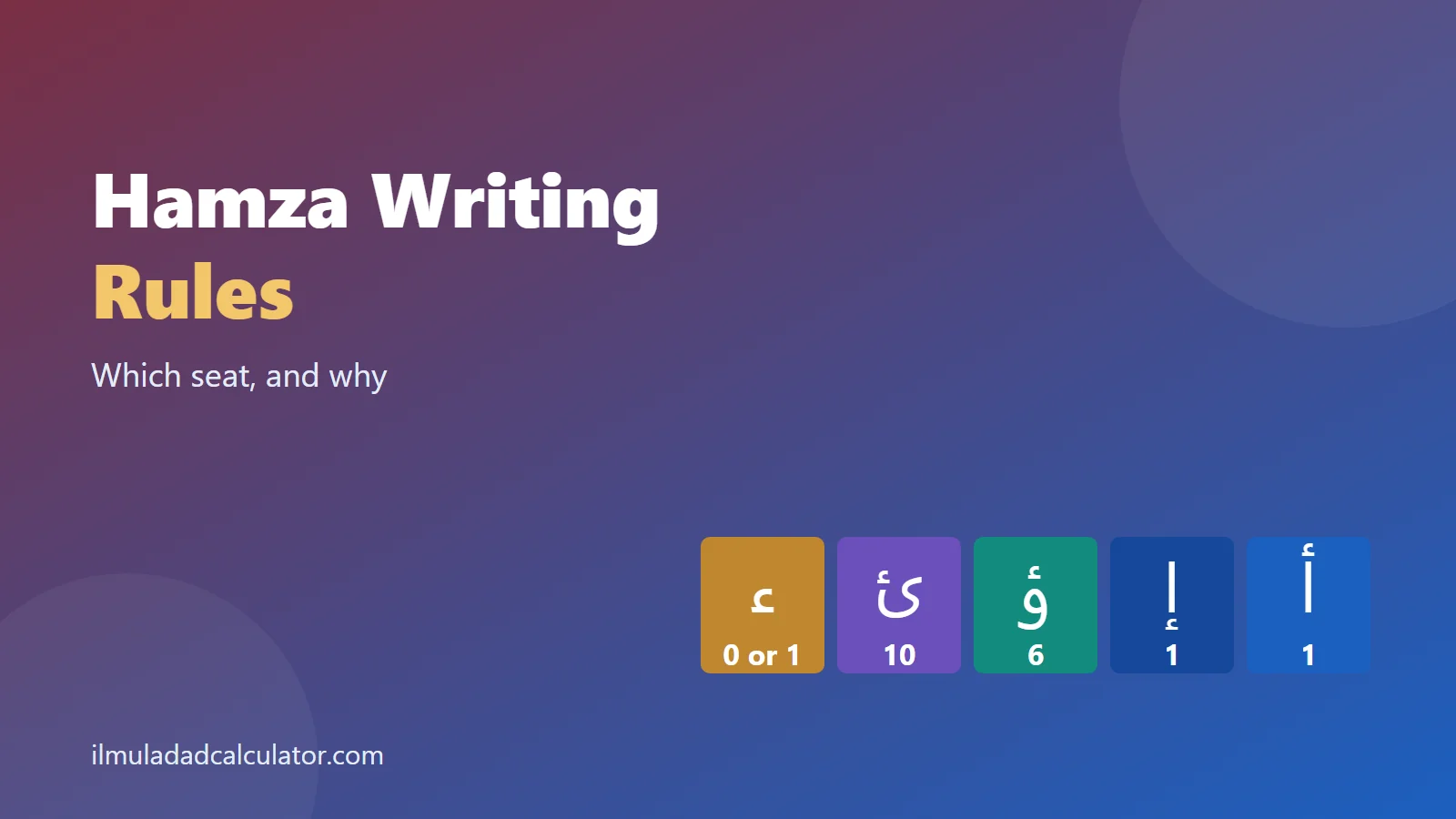
Arabic picks the hamza seat by a vowel contest. The kasra (i) beats the damma (u), and the damma beats the fatha (a). When no short vowel counts, the hamza stands alone on the line.
What Is a Hamza Seat?
Hamza (ء) marks a catch in the voice, the glottal stop. It can stand alone, but it is usually written on a carrier letter called a seat.
The seats are alif (أ and إ), waw (ؤ) and ya (ئ). The mark on the seat is the hamza, and the seat letter tells you which vowel is nearby.
This page explains how writers choose between these forms. For how each form counts in Ilm-ul-Adad, see hamza in Ilm-ul-Adad.
Where Did the Hamza Sign Come From?
Early Semitic scripts wrote the glottal stop with the letter aleph, which became alif in Arabic. But alif also stood for the long vowel a, so readers could not always tell the two apart.
The fix was a small sign added to the alif to mark the glottal stop. Wikipedia says the sign derives from the letter ayn. It gives no firm dates, so treat any exact year with care.
Where Does Hamza Go at the Start of a Word?
At the start of a word, the hamza always sits on an alif. It goes above the alif before an a or u sound, as in أكل. It goes below the alif before an i sound, as in إلى.
If the next sound is a long a, the two alifs merge into one alif madda (آ). That is the only start-of-word case that looks different.
Wikipedia gives the example of آكل (I eat), where the hamza and a long a collapse into one sign. Read it as an alif with a hamza, followed by the long a that the madda stands for.
This is a spelling shortcut, so the madda is one written letter, not two. The counting convention for it is on the hamza page linked above.
Why Do Some Initial Alifs Have No Hamza?
Not every alif at the start of a word carries a hamza. Grammarians separate two kinds, the stable hamza and the connecting hamza.
The stable kind is always pronounced, so it gets the written mark. The connecting kind is pronounced only at the start of speech, and it is usually written as a plain alif. The definite article ال and the word ابن (son) are common examples.
How Do Vowels Pick the Middle Seat?
In the middle of a word, the seat depends on two short vowels. One is the vowel on the hamza itself, and the other is the vowel on the letter before it.
The Vowel Contest
If the two vowels match, that vowel picks the seat. If they differ, the stronger one wins. The order is i, then u, then a.
- An i sound gives a ya seat (ئ), as in مئة.
- A u sound gives a waw seat (ؤ), as in مسؤول.
- An a sound gives an alif seat (أ), as in سأل.
Special Cases in the Middle
Some situations skip the contest. Most reference sources agree on these cases.
- Long vowels and diphthongs before the hamza do not count in the contest.
- After a long a, a hamza with an a sound stands alone, as in قراءات.
- After a ya with no vowel, the hamza sits on a ya, as in هيئة.
Edge cases like these are where sources differ most. Check a grammar book when a word is rare.
How Does Hamza Work at the End of a Word?
At the end, the hamza has no vowel of its own to compare. So the vowel on the letter before it picks the seat.
- After a fatha, the seat is alif, as in خبأ.
- After a damma, the seat is waw, as in جرؤ.
- After a kasra, the seat is ya, as in يطفئ.
- After a long vowel or a letter with no vowel, the hamza stands alone, as in مساء and بطء.
Quick check: name the vowel before the hamza. Then pick alif, waw or ya to match it. If the letter before has no vowel, or is a long vowel, write the hamza on the line.
Which Hamza Seat Goes Where?
The table gathers the rules above with one sourced example each. The last column is the Mashriqi total with the standalone hamza not counted.
| Position and condition | Seat | Word | Said as | Total |
|---|---|---|---|---|
| Start of word, before a or u | أ | أكل | akala (he ate) | 51 |
| Start of word, before i | إ | إلى | ila (to) | 41 |
| Middle, a and a | أ | سأل | sa’ala (he asked) | 91 |
| Middle, u wins | ؤ | مسؤول | mas’ul (responsible) | 142 |
| Middle, i wins | ئ | مئة | mi’a (hundred) | 55 |
| Middle, after ya with no vowel | ئ | هيئة | hay’a (shape) | 30 |
| Middle, after a long a | ء | قراءات | qira’at (readings) | 702 |
| End, after a | أ | خبأ | khaba’a (he hid) | 603 |
| End, after u | ؤ | جرؤ | jara’a (he dared) | 209 |
| End, after i | ئ | يطفئ | yutfi’ (he puts out) | 109 |
| End, after no vowel | ء | بطء | bu’t (slowness) | 11 |
| End, after a long vowel | ء | مساء | masa’ (evening) | 101 |
Does a Suffix Change the Seat?
Yes, because the suffix changes the vowel or the letter that comes before the hamza. Take the word شيء (thing) from the earlier figure. With the tanwin fatha ending, it becomes شيئا, and the hamza now sits on a ya.
The ArabiKey guide gives another set, built on the word for sons. After a long a, the seat follows the vowel of the hamza itself.
- With a damma, the hamza sits on waw: أبناؤك, total 80.
- With a fatha, it stands alone: أبناءك, total 74.
- With a kasra, it sits on ya: أبنائك, total 84.
The three totals differ only because the seat letters have different values. The bare hamza adds nothing by default.
Why Do Spelling Conventions Vary?
The rules above are the ones most references state. Yet reference books do not agree on every word, and writers often follow the book they learned from.
A well known case is مسؤول and مسئول, both seen for mas’ul. A grammar that favors the u sound writes waw. One that favors a ya after a long vowel writes ya.
The Wikipedia article on hamza compares four grammar books and finds that they differ in a few verb forms. So treat a rare spelling as a convention of the source, not an error.
The seat is not only cosmetic here. The two spellings of mas’ul total 142 and 146, a gap of 4. That follows from waw (6) and ya (10).
Do the Seats Change How Letters Join?
Yes, in a practical way. The ya seat joins its neighbors like an ordinary ya, so it has initial and medial shapes. The Unicode database lists those shapes for ئ.
The waw seat and the alif seat do not join the next letter, like plain waw and alif. After ؤ or أ, the next letter starts a new connected group.
The page on letters that do not connect explains this gap in full. The letter forms page shows the four shapes of a joining letter.
How Does Urdu Treat Hamza?
Urdu borrows the signs but uses them differently. A hamza does not sit on an alif at the start of an Urdu word. In the middle, it often marks the break between two vowels.
Urdu also uses hamza on choti he, ye and bari ye to mark the izafat link. The Urdu cases and their totals are on the hamza page, so they are not repeated here.
How Do the Rules Fit With Abjad Values?
The spelling comes first, and the value follows from it. Once you know which seat a word needs, you can count the seat as its base letter.
For example, سأل breaks into three letters, with the alif counted as 1.
س 60 + أ 1 + ل 30 = 91
You can check any spelling with the Abjad value calculator. For the wider context, see the Arabic alphabet in order and the count of Arabic letters.
Why Is It Hard to Apply These Rules in Plain Text?
Most Arabic and Urdu text is printed without short vowel marks. The seat rules depend on those vowels, so the reader must already know the word.
That is why learners meet hamza as a spelling skill, not a calculation. You learn the vowelled form of a word once, and the seat comes with it.
The same fact matters for counting. A copied word may show an unexpected seat, so compare it with a dictionary spelling before you add the letters.
Can You Pick the Seat for These Cases?
Use only the vowel order i, then u, then a. For each case, name the seat. Then open the answers to check.
- A hamza with a fatha, after a letter with a kasra.
- A hamza with a damma, after a letter with a fatha.
- A hamza with a fatha, after a letter with a damma.
- A hamza with a kasra, after a letter with a damma.
Show the answers
- Ya, because the kasra beats the fatha.
- Waw, because the damma beats the fatha.
- Waw, because the damma beats the fatha.
- Ya, because the kasra beats the damma.
Which Mistakes Come Up Most?
- Counting long vowels in the contest. Only short vowels compete in the middle of a word.
- Forgetting that the start-of-word seat is always alif.
- Writing a ya with two dots under the hamza. The seat ya is written without dots.
- Treating a rare variant spelling as a mistake before checking a second source.
خلاصہ
عربی میں ہمزہ کی کرسی ارد گرد کی حرکات سے طے ہوتی ہے۔ زیر سب سے مضبوط ہے، پھر پیش، پھر زبر۔ لفظ کے شروع میں ہمزہ ہمیشہ الف پر آتا ہے، اور جہاں کوئی حرکت فیصلہ نہ کرے وہاں ہمزہ سطر پر اکیلا لکھا جاتا ہے۔ بعض الفاظ کی املا میں کتابوں کا اختلاف بھی ملتا ہے۔
Sources and Further Reading
- Hamza in Arabic, ArabiKey. Seat choice by vowel for initial, medial and final hamza, with vowelled examples.
- Hamza, Wikipedia. The seat rules, the vowel order i, u, a, differences between grammar books, and Urdu usage.
- Letter names and shaping forms come from the Unicode Character Database, read through Python. Abjad values come from this site’s tested engine. See the methodology.
Frequently Asked Questions
Why does hamza sit on different letters?
The letter is chosen by the nearby short vowels. Kasra gives ya, damma gives waw, and fatha gives alif.
Which vowel is strongest for choosing a hamza seat?
The kasra is strongest, then the damma, then the fatha. A letter with no vowel is weaker than all three.
When does hamza stand alone on the line?
It stands alone after a long vowel in many cases, and at the end after a letter with no vowel.
Are both مسؤول and مسئول correct?
Both appear in print. Sources differ on the seat, so follow the convention of the book or style guide you use.
Does the hamza seat change an Abjad value?
Yes. The seat counts as its base letter, so waw gives 6 and ya gives 10. That is why the two mas’ul spellings differ by 4.