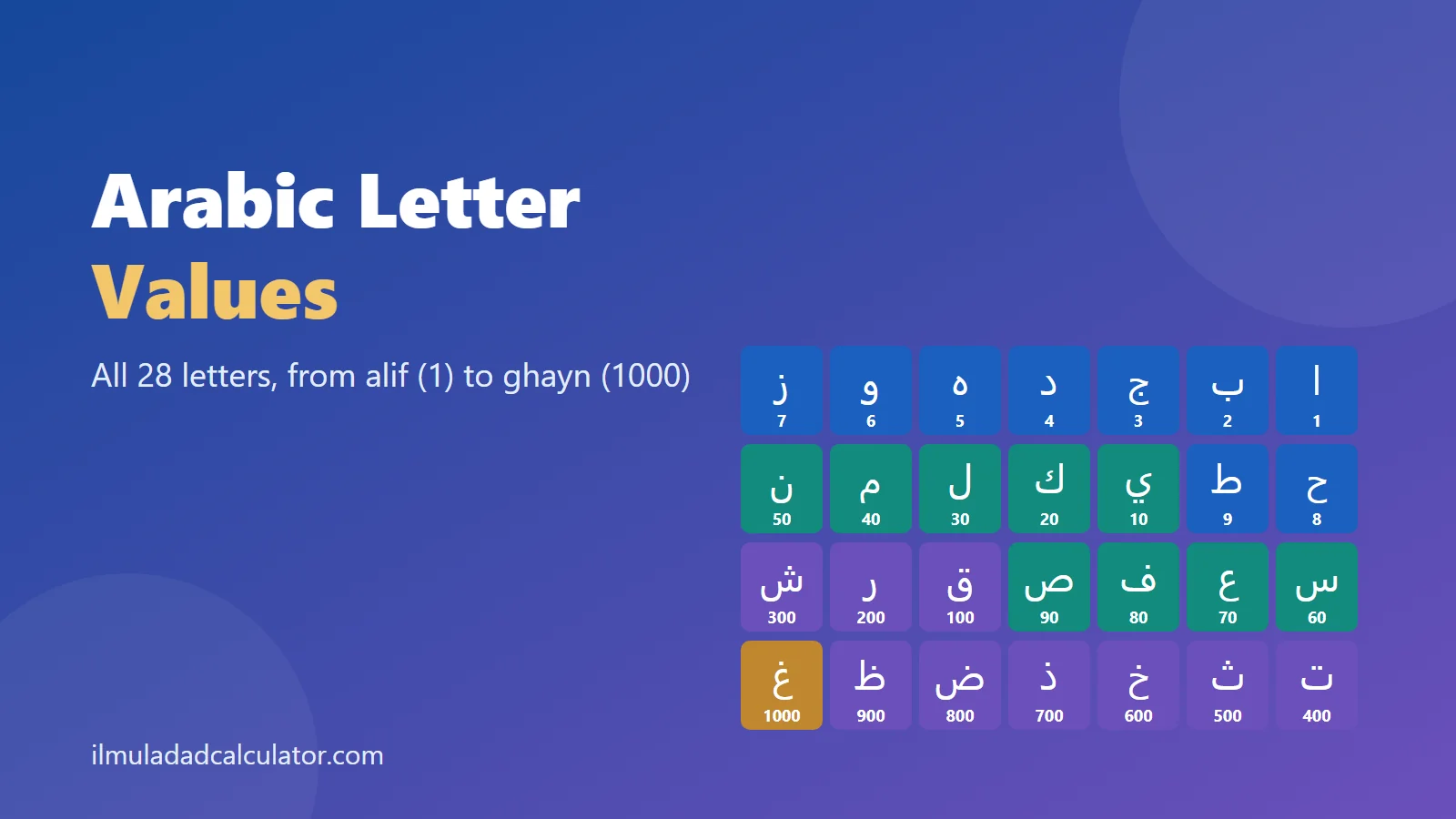
Each of the 28 Arabic letters has a fixed Abjad value, from alif (1) to the last letter (1000). This page shows every letter in the Mashriqi (Eastern) and Maghribi (Western) systems side by side. Twenty-two letters match in both systems, and six differ.
| # | Letter | Name | Group | Mashriqi | Maghribi |
|---|---|---|---|---|---|
| 1 | ا | Alif | أبجد | 1 | 1 |
| 2 | ب | Ba | أبجد | 2 | 2 |
| 3 | ج | Jim | أبجد | 3 | 3 |
| 4 | د | Dal | أبجد | 4 | 4 |
| 5 | ه | Ha | هوز | 5 | 5 |
| 6 | و | Waw | هوز | 6 | 6 |
| 7 | ز | Zay | هوز | 7 | 7 |
| 8 | ح | Ha (Hooti) | حطي | 8 | 8 |
| 9 | ط | Ṭa | حطي | 9 | 9 |
| 10 | ي | Ya | حطي | 10 | 10 |
| 11 | ك | Kaf | كلمن | 20 | 20 |
| 12 | ل | Lam | كلمن | 30 | 30 |
| 13 | م | Mim | كلمن | 40 | 40 |
| 14 | ن | Nun | كلمن | 50 | 50 |
| 15 | س | Sin | سعفص | 60 | 300 |
| 16 | ع | Ayn | سعفص | 70 | 70 |
| 17 | ف | Fa | سعفص | 80 | 80 |
| 18 | ص | Sad | سعفص | 90 | 60 |
| 19 | ق | Qaf | قرشت | 100 | 100 |
| 20 | ر | Ra | قرشت | 200 | 200 |
| 21 | ش | Shin | قرشت | 300 | 1000 |
| 22 | ت | Ta | قرشت | 400 | 400 |
| 23 | ث | Tha | ثخذ | 500 | 500 |
| 24 | خ | Kha | ثخذ | 600 | 600 |
| 25 | ذ | Dhal | ثخذ | 700 | 700 |
| 26 | ض | Dad | ضظغ | 800 | 90 |
| 27 | ظ | Za | ضظغ | 900 | 800 |
| 28 | غ | Ghayn | ضظغ | 1000 | 900 |
Need a value for a whole word? Use the Ilm-ul-Adad Calculator or compare both systems with the Multi-System Comparator.
حروفِ ابجد کی قیمتیں
عربی کے 28 حروف میں سے ہر ایک کی ایک مقررہ ابجد قیمت ہے، الف (1) سے غ (1000) تک۔ اس جدول میں مشرقی اور مغربی دونوں نظام ساتھ ساتھ دیے گئے ہیں۔ چھ حروف کی قیمت دونوں نظاموں میں مختلف ہے۔
How the Values Are Organized
The values follow the old abjad order of the alphabet, not the dictionary order. The pattern has four steps.
- The first nine letters count the units, from 1 to 9.
- The next nine letters count the tens, from 10 to 90.
- The next nine letters count the hundreds, from 100 to 900.
- The last letter, غ, stands for 1000.
Once you know a letter’s place in the order, you know its value. That is why learners memorize the order first.
The Eight Memory Words
Students remember the order with eight short words: أبجد هوز حطي كلمن سعفص قرشت ثخذ ضظغ. In the Mashriqi reading they sound like abjad, hawwaz, hutti, kalaman, sa’fas, qarashat, thakhadh and dazagh.
The words have no meaning of their own. They simply group the letters in counting order.
The Eight Groups at a Glance
| Group | Letters | Mashriqi values | Maghribi values |
|---|---|---|---|
| أبجد | ا ب ج د | 1, 2, 3, 4 | 1, 2, 3, 4 |
| هوز | ه و ز | 5, 6, 7 | 5, 6, 7 |
| حطي | ح ط ي | 8, 9, 10 | 8, 9, 10 |
| كلمن | ك ل م ن | 20, 30, 40, 50 | 20, 30, 40, 50 |
| سعفص | س ع ف ص | 60, 70, 80, 90 | 300, 70, 80, 60 |
| قرشت | ق ر ش ت | 100, 200, 300, 400 | 100, 200, 1000, 400 |
| ثخذ | ث خ ذ | 500, 600, 700 | 500, 600, 700 |
| ضظغ | ض ظ غ | 800, 900, 1000 | 90, 800, 900 |
The groups are not equal in size. Four groups hold four letters, and four hold three.
The values only change between systems in the last four groups. The first four groups are identical everywhere.
Where the Order Comes From
The abjad order follows the order of older Semitic alphabets, such as Aramaic. Hebrew and Greek letter numerals follow a closely related order.
Arabic uses six sounds the older alphabets lacked. Those six letters, ث خ ذ ض ظ غ, come at the end, with the highest values.
Arabic writers used letters as numbers before the eighth century. Positional digits like 1, 2 and 3 became common later.
Letters That Share a Shape Do Not Share a Value
Many Arabic letters differ only by their dots. Their values, however, can be far apart.
- ب 2, ت 400, ث 500
- ج 3, ح 8, خ 600
- د 4, ذ 700
- ص 90, ض 800
- ط 9, ظ 900
- ع 70, غ 1000
This matters when you read a name from print. One missing dot can change a total by hundreds.
Mashriqi and Maghribi: The Six Differences
The Mashriqi system was used across the eastern Islamic world and is the default on this site. The Maghribi system was used in North Africa and al-Andalus.
The two systems differ only for س ص ش ض ظ غ. A word without those letters has the same value in both.
Some early authorities quote the Maghribi order, and some scholars consider it the older one. Compare both at once with the Mashriqi vs Maghribi comparator.
How to Use This Table
- Find each letter of your word in the table.
- Write down its Mashriqi value.
- Add the values together.
- Check your answer with the Ilm-ul-Adad Calculator.
A ta marbuta (ة) counts as ه, which is 5. An alif maqsura (ى) counts as ي, which is 10.
Urdu and Persian Letters
Persian and Urdu add letters that are not part of the 28. Examples are پ چ ژ گ and the Urdu letters ٹ ڈ ڑ. See every one on the Urdu and Persian letter values page.
Each one takes the value of the Arabic letter it is based on. For example, پ counts as ب, which is 2.
Other Reckonings
Older books also mention smaller reckonings, such as Saghir and Wusta. Sources describe them in different ways.
We will add them once each rule is confirmed from a reliable source.
To practice the table, take the Abjad Quiz or print a letter value chart.
Letter Rules
- Abjad hawwaz hutti: the eight memory words behind the letter order.
- Hamza in Ilm-ul-Adad: how seated and standalone hamza are counted.
- Ta marbuta: why the bound ta is usually counted as 5.
- Abjad order vs dictionary order: why Arabic has two letter orders and which one carries values.
- Alif maqsura: why the final ى is counted as 10, with name examples.
- The dagger alif: why the small superscript alif adds nothing to a total.
- Shadda (tashdid): why a doubled letter is counted once, not twice.
- How many letters are in the Urdu alphabet: all 39 letters with names and values.
- The Maghribi letter order: the western order, where it was used, and the six letters that differ.
Sources and Further Reading
- Wikipedia: Abjad numerals (order, mnemonics and Maghribi variant)
- MELA Committee on Cataloging: Alphabetic numeral system (abjad table)
- The Unicode Standard: Arabic block chart
Frequently Asked Questions
Which letter has the value 1000?
In the Mashriqi system, غ (ghayn) is 1000. In the Maghribi system, ش (shin) is 1000.
Does hamza have a value?
A hamza on alif, waw or ya takes the value of that letter. A standalone hamza is not counted by default.
How do I type these letters on my phone?
Add an Arabic or Urdu keyboard in your phone settings. You can also tap the letters on the calculator keypad.
Do today’s Arabic digits come from these letters?
No. Today’s digits came from India. Letter values are an older, separate way of writing numbers.
Do vowel marks have values?
No. Fatha, kasra, damma and the shadda are marks, not letters, so they are not counted.
Can I download this table?
Yes. Use the printable chart page to make a version for A4 or US Letter paper.
Author: Shakeel Muzaffar
Reviewer: Moulana Haji Abdul Basit (Islamic Scholar and Mentor)