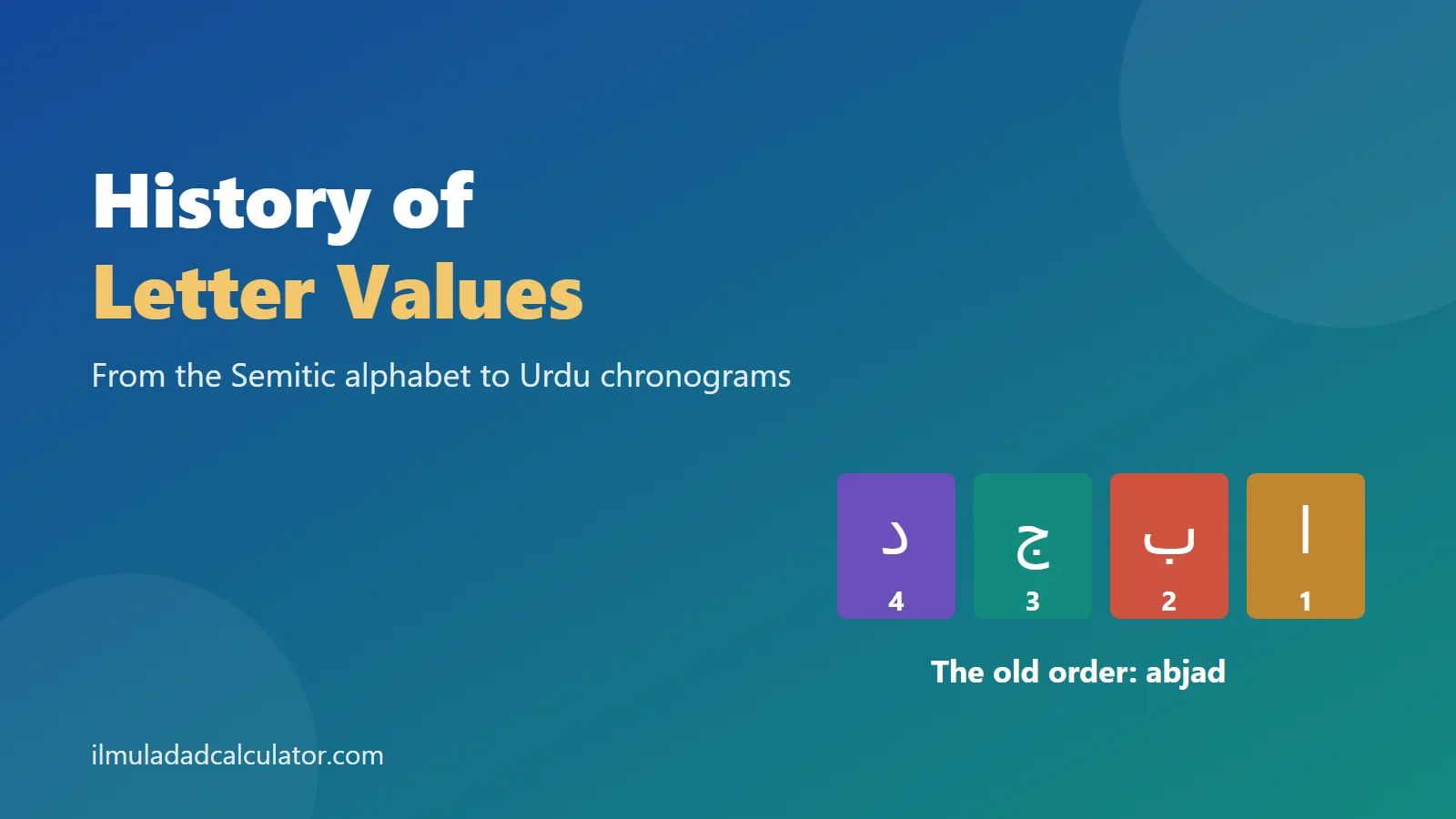
The history of abjad letter values runs for more than three thousand years. It starts with an old Semitic letter order and passes through Greek and Hebrew numerals. It then reaches Arabic, Persian, Ottoman and Urdu writing, where letters counted as numbers long after digits arrived.
What Is the Short Timeline of Letter Values?
The table gives the main steps in order. Each date comes from a source in the list at the end of this page.
| When | What happened | Source |
|---|---|---|
| c. 1400 BCE | Ugaritic alphabet; early listings of the Semitic letter order | Abjad; Iranica |
| c. 1050 BCE | Phoenician alphabet of 22 letters (a conventional date) | Phoenician alphabet |
| 9th century BCE | Greeks adapt the Phoenician script | Abjad |
| By about 350 BCE | Greek alphabetic numerals in use | Greek numerals; Hebrew numerals |
| 200 to 78 BCE | Hebrew numerals adapted from the Greek system | Hebrew numerals |
| 512 CE | Earliest dated Arabic text, the Zabad inscription | Arabic alphabet |
| Before the 8th century | Arabic letters already used as numbers, by one account | Abjad numerals |
| 8th to 10th century | Arabic accounts in Egypt still write numbers in Greek | Caliphal Finances |
| c. 825 | Al-Khwarizmi writes on the Indian numerals | Hindu-Arabic numeral system |
| 8th to 15th century | Over 200 astronomical tables (zij) produced | Zij; Iranica |
| 1076 to 1077 | Mas’ud-e Sa’d names a year with letters as number-words | Iranica, Madda tarik |
| 14th century | Persian poets begin phrase chronograms | Iranica, Madda tarik |
| 1385 | Hafez dates a vizier’s death with a phrase | Iranica, Madda tarik |
| 1605 | Chronogram for the death of Akbar | Iranica, Abjad |
| Into the 20th century | Chronogram poems still printed in Persian journals | Iranica, Madda tarik |
| Today | Letters number lists and front-matter pages | Abjad numerals; Iranica |
Some early dates are uncertain, and the sources say so. Where they hedge, this page hedges too.
Where Does the Abjad Order Come From?
The word abjad is built from the first four letters of the old Semitic alphabet: alif, ba, jim and dal. The same start, A B G D, appears in Phoenician, Aramaic and Hebrew.
Encyclopaedia Iranica calls this sequence remarkably stable. It runs with small changes from the earliest Ugaritic and Phoenician listings to Hebrew and Aramaic.
Those older alphabets had only 22 letters. They stopped at taw, which counts as 400.
How Did the Arabic Script Inherit It?
Arabic script grew out of the Nabataean form of Aramaic writing. The earliest dated Arabic text is the Zabad inscription of 512.
Several Arabic letters came to share one shape and were told apart by dots. So a new order grouped letters by shape, while the old order survived for counting.
How Do Greek and Hebrew Letter Numerals Compare?
Arabic was not the only script to count with its letters. Greek and Hebrew writers did the same, and their systems help explain the abjad.
Greek Numerals
Greek alphabetic numerals used 27 signs in three sets of nine. These covered the ones, the tens and the hundreds.
The system was in limited use from at least 350 BCE, and some finds may push it back further. Greece still uses these letters for ordinal numbers today.
Hebrew Numerals
Hebrew numerals were adapted from the Greek system sometime between 200 and 78 BCE. The later date marks the earliest physical evidence.
Up to 400, the Hebrew values match the Arabic abjad values. Hebrew then builds larger hundreds by combining letters, since it has no more letters to spend.
How Did Arabic Extend the Order to 1000?
Arabic has 28 letters, six more than the old Semitic set. These extra letters continue the count after taw.
ث خ ذ ض ظ غ
They stand for 500, 600, 700, 800, 900 and 1000. Together they form the memory words thakhadh and dazagh, the last two in the series.
Iranica notes that the origin of this order was forgotten in medieval times. Some later authors offered fanciful explanations for it.
What Does Hisab al-Jummal Mean?
Hisab al-jummal (حساب الجمل) is the classical Arabic name for the abjad numeral system. Persian writers call it hesab-e abjad or hesab-e jommal.
Iranica’s entry on chronograms translates it as reckoning by phrases. That fits its most famous later use: adding up whole phrases to find a year.
Which Six Letters Differ in the Maghribi System?
North Africa and Spain kept a slightly different abjad order. Six letters change places, so they take different values.
| Letter | Name | Mashriqi value | Maghribi value |
|---|---|---|---|
| س | sin | 60 | 300 |
| ص | sad | 90 | 60 |
| ش | shin | 300 | 1000 |
| ض | dad | 800 | 90 |
| ظ | za | 900 | 800 |
| غ | ghayn | 1000 | 900 |
Wikipedia notes that the Maghribi sequence is quoted in apparently earliest authorities and is considered older. The Mashriqi order became the common one. The calculation methods page explains both systems in practice.
Were Letter Numbers Used in Government Records?
Not as widely as one might expect. Early Arabic accounts from Egypt wrote their text in Arabic but their numbers in Greek.
Researchers at the University of Edinburgh found this practice lasting into the Abbasid era. One Arabic account dated 901 still uses Greek numerals.
Practice differed by region. Arabic documents from Khurasan spelled numbers out in full words instead. Later clerks used special accounting signs, covered on the numbers in Arabic script page.
How Did Astronomers Use Abjad Numerals?
Astronomers kept letter numerals longer than almost anyone. Their handbooks of tables, called zij, are full of them.
Over 200 different zij were produced by astronomers of the Islamic world from the 8th to the 15th century. Major centers included Baghdad, the Maragheh observatory and Samarkand.
Iranica says letter numerals persisted in these tables until the start of the modern age. Short letter groups fit neatly into narrow table columns.
Why Did Indian Digits Replace the Letters?
By the 9th century, Arabic mathematicians had adopted the Indian place-value digits. Al-Khwarizmi wrote his book on them in about 825.
Digits made long sums and fractions much easier. So, in Iranica’s words, use of the letters “gradually declined” for everyday counting.
The full story of the digits is told on where Arabic numerals come from. This page follows the letters, which found new work as the digits took over.
How Did Persian Poets Turn Letters Into Dates?
Persian poets found the letters’ most lasting role. Over several centuries, they moved from naming numbers to hiding them inside meaningful phrases.
- The poet Kesa’i stated his birth year of 953 in plain number words.
- Mas’ud-e Sa’d, who died in 1121, named a year with single letters standing as numbers. They give 469 AH, or 1076 to 1077.
- Around 1300, poets began choosing phrases whose letters add up to the year. This is the true chronogram.
Hafez, who died in 1392, wrote such a poem for the death of a vizier. The closing phrase میل بهشت, “inclination to paradise,” gives 787 AH, which is 1385.
How Big Did the Genre Grow?
Hafez left eleven chronogram poems. About 150 years later, Mohtasham of Kashan gave 233 of them a section of their own. He died in 1588.
Poets dated deaths, buildings, births, new appointments and safe journeys. Persian journals still printed chronogram poems well into the 20th century.
How Were Chronograms Used in Mughal India and the Ottoman World?
The genre was just as popular at the Mughal court. Iranica gives a clear example from the death of an emperor.
The Death of Akbar
A later poem says that “the death of Akbar Shah” itself became the date. The first three words give the year:
ف 80 + و 6 + ت 400 + ا 1 + ک 20 + ب 2 + ر 200 + ش 300 + ه 5 = 1014
The total is 1014 AH, or 1605. Iranica points out that shah must be written short, without alif. With alif it would give 1015.
Spelling matters: one letter more or less changes the year. Always copy a chronogram exactly as the source writes it.
Ottoman and Urdu Chronograms
In the Ottoman period, Arabic chronograms were common on tombstones and foundation plaques. Iranica links this to steady demand for such inscriptions.
Urdu poets carried the art into modern times, where it is called tarikh goi. The chronograms section covers the Urdu tradition and its famous examples.
Where Are Abjad Letters Used Today?
The letters still number things in Arabic writing. Lists and outlines often run أ, ب, ج, د, in abjad order rather than alphabet order.
Many books also number their introduction pages with abjad letters. Iranica compares this to the Roman numerals used in Western front matter.
- Lists and outlines: items marked أ, ب, ج, like A, B, C in English.
- Front matter: introduction pages numbered with letters before the main digits begin.
- Chronograms: dated verses and inscriptions that readers can still decode.
Hebrew and Greek show the same pattern. Both still use letters for lists, much as Arabic does.
Why Did Letter Values Last So Long?
Digits won for arithmetic, yet letters never fully disappeared. Each surviving use had a practical or artistic reason.
- Habit and training: astronomical tables were long written in letters, and copyists kept the old format.
- Memory: a phrase is easier to remember than a bare number, which suited dates of deaths and buildings.
- Beauty: a chronogram joins meaning and number in one line, so poets prized it as a test of skill.
- Order: the letters give a fixed sequence for lists without clashing with the digits in the text.
These reasons explain the pattern in the timeline. Letters left everyday sums early but stayed wherever memory, tradition or art mattered.
How Should You Read an Old Letter Number?
First, check which system the writer used. A North African text may follow the Maghribi values, while Persian and Urdu texts use the Mashriqi ones.
Next, copy the letters exactly and add them from right to left. Then convert the Hijri total to the Common Era before comparing dates.
Where Should You Go Next?
- Arabic letter values: the full table of all 28 values.
- Calculation methods: Mashriqi, Maghribi and other ways of counting.
- Numbers in Arabic script: letters, digits and accounting ciphers side by side.
- Chronogram decoder: check any of the dated phrases on this page yourself.
خلاصہ
ابجد کی ترتیب پرانے سامی حروفِ تہجی سے آئی ہے، اور یونانی و عبرانی میں بھی حروف کو اعداد کے طور پر لکھا جاتا تھا۔ عربی نے چھ نئے حروف جوڑ کر گنتی ہزار تک پہنچائی۔ ہندی ہندسوں کے آنے کے بعد حروف کا عام استعمال کم ہو گیا، مگر زیج کی جدولوں، فارسی، مغل اور اردو تاریخ گوئی میں یہ باقی رہے۔ آج بھی عربی فہرستوں اور کتابوں کے دیباچے کے صفحات پر ابجد حروف نظر آتے ہیں۔
Sources and Further Reading
- Abjad, Encyclopaedia Iranica, by Georg Krotkoff (1982). The stable Semitic order, zij tables, front-matter numbering and the Akbar chronogram.
- Madda Tarik (chronogram), Encyclopaedia Iranica, by Paul E. Losensky (2006). Persian stages, Hafez, Mohtasham and Ottoman inscriptions.
- Abjad numerals, Wikipedia. Hisab al-jummal, the 22-letter Semitic set, the Maghribi order and modern list numbering.
- Abjad and Phoenician alphabet, Wikipedia. Ugaritic and Phoenician dates and the Greek adaptation.
- Greek numerals and Hebrew numerals, Wikipedia.
- Arabic alphabet, Wikipedia. The Nabataean origin and the Zabad inscription of 512.
- Accounting practices in the multilingual administration of the Abbasid era, Caliphal Finances project, University of Edinburgh (2025).
- Zij and Hindu-Arabic numeral system, Wikipedia.
- Abjad values come from this site’s tested engine. See the methodology and our sources page.
Frequently Asked Questions
How old is the abjad letter order?
The order goes back to the Semitic alphabets of the second millennium BCE. Ugaritic and Phoenician listings already show it.
Is the abjad copied from Greek numerals?
Not directly. Greek, Hebrew and Arabic all draw on the same Semitic order. Hebrew numerals were adapted from the Greek system.
What is the difference between abjad and hisab al-jummal?
Abjad names the letter order. Hisab al-jummal names the counting system that uses it.
Why do Arabic lists start with أ ب ج د?
They follow the old abjad order, the same order used for counting. The everyday alphabet order is never used for numbers.
When did people stop using letters as numbers?
There was no single date. Use declined gradually after Indian digits spread, but survived in tables, chronograms and lists.