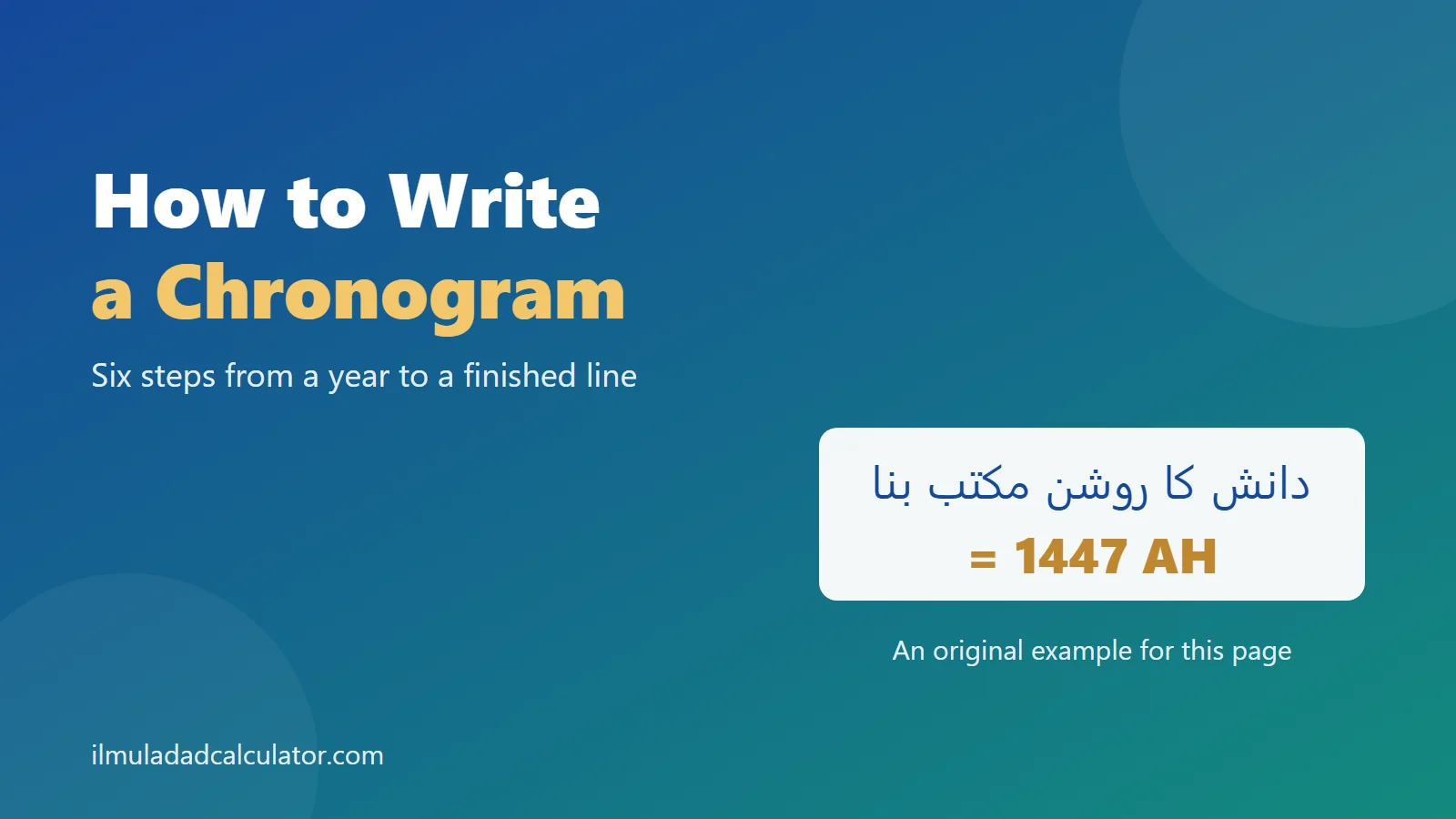
To write a chronogram, you start with a year and end with a phrase whose letters add up to it. The work is a mix of word choice and simple addition. This guide walks through each step with one worked example.
What Do You Need Before You Start?
You need three things: the year, the letter values, and a clear idea of what the line should say. Most Urdu and Persian chronograms use the Mashriqi values, where alif is 1 and ghayn is 1000.
If you are new to the values, read how to calculate by hand first. The craft is explained in what a chronogram is, and its Urdu tradition in tarikh goi.
How Do You Write a Chronogram Step by Step?
Here are the six steps in order. The sections below show each one at work on a single line.
- Pick the year and the calendar.
- Decide the target total.
- Draft a phrase that carries the meaning.
- Add the letter values.
- Adjust words or spelling until the total matches.
- Polish the line for rhythm and sense.
Note: the example in this guide is an original line written for this page. It is an illustration, not a historical chronogram, and no real event is attached to it.
Step 1: Which Year and Calendar Should You Use?
Choose the year of the event, and choose the calendar. Urdu and Persian chronograms are usually written in Hijri years.
Our example imagines a new school opening in 1447 AH. That year ran from about June 2025 to June 2026 in the Common Era.
If you have a Common Era year, convert it before you begin. The chronogram decoder shows the Hijri and Common Era years side by side.
Step 2: How Do You Set the Target Total?
The target is the number your phrase must reach. For a plain chronogram it is the whole year, here 1447.
Fix three rules before you add anything. These choices change the total, so write them down.
- The system: Mashriqi values, as the Urdu tradition expects.
- The spelling: count each letter as written, with Urdu letters taking the value of their base letter.
- The scope: every word of the phrase counts, and the cue words before it do not.
Hamza and a few other marks are treated differently by different writers. See hamza in Ilm-ul-Adad and why values differ before you rely on one.
Step 3: How Do You Draft the Phrase?
Write the meaning first and ignore the numbers. Ask what the line should say about the event: who, what, and in what mood.
For our school, the idea is that a bright place of learning opened. A few Urdu words come to mind at once:
- دانش for wisdom or knowledge
- روشن for bright or lit
- مکتب for a school
- کھلا for opened
These make a natural first draft: دانش کا روشن مکتب کھلا. It reads as “the bright school of wisdom opened.”
Step 4: How Do You Add Up the Letters?
Take the draft one word at a time and add each letter. Do the sum slowly, because one missed letter ruins the total.
The table shows the final line. Each word is split into its letters, with the value of every letter beside it.
| # | Word | Letters and total |
|---|---|---|
| 1 | دانش | د 4 + ا 1 + ن 50 + ش 300 = 355 |
| 2 | کا | ک 20 + ا 1 = 21 |
| 3 | روشن | ر 200 + و 6 + ش 300 + ن 50 = 556 |
| 4 | مکتب | م 40 + ک 20 + ت 400 + ب 2 = 462 |
| 5 | بنا | ب 2 + ن 50 + ا 1 = 53 |
The five words give 355 + 21 + 556 + 462 + 53, which is 1447.
You can skip the hand work by pasting the line into the phrase value calculator. It shows every letter and every word total.
Step 5: How Do You Adjust the Phrase to Hit the Number?
The first draft almost never lands exactly. Ours ended in کھلا, and its total was 1450, which is 3 too high.
The fix was one word. بنا means “came into being,” it fits the sense, and it is worth 3 less than کھلا.
What Can You Change?
Poets kept a small toolbox. Each tool moves the total by a known amount, so you can aim.
| Tool | Example | Change |
|---|---|---|
| Swap a synonym | کھلا (56) becomes بنا (53) | 3 lower |
| Change the word | مکتب (462) becomes مدرسہ (309) | 153 lower |
| Change the spelling | روشن (556) becomes روشنی (566) | 10 higher |
| Add a small word | ہے is 15, بھی is 17 | small steps |
What If No Swap Works?
Some years resist every synonym. Then poets added or subtracted a word and said so in the verse. Add and subtract devices covers this in full.
Use these only when you must. A line that reaches the year with plain words reads better and is easier to check.
Step 6: How Do You Check and Polish the Line?
Check the total again with the engine, not by memory. Paste the line into the chronogram decoder and confirm that it returns 1447.
Then read it aloud as a poem. The numbers are only half of the craft.
- Meaning: does the line say something true and clear about the event?
- Rhythm: our line is short and falls easily from the tongue.
- Grammar: check gender and agreement, as in روشن مکتب.
- Spelling: keep the exact spelling you counted, because a changed letter changes the year.
If you change any word during polishing, go back to step 4 and add the line again. Ask a friend who reads Urdu to read the line cold, without telling them the year. If they stumble, the line needs more work, even when the total is perfect.
How Do You Choose Words With Useful Values?
Experienced writers think of words as building blocks of different sizes. Heavy letters such as ش (300), ت (400) and غ (1000) add bulk quickly. Light letters such as ا (1) and ب (2) fine-tune the result.
Start with the content words that carry the meaning, then fill the gap with small words. Urdu helps here, because short particles can be placed in many spots.
| Word | Letters and total |
|---|---|
| ہے | ہ 5 + ے 10 = 15 |
| کا | ک 20 + ا 1 = 21 |
| کی | ک 20 + ی 10 = 30 |
| نے | ن 50 + ے 10 = 60 |
| کو | ک 20 + و 6 = 26 |
| سے | س 60 + ے 10 = 70 |
| میں | م 40 + ی 10 + ں 50 = 100 |
| ہی | ہ 5 + ی 10 = 15 |
| بھی | ب 2 + ھ 5 + ی 10 = 17 |
| اب | ا 1 + ب 2 = 3 |
Keep such words natural. A particle that sits oddly in the sentence only shows that the line was forced.
Should the Line Be a Single Phrase or a Whole Poem?
Both exist. A short phrase can stand alone on a plaque, a gate or a book cover. A longer poem, called a qita, usually saves the dated phrase for its last line.
If you write a poem, the other lines are free of the arithmetic. Only the dated words, often after a cue such as “the unseen voice said,” must reach the total.
How Can You Practice?
Take our example and change the year to 1448. The gap is 1, a single point. A one-letter change in the right word may close it.
Then pick a year that matters to you, such as the year you were born, and repeat the six steps. Check each attempt with the decoder, and compare words with the phrase value calculator.
How Do You Keep Track of Your Drafts?
A simple worksheet saves time and avoids repeated sums. Write each attempt on its own row, and note what you changed.
- Draft: the full phrase, exactly as spelled.
- Total: the sum from the engine.
- Gap: the target minus the total, positive or negative.
- Next move: the word or letter you will try next.
After a few rows, the gap shrinks and a pattern appears. You also build a private list of words that fit your event.
Can You Write One for an Occasion Other Than an Opening?
Yes. The six steps are the same for a birth, a book, a building or a wedding. Only the mood of the words changes.
A line for a loss needs special care, because the wording should be gentle and plain. The page on death date chronograms discusses that tradition factually.
Do the Same Steps Work in Latin?
The idea is the same, but the numbers come from Roman numeral letters instead of the abjad. You choose the year and write a sentence. Its capital letters I, V, X, L, C, D and M must add up to that year.
The method of drafting, adding and adjusting carries over. The details are on the page about Latin chronograms.
What Makes a Chronogram Good?
A good chronogram works on two levels. A reader who ignores the numbers still finds a clear, graceful line. A reader who adds the letters finds the year waiting.
The best examples feel effortless, and that is the hard part. It usually takes many drafts, and most of them are thrown away. Do not be discouraged if your first line is clumsy.
Plain words also last longer. Rare words may fit the number, but the reader then needs a dictionary before the arithmetic can even begin.
How Is Writing Different From Reading?
A reader starts with a line and recovers a year. A writer starts with a year and has to invent the line. That reversal makes writing slower and more playful.
If you want the reading side, see how to read a chronogram. For real lines by poets, look at the famous chronograms and the Urdu chronograms.
What Mistakes Should Beginners Avoid?
- Choosing numbers over meaning. A line that fits the total but says nothing will not please a reader.
- Mixing systems. Add every letter with the same table.
- Forgetting the calendar. A Hijri total and a Common Era year are different numbers.
- Counting the cue. Words such as “the date is” stand outside the sum.
- Trusting a hand total. Confirm the final line with a tool.
خلاصہ
تاریخ لکھنے کے لیے پہلے سال اور کیلنڈر چنیں، پھر کل عدد طے کریں۔ اس کے بعد واقعے کے مطلب کے مطابق جملہ بنائیں اور حروف کی ابجد قیمتیں جمع کریں۔ اگر جمع غلط نکلے تو کسی لفظ کو ہم معنی لفظ سے بدلیں، آخر میں انجن سے جانچیں اور مصرع کو رواں بنائیں۔ اس صفحے کی مثال (۱۴۴۷ ہجری) اسی صفحے کے لیے لکھی گئی ہے، تاریخی نہیں۔
Sources and Further Reading
- Tarikh Nigari: Numbers Speaking Through Words, Rekhta blog (2020). How a chronogram is composed, including adding and subtracting.
- Chronogram, Wikipedia. Pure and natural chronograms and abjad examples.
- The example line دانش کا روشن مکتب بنا is original to this page. Its total was computed with this site’s engine; see the methodology and sources pages.
Frequently Asked Questions
How do I write a chronogram in simple steps?
Pick the year and set the target total. Draft a phrase, add the letter values, and adjust words until the total matches. Then polish.
Do I need to know Arabic or Urdu to write one?
You need the letters and their values, and a feel for words in the language you write in. A phrase calculator does the addition.
What if my phrase is a few points off the year?
Swap a word for a synonym, change the word, or adjust the spelling. Small word changes move the total by small, known amounts.
Which values should I use for Urdu?
Use the Mashriqi values and count each Urdu letter as its base Arabic letter. Write down your rules before you add.
Can I check my chronogram online?
Yes. Paste the line into the chronogram decoder or the phrase value calculator and compare the total with your year.