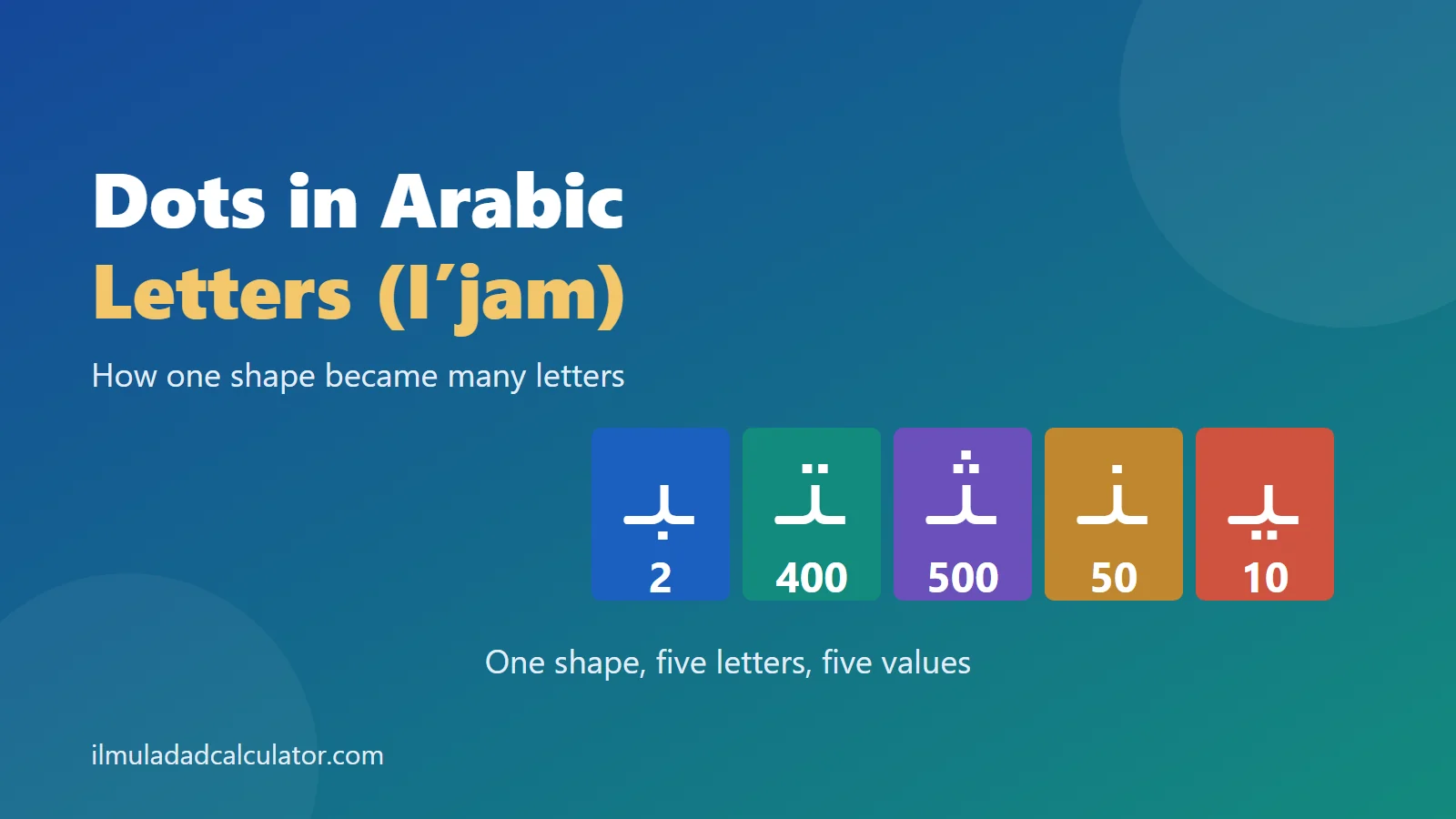
Many Arabic letters share one basic shape and are told apart by dots. These dots are called i’jam (إعجام), and they were added in the early centuries of the script. This guide gives a sourced timeline, says what is still uncertain, and shows how the dots affect Abjad values.
What Is I’jam in Arabic Writing?
I’jam means the dots that separate letters with the same backbone. The backbone is called rasm. Wikipedia says it is sometimes also called nuqat, which means points.
Tashkil is a different set of marks. It covers short vowel signs such as fatha, damma and kasra, plus signs such as shadda and sukun.
Key difference: i’jam is part of the letter itself. Tashkil is an optional guide added on top.
Modern Arabic is always written with i’jam. Full tashkil appears mostly in religious texts, children’s books and learner materials, according to Wikipedia’s Arabic diacritics article. Omniglot says much the same.
Why Did Arabic Need Dots?
Britannica says the Arabic alphabet probably developed in the 4th century CE as a direct descendant of Nabataean. Omniglot adds that Aramaic had fewer consonants than Arabic. New Arabic letters were made by adding dots to existing ones.
The result is a script where several letters share a shape. Wikipedia’s History of the Arabic alphabet counts 28 letters built on 18 backbone shapes. In our grouping, 8 shapes are shared by 18 letters, and the other 10 letters stand alone.
Count the dots on the standard letter shapes and you get 15 dotted letters and 13 undotted ones. Together the dotted letters carry 22 dots. Without them, a page of Arabic would look like many repeated shapes.
When Did Dots Appear? A Timeline
The timeline below mixes firm dates with traditional accounts. Wikipedia’s articles and Omniglot agree on the broad picture, but they differ on details. Treat every date here as approximate unless it is tied to a dated document.
What Does the Earliest Evidence Show?
- Early inscriptions mostly use no dots. Wikipedia lists a few with some dotting, including Jabal Ramm in Jordan from about the late 4th century.
- The Zabad inscription from 512 is the earliest dated Arabic text, per Wikipedia and Omniglot. It is written in Greek, Syriac and Arabic.
- Papyrus PERF 558 is a tax receipt from Egypt, kept in the Austrian National Library. It is dated April 643 CE, which is year 22 of the Hijri era.
Wikipedia calls PERF 558 the first well-attested use of disambiguating dots. It adds that dots did not become required until much later. Educated readers could often work out a word from context.
What Is Still Uncertain?
- Who added the dots. Wikipedia’s History page flags the question as unanswered.
- Who commissioned the red vowel dots. One Wikipedia article credits Abu al-Aswad al-Du’ali. Another says the governor al-Hajjaj ibn Yusuf commissioned them, citing traditional accounts.
- When the final shapes settled. Wikipedia says al-Farahidi’s system, finished around 786, is the basis of today’s marks. It also says the modern system was in universal use by the early 11th century.
- The exact century of the vowel marks. Wikipedia’s History page says “last half of the 6th century”, which looks like a slip. Its Arabic alphabet page says the latter half of the 7th century.
How Did Vowel Marks Develop?
The first vowel system used red dots. A dot above stood for a, a dot below for i, and a dot beside the letter for u. Two dots marked tanwin, the nasal ending.
Using two ink colors was slow. The consonant dots, which had been short strokes by then, could also be confused with the vowel dots. Al-Farahidi replaced the red dots with small letters written above or below the line.
He used small alif, ya and waw for the vowels, and a small sin for doubling. His system is essentially the one we use today. The Unicode chart lists the modern marks as combining characters.
| Mark on ba | Name | Unicode | Role |
|---|---|---|---|
| بَ | fatha | U+064E ARABIC FATHA | short a |
| بُ | damma | U+064F ARABIC DAMMA | short u |
| بِ | kasra | U+0650 ARABIC KASRA | short i |
| بّ | shadda | U+0651 ARABIC SHADDA | doubled consonant |
| بْ | sukun | U+0652 ARABIC SUKUN | no vowel after the letter |
How Do the Three Layers Fit Together?
- Rasm is the bare backbone of each word.
- I’jam adds dots so each backbone points to one letter.
- Tashkil adds vowels and doubling where a reader needs them.
This layering explains why the shapes on the Arabic letter forms page look alike before dots.
What Were the Marks for Letters Without Dots?
When dots were optional, an undotted letter was easy to misread. Scribes sometimes added a sign to show the letter was truly undotted. Wikipedia lists a small v, a small crescent and a tiny copy of the letter below the line.
These signs are collectively called alamat al-ihmal. They are still used occasionally in calligraphy, often as decoration. The small kaf above ك began as one of these signs and became part of the letter.
How Do Dots Change Abjad Values?
Abjad values belong to letters, and dots decide which letter you have. So dots matter a great deal.
Five letters share one toothed shape at the start of a word. Their values are ب 2, ت 400, ث 500, ن 50 and ي 10.
| Dots | Letters | Count | Values |
|---|---|---|---|
| One dot below | ب ج | 2 | 2, 3 |
| One dot above | خ ذ ز ض ظ غ ف ن | 8 | 600, 700, 7, 800, 900, 1000, 80, 50 |
| Two dots above | ت ق | 2 | 400, 100 |
| Two dots below | ي | 1 | 10 |
| Three dots above | ث ش | 2 | 500, 300 |
| No dots | ا ح د ر س ص ط ع ك ل م ه و | 13 | 1, 8, 4, 200, 60, 90, 9, 70, 20, 30, 40, 5, 6 |
Take the word بنت, meaning daughter or girl. Its three letters would be identical teeth without dots:
ب 2 + ن 50 + ت 400 = 452
Tashkil is different. It never changes a value in this site’s engine. The three consonants كتب give 422, and adding vowel marks leaves the total unchanged.
Wikipedia uses these same consonants as its example of ambiguity. The bare spelling could be read as kataba, kutiba or kutub. The marks settle the reading, and the Abjad value stays put.
You can test any spelling on the Abjad value calculator.
Which Six Letters Were Added Last in the Abjad Order?
Wikipedia says new dotted letters were sometimes placed after their undotted partners. Sometimes they went at the end of the list. In the numerical order, they went at the end, which is why the last six Abjad letters are ثخذضظغ.
- ث has 3 dots and the value 500.
- خ has 1 dot and the value 600.
- ذ has 1 dot and the value 700.
- ض has 1 dot and the value 800.
- ظ has 1 dot and the value 900.
- غ has 1 dot and the value 1000.
All six are dotted, and they take the values 500 to 1000. The first 22 letters keep the older Semitic sequence. For the full comparison of orders, see Abjad order versus hijai order.
Wikipedia adds a related rule. New signs took the order value of the letter they replaced, so ta marbuta took the value of ordinary ta. The many diacritics carry no value of their own.
For hamza in Ilm-ul-Adad, see the hamza guide.
How Did Persian and Urdu Add More Dots?
When the script spread to new languages, writers invented extra letters. Wikipedia says the change was usually three dots above, as in ژ, or below, as in چ and پ. The Unicode chart names them jeh, tcheh and peh.
On this site, a letter that Arabic lacks takes the value of its base letter. So پ counts as ب (2), چ as ج (3) and ژ as ز (7). More detail is on the Urdu and Persian letters page.
Do All Modern Texts Handle Dots the Same Way?
No. Wikipedia notes that Egyptian writers usually leave the two dots off final ya, so it looks like alif maqsura.
Persian has a similar merger, which Unicode calls Farsi Yeh. The Unicode chart says Farsi Yeh keeps two dots below in its initial and medial forms.
Unicode also lists regional shapes. It gives fa with its dot moved below and qaf with one dot above as Maghrib Arabic forms. It also keeps archaic dotless beh, dotless qaf and dotless feh, which show the old undotted script.
Always check which spelling convention a text uses before you count letters.
For letter order, see the Arabic alphabet in order. For the wider guide, start at the Arabic script overview.
How Can You Count a Word That Has Dots?
Dots are easy to miss in print, and a missing dot gives a different letter. A short routine helps.
- Write the word and check each backbone shape.
- Count the dots on each shape and note whether they sit above or below.
- Match each shape to a letter using the table above.
- Add the Abjad values and ignore any vowel marks.
Typed text avoids most problems, because the computer stores the letter, not the shape. If you copy a word from a scanned page, check it against the original. The calculator on the home page reads typed letters directly.
خلاصہ
عربی کے کئی حروف کی بنیادی شکل ایک جیسی ہوتی ہے اور انہیں نقطوں سے الگ کیا جاتا ہے۔ ان نقطوں کو اعجام کہتے ہیں۔ زبر، زیر اور پیش جیسی علامات تشکیل کہلاتی ہیں اور یہ الگ چیز ہیں۔ ابتدائی عبارتوں میں نقطے بہت کم ملتے ہیں، اور سن 643 کا ایک پیپرس نقطوں کے استعمال کی پہلی پکی مثال مانا جاتا ہے۔ بہت سی تفصیلات پر ماخذ ایک دوسرے سے مختلف ہیں۔ ابجد میں نقطے حرف بدل دیتے ہیں، اس لیے قیمت بھی بدل جاتی ہے، مگر زبر زیر پیش سے قیمت نہیں بدلتی۔
Sources and Further Reading
- Arabic alphabet, Encyclopaedia Britannica. Descent from Nabataean, the 512 inscription and the 8th-century diacritical marks.
- Arabic alphabet, Omniglot. Aramaic had fewer consonants, and dots were added in the 7th century.
- Arabic, U+0600 to U+06FF, The Unicode Standard code chart. Mark names, archaic dotless letters, Persian and Maghrib letters.
- Arabic diacritics, Wikipedia. I’jam versus tashkil, the red-dot system, al-Farahidi’s system and the marks for undotted letters.
- History of the Arabic alphabet, Wikipedia. Eighteen backbone shapes, the dots table and the Abjad order.
- PERF 558, Wikipedia. The April 643 papyrus.
- Abu al-Aswad al-Du’ali, Wikipedia. The traditional attribution and al-Hajjaj’s request for a simpler system.
- Abjad values and character names come from this site’s tested engine and Python’s Unicode database. See the methodology.
Frequently Asked Questions
What does i’jam mean?
I’jam means the dots that separate Arabic letters sharing one basic shape. It is part of the letter itself.
What is the difference between i’jam and tashkil?
I’jam is the letter dots. Tashkil is the optional set of vowel and doubling marks, such as fatha and shadda.
When were dots first used in Arabic?
Some early inscriptions show a few dots. A papyrus dated April 643 CE is the first surviving document that clearly uses them.
Do vowel marks change the Abjad value?
No. Only the letters count. Adding fatha, damma, kasra or shadda leaves the value the same.
Why are the last six Abjad letters all dotted?
They were added after the older letter sequence. Their values run from 500 to 1000.