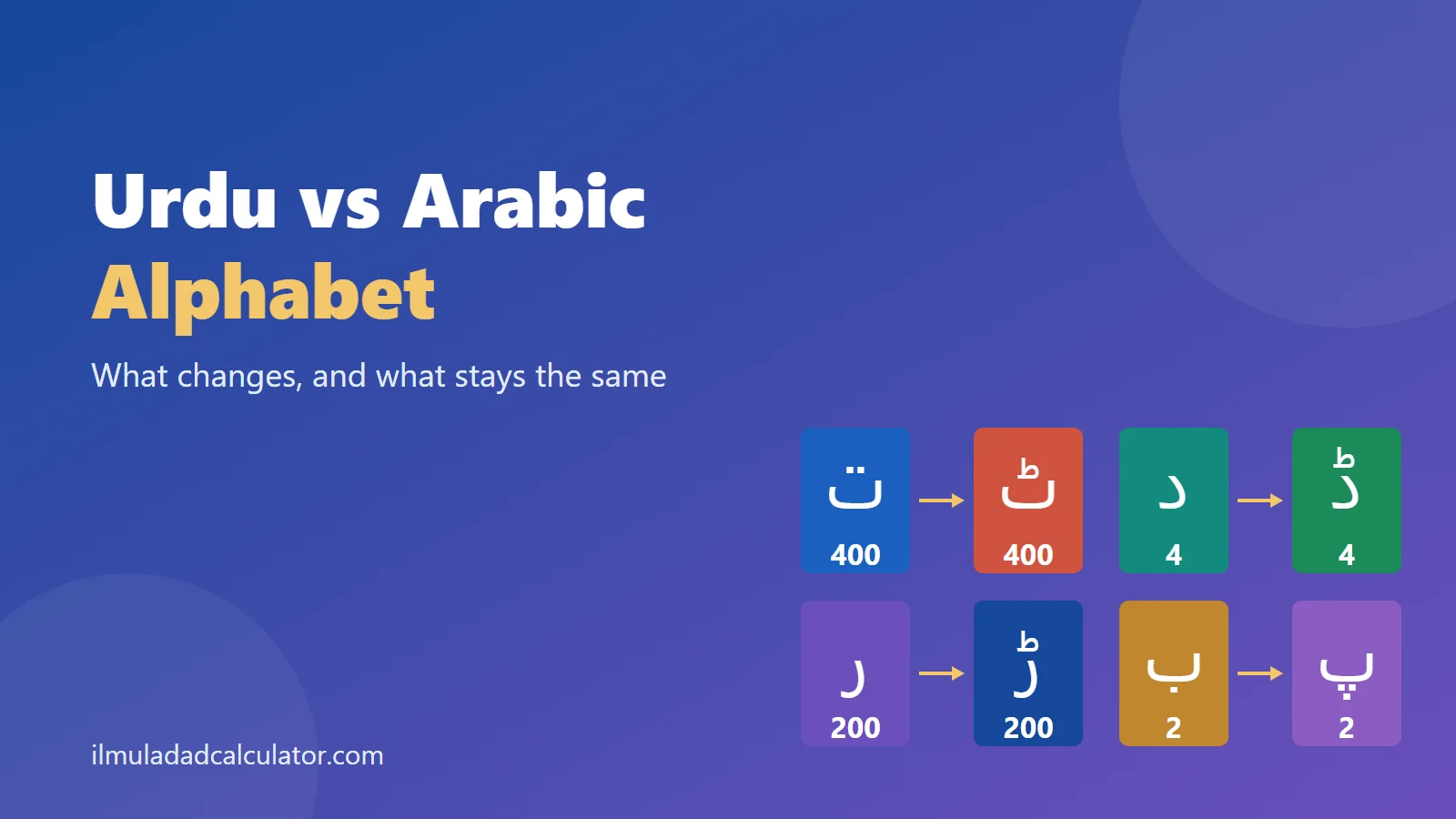
Arabic has 28 letters, and Urdu is usually counted at 39.
Urdu keeps the Arabic letters and adds ten more. It also changes a few shapes and usually uses a different style of writing. This guide shows exactly what differs, and what does not.
What Is the Main Difference Between the Urdu and Arabic Alphabets?
The Arabic alphabet has 28 letters, all of them consonants. Urdu is written in an alphabet derived from both the Arabic and Persian alphabets.
So the Urdu set is a larger version of the Arabic set. It holds all 28 Arabic letters, four letters from Persian and six made for Urdu itself.
Both alphabets run from right to left and join most letters in a flowing line. The differences lie in extra letters, a few changed shapes, some sounds and the usual style of writing.
The Urdu total is less firm than the Arabic one. Wikipedia says the Urdu alphabet has up to 39 or 40 letters, depending on which signs a list counts. Arabic lists agree on 28.
Which Letters Does Urdu Add to the Arabic Set?
Urdu adds ten letters in two steps. Persian came first, and Urdu followed.
Added in Persian
Persian added پ, چ, ژ and گ for the sounds p, ch, zh and g. Arabic has no plain letters for them. Urdu kept all four.
Added for Urdu
Urdu added six more. Three are retroflex letters, ٹ, ڈ and ڑ, made with the tongue curled back.
The other three are nun ghunna (ں), do-chashmi he (ھ) and bari ye (ے). The table lists all ten with a sound hint and the Abjad value.
| Letter | Name | Sound hint | Abjad value |
|---|---|---|---|
| پ | pe | p as in “pen” | 2 |
| چ | che | ch as in “chair” | 3 |
| ژ | zhe | s as in “television” | 7 |
| گ | gaf | g as in “go” | 20 |
| ٹ | tte | retroflex t, tongue curled back | 400 |
| ڈ | ddal | retroflex d, tongue curled back | 4 |
| ڑ | rre | retroflex flap | 200 |
| ں | nun ghunna | nasal sound on the vowel before it | 50 |
| ھ | do-chashmi he | adds a puff of air to a consonant | 5 |
| ے | bari ye | long e sound at the end of a word | 10 |
Hamza (ء) is not new, since Arabic has it too. Lists that count Urdu at 39 include it as a separate sign.
The full numbered list is on the page about how many letters are in the Urdu alphabet. The Urdu alphabet in order page gives names and sound hints for all 39.
Do Some Arabic Letters Look Different in Urdu?
Yes. Three Arabic letters have a different usual shape in Urdu. These are kaf, he and ye, and the change is one of form, not of sound.
- Kaf: Arabic ك becomes ک. This is the Persian variant of kaf.
- He: Arabic ه becomes ہ, called gol he or chhoti he in Urdu.
- Ye: Arabic ي becomes ی, which is dotless at the end of a word.
Each pair uses two different Unicode characters, so a computer treats them as different letters. A search for one shape will not find the other.
| Letter | Arabic form | Urdu form | Abjad value |
|---|---|---|---|
| kaf | ك U+0643 | ک U+06A9 | 20 |
| he | ه U+0647 | ہ U+06C1 | 5 |
| ye | ي U+064A | ی U+06CC | 10 |
Why it matters: a name copied from an Arabic website may use ي where an Urdu keyboard types ی. The Abjad value is the same, but the text will not match in a search.
Which Arabic Sounds Does Urdu Treat Differently?
Arabic has four emphatic consonants, ص, ض, ط and ظ. Arabic also has two throat sounds, ح and ع.
Urdu keeps these letters for words borrowed from Arabic, but its speakers sound several of them like simpler letters. A Texas university course notes that ط sounds like ت and ص sounds like s. It says ض and ظ both sound like z.
Two more Arabic signs fade in Urdu. Hamza is silent except in one grammar use, and ع is silent at the start and end of a word.
Ta marbuta (ة) is rarely used in Urdu, except in some Arabic loanwords. Urdu usually writes gol he in its place.
The Abjad values still follow the spelling and not the sound. For example, ط is 9 while ت is 400, even though Urdu speakers say them alike. The page on Urdu letters that sound alike covers this in more detail.
Why Do Urdu and Arabic Look So Different on the Page?
The usual style differs. Arabic is more commonly written in the Naskh style, while Urdu is typically written in Nastaliq.
In Naskh, the letters sit on a horizontal line. In Nastaliq, each word tends to cascade down from the upper right to the lower left.
The letters themselves are the same ones. A Nastaliq word and a Naskh word can spell the same thing with the same Abjad value.
Nastaliq gives many letters extra forms. A letter’s shape also depends on the letter that follows it. The sibling page on Nastaliq versus Naskh looks at the two styles in more detail.
Which Arabic Letters Do Urdu Words Still Use?
Urdu borrowed thousands of words from Arabic and kept their spellings. That is why Urdu still has ث, ح, ذ, ص, ض, ط, ظ, ع and غ.
The Texas course says these letters appear mainly in words borrowed from Arabic. A good example is علم, meaning knowledge, which Urdu spells exactly as Arabic does:
ع 70 + ل 30 + م 40 = 140
So the Arabic letter set is not left behind in Urdu. It is the foundation, and the added letters sit on top of it.
Why Did Urdu Need More Letters Than Arabic?
Urdu has sounds that Arabic does not. Retroflex stops are made with the tongue curled back, and aspirated stops carry an extra puff of air.
Arabic has no plain letters for these sounds, so Urdu writers built them from existing letters. A small sign over ت, د or ر marks a retroflex sound.
Aspiration uses do-chashmi he after a consonant, so ب becomes بھ. The University of Texas course describes this letter as an aspirate that combines with other letters.
This design keeps the alphabet small. Each new sound is a small change to a letter the reader already knows.
What Stays the Same in Both Alphabets?
A lot stays the same. Both alphabets are written from right to left, and both join most letters into a connected line.
- Joining: a letter changes shape depending on where it sits in a word. Both alphabets use this idea.
- No capital letters: neither has upper and lower case.
- Non-joiners: alif, dal, zal, re, ze and wao do not join the next letter in either language. The added letters ڈ, ڑ and ژ follow the same rule as their base letters.
- Dots: both rely on dots to tell look-alike letters apart, such as ب, ت and ث.
- Missing short vowels: both are usually written without short vowel marks. Learners meet the marks mainly in textbooks.
The page on letters that do not connect explains the rule in full.
Is the Order of the Letters the Same?
No. Urdu learners study the alphabet in a shape-based order that begins ا ب پ ت ٹ ث. The Arabic order places its own 28 letters in a similar shape-based line.
Both differ from the old abjad order used for numbers, which begins ا ب ج د. Ilm-ul-Adad uses that older order, as explained on the page about abjad order versus alphabet order.
Do Urdu and Arabic Use the Same Numerals?
Not quite. Both languages can use Arabic-Indic digits, but Urdu has its own set, called Extended Arabic-Indic digits. They sit in a different block of Unicode.
Some digits are drawn differently in the two sets. Wikipedia notes this for 4, 5 and 6, and the table shows them with their code points.
| Number | Arabic-Indic | Urdu form |
|---|---|---|
| 4 | ٤ U+0664 | ۴ U+06F4 |
| 5 | ٥ U+0665 | ۵ U+06F5 |
| 6 | ٦ U+0666 | ۶ U+06F6 |
Other digits look alike or nearly alike in both sets, and the exact shapes change with the font. Each digit still has its own code point. The page on Abjad numerals covers the letter system, which is a separate matter from these digits.
Do Urdu and Arabic Letters Have the Same Abjad Values?
Yes, for every letter they share. The calculator gives the same value to the Arabic and Urdu shapes of kaf, he and ye.
The word kitab (كتاب, book) can be typed in either style:
ك 20 + ت 400 + ا 1 + ب 2 = 423
With the Urdu kaf, کتاب also gives 423. The same holds for هند and ہند, which both give 59.
The added letters take the value of the letter they are built from. So ٹاج gives 404, the same as تاج, and ڈال gives 35, the same as دال.
This is the convention used on this site. The page on why Abjad values differ explains why other tables can disagree. You can check any word with the Abjad value calculator.
How Can You Tell Whether Text Is Urdu or Arabic?
A few quick checks usually settle it. Look for these signs:
- Any of ٹ, ڈ, ڑ or ں means the text is Urdu, since Arabic does not use them.
- The pair ھ after a consonant, as in بھ, points to Urdu.
- A final ے is a strong sign of Urdu.
- The shapes ک, ہ and ی suggest Urdu or Persian, not Arabic.
- A flowing, slanted style suggests Nastaliq, which is more usual for Urdu.
Persian shares many of these signs. Persian lacks the retroflex letters, so they are the best sign of Urdu. For another comparison, see the Arabic and Hebrew alphabets.
For the base set, read about the Arabic alphabet in order and the Urdu and Persian letters page.
خلاصہ
عربی حروفِ تہجی میں اٹھائیس حروف ہیں، جبکہ اردو میں عام طور پر انتالیس گنے جاتے ہیں۔ اردو نے فارسی سے پ، چ، ژ اور گ لیے، اور اپنی آوازوں کے لیے ٹ، ڈ، ڑ، ں، ھ اور ے شامل کیے۔ ک، ہ اور ی کی شکلیں عربی سے مختلف ہیں، مگر ان کی ابجد قیمت وہی رہتی ہے۔ عربی عموماً نسخ میں اور اردو عموماً نستعلیق میں لکھی جاتی ہے۔
Sources and Further Reading
- The Arabic Alphabet, Northwestern University. Twenty-eight letters, all consonants, written right to left in a cursive style.
- Introduction, The Urdu Alphabet, UNC Chapel Hill. Urdu derived from Arabic and Persian, with Nastaliq cascading and Naskh on a line.
- Urdu Script and Pronunciation, University of Texas at Austin. Retroflex letters, the aspirate, and Arabic letters that sound alike in Urdu.
- Arabic: Nastaliq or Naskh?, Got Unicode, Penn State. Modern Arabic text is based on Naskh, and Persian and Urdu prefer Nastaliq.
- Urdu alphabet, Wikipedia. The added letters, ta marbuta, silent hamza and ain, and the count of up to 39 or 40.
- Persian alphabet, Wikipedia. Four additional letters beyond Arabic.
- Arabic alphabet, Wikipedia. The 28-letter basic alphabet and the Persian forms of kaf and yeh.
- The Arabic Alphabet, Every Alphabet. The four emphatic consonants and two pharyngeal sounds.
- Unicode names and code points were checked with the Unicode database in Python. Abjad values come from this site’s tested engine. See the methodology.
Frequently Asked Questions
How many letters does Urdu have compared with Arabic?
Arabic has 28 letters. Urdu is usually counted at 39, though some lists give 37, 38 or 40.
Which letters are in Urdu but not in Arabic?
Ten letters: پ, چ, ژ, گ, ٹ, ڈ, ڑ, ں, ھ and ے. Persian added the first four.
Can an Arabic keyboard type Urdu?
Not fully. It lacks some Urdu letters, and its kaf, he and ye are different characters from the Urdu ones.
Do Arabic and Urdu letters have different Abjad values?
No. Shared letters have the same value, and added letters take the value of their base letter.
Is Urdu written in Naskh or Nastaliq?
Urdu is typically written in Nastaliq, though Naskh is also used. Arabic is more commonly written in Naskh.