To calculate an Urdu name, swap each extra Urdu letter for the Arabic letter it counts as, then add. For example, گلزار (Gulzar) counts گ as ک (20) and totals 258. This guide shows the swap for every extra letter, with Pakistani names as worked examples.
How Do You Calculate an Urdu Name Step by Step?
The method is the same as for an Arabic name, with one extra move. You swap the letters that Arabic lacks before you add. The full method for any word is in the complete method guide.
- Write the name in Urdu script. Use the spelling on the family’s documents, not an English guess.
- Remove what has no value. Vowel marks, spaces and the tatweel stretch carry nothing.
- Swap each extra letter. Replace it with its Arabic base from the table below.
- Write a value under every letter. Use the Mashriqi values unless your source says otherwise.
- Add, then check. Add once more in the opposite direction.
Step 3 is the only part that is special to Urdu. The guide to calculating by hand covers the adding itself in more detail.
Which Urdu Letters Count as an Arabic Letter?
Urdu keeps the 28 Arabic letters and adds more. Each added letter is built from an Arabic letter, so it takes that letter’s value. Nothing new is invented for the count.
The calculator on this site follows the same swap. Its engine converts the extra letters to Arabic ones, then looks up each value.
| Letter | Sound | Value | Example name | Name total |
|---|---|---|---|---|
| پ | p | 2 | پروین (Parveen) | 268 |
| چ | ch | 3 | چمن (Chaman) | 93 |
| ژ | zh | 7 | ژالہ (Zhala) | 43 |
| گ | g | 20 | گلزار (Gulzar) | 258 |
| ٹ | hard t | 400 | ٹیپو (Tipu) | 418 |
| ڈ | hard d | 4 | ڈار (Dar) | 205 |
| ڑ | rolled r | 200 | گڑیا (Guriya) | 231 |
| ں | nasal n | 50 | مژگاں (Mizhgan) | 118 |
| ے | long e | 10 | پیارے (Pyare) | 223 |
| ھ | aspiration | 5 | ننھے (Nanhe) | 115 |
| ہ | final a or h | 5 | ثمینہ (Sameena) | 605 |
| ۃ | final t or h | 5 | رحمۃ (Rahmat) | 253 |
Rule of thumb: an extra letter is worth exactly its Arabic base. So پ is 2, the same as ب, and چ is 3, the same as ج.
Abjad has only 28 values, because it was built for the Arabic alphabet. Later Persian and Urdu writers needed letters for new sounds, but they did not add new numbers. They gave each new letter the value of the letter it was drawn from.
Wikipedia’s article on Abjad numerals lists this for the four Persian letters. This site extends the same idea to the Urdu letters.
Letters From Persian
Four letters came into Urdu through Persian: پ, چ, ژ and گ. They are built from ب, ج, ز and ک. Their values are 2, 3, 7 and 20.
The history of these letters is on the Urdu and Persian letters page. You only need the values here.
Retroflex Letters
The three retroflex letters are ٹ, ڈ and ڑ. They are ت, د and ر with a small sign above. The values are 400, 4 and 200.
The small sign looks like a tiny ط, which is worth 9. It is only a mark, so it adds nothing. A common slip is writing 400 + 9 = 409 for ٹ.
Endings and Nasal Sounds
Four signs matter at the end of a name. Nun ghunna (ں) counts as nun, so it is 50. Bari ye (ے) counts as ya, so it is 10.
Gol he (ہ) and ta marbuta goal (ۃ) both count as he, which is 5. So رحمۃ and رحمہ both total 253. The ta marbuta page explains why the Arabic form counts as 5 here too.
How Does Do-Chashmi He Count in a Name?
Do-chashmi he (ھ) is the letter that makes Urdu’s aspirated sounds. It follows another letter, as in بھ (bh) or کھ (kh). It counts as he, which is 5.
That means every aspirated pair is two letters in the total. The pair بھ is 2 plus 5, so it gives 7. The name بھٹی (Bhatti) gives 417, which is 412 for بٹی plus 5.
Do not skip the aspiration letter because it is silent on paper. It is a full letter in the spelling, so it counts.
Worked Example: A Name With Do-Chashmi He
Take the surname Chaudhry, written چودھری. It has six letters, and three of them are extra: che, do-chashmi he and Urdu ye.
چ 3 + و 6 + د 4 + ھ 5 + ر 200 + ی 10 = 228
Che counts as jim (3), and do-chashmi he counts as he (5). The Urdu ye counts as Arabic ya (10). The total is 228.
Worked Example: A Name With a Retroflex Letter
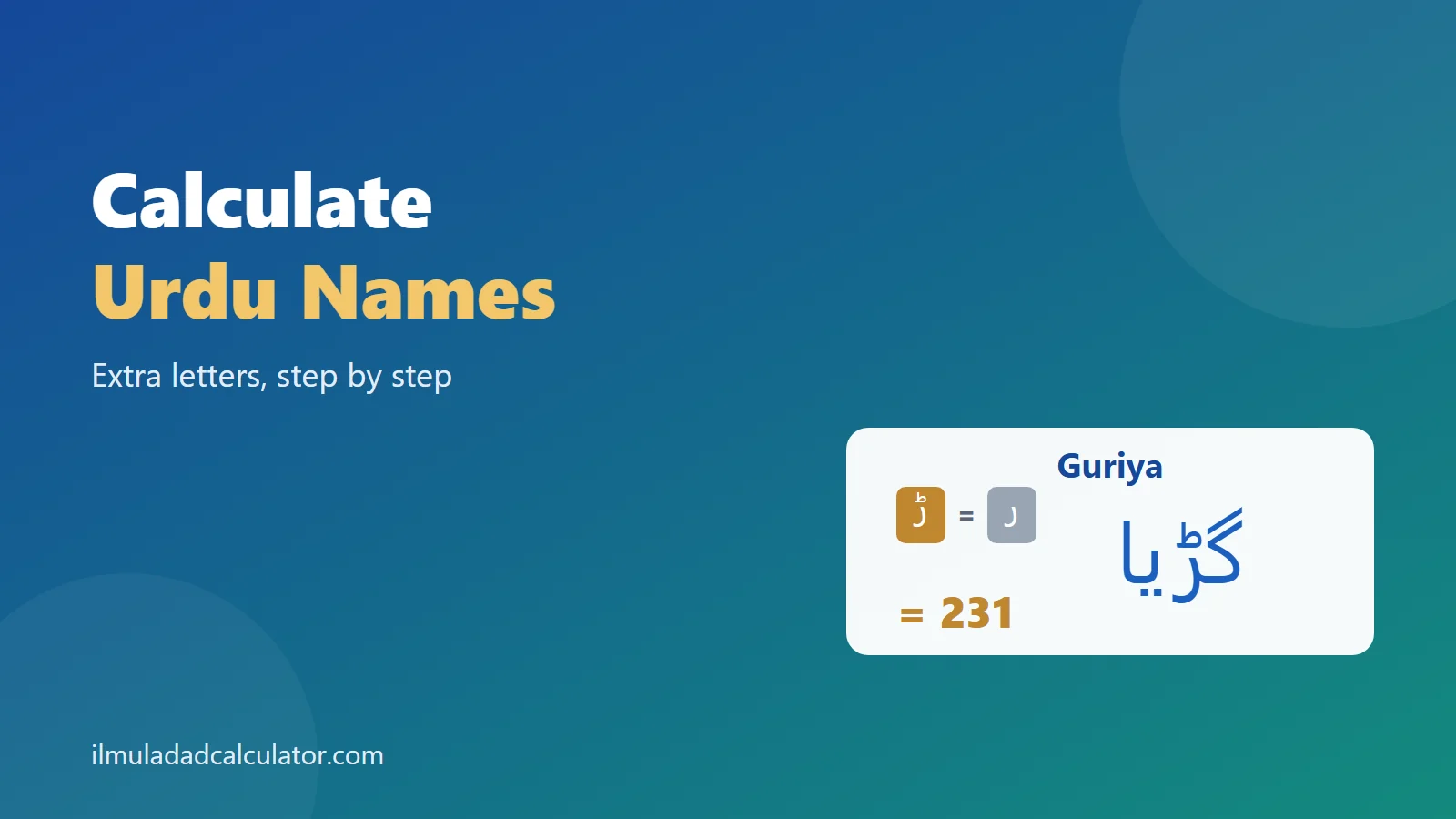
The girl’s name Guriya is written گڑیا. It uses gaf and the rolled r, two letters that Arabic does not have.
گ 20 + ڑ 200 + ی 10 + ا 1 = 231
Gaf counts as kaf (20), and the rolled ڑ counts as ra (200). With ya (10) and alif (1), the name totals 231. Spelled with a plain ر, the total would be the same.
Worked Example: A Name With Zhe and Nun Ghunna
Mizhgan means eyelashes, and it is a name in Pakistan. It is written مژگاں. It has three extra letters: zhe, gaf and nun ghunna.
م 40 + ژ 7 + گ 20 + ا 1 + ں 50 = 118
Zhe counts as zay (7), and gaf counts as kaf (20). The final nun ghunna counts as nun (50), so the total is 118.
Worked Example: Names Ending in Bari Ye
Many Urdu words end in bari ye (ے), the long “e” sound. The nickname Pyare is پیارے, and Nanhe is ننھے.
پ 2 + ی 10 + ا 1 + ر 200 + ے 10 = 223
ن 50 + ن 50 + ھ 5 + ے 10 = 115
Bari ye counts as ya (10) in both. In Nanhe, the do-chashmi he adds 5 as well, so the total is 115.
How Do You Calculate a Full Name With Extra Letters?
Total each word first, then add the word totals. The name چودھری گلزار احمد (Chaudhry Gulzar Ahmad) has extra letters in the first two words.
| Word | Working |
|---|---|
| چودھری | چ 3 + و 6 + د 4 + ھ 5 + ر 200 + ی 10 = 228 |
| گلزار | گ 20 + ل 30 + ز 7 + ا 1 + ر 200 = 258 |
| احمد | ا 1 + ح 8 + م 40 + د 4 = 53 |
The word totals are 228, 258 and 53. Together they give 539. The spaces are worth nothing.
The worked examples page has more full names to practice on.
What If a Name Has Arabic and Urdu Parts?
Many Pakistani names mix an Arabic first name with an Urdu surname. The Arabic letters count as they are. Only the Urdu letters need the swap, and the rest of the method stays the same.
Take محمد حسین چودھری (Muhammad Hussain Chaudhry). The first two words have no extra letters, so they total 92 and 128. The surname gives 228, and the full name is 448.
Note that حسین uses the Urdu form of ya, which counts the same as the Arabic form. You can type either one and get the same total.
How Do You Start From a Roman Spelling?
Names often reach you in English letters, such as Parveen or Bhatti. The first job is to pick the Urdu letters, because the Roman letters carry no value at all.
Listen for sounds that need an extra letter, such as p, ch, g and bh. Each one points to a letter in the table above. The guide to writing your name in Urdu covers this step in full.
One spelling is enough for one total. If two relatives write the name differently, calculate both and keep them side by side.
Which Spelling Choices Change the Total?
Many Urdu spelling choices look important but do not change the value. They swap an extra letter for its own base, or the other way round. The total moves only when the base letter itself changes.
| Choice | Spelling A | Spelling B | Totals | Changes? |
|---|---|---|---|---|
| ٹ or ت | ٹیپو | تیپو | 418 and 418 | No |
| پ or ب | پروین | بروین | 268 and 268 | No |
| ں or ن | مژگاں | مژگان | 118 and 118 | No |
| ے or ی | پیارے | پیاری | 223 and 223 | No |
| ۃ or ہ | رحمۃ | رحمہ | 253 and 253 | No |
| ھ kept or dropped | ننھے | ننے | 115 and 110 | Yes, by 5 |
| ہ or ا at the end | ثمینہ | ثمینا | 605 and 601 | Yes, by 4 |
So you can be relaxed about the retroflex dots and the nasal ending. Be careful with aspiration and with a final he or alif.
For the wider topic of why one name has several totals, read why spelling changes a name’s value.
Which Letters Does the Calculator Skip?
The engine knows the Urdu letters listed above. It does not know letters from other languages that use the same script. It skips them and counts them as zero.
- The Sindhi letters ڻ and ڪ count as 0.
- The Pashto letters ټ, ډ and ړ count as 0.
- The letter ې counts as 0.
If your name contains one of these, a total with a missing letter will be too low. Replace it by hand with the letter it is built from, and say so beside the result.
Standalone hamza (ء) is also skipped unless a setting counts it. See the hamza guide for that rule.
What Mistakes Happen With Urdu Letters?
- Counting the dots. The dots on پ, چ and ژ do not add anything.
- Counting the small toe sign. The sign over ٹ, ڈ and ڑ is not a letter.
- Dropping do-chashmi he. A pair like کھ is 25, not 20.
- Mixing up gol he and do-chashmi he. Both are 5, but the spelling differs.
- Using Roman spelling. Letters like “aa” and “ee” are not Urdu letters at all.
Copied text can hide a problem. Some Urdu text uses joined presentation forms of letters, which look the same on screen.
The engine converts these to normal letters first, so pasting is safe. The Unicode standard calls this step compatibility normalization.
How Can You Check an Urdu Name Quickly?
- Count the letters. The number of values you added must equal the number of letters in the name.
- Mark the extras. Circle each extra letter, then confirm it has its base value beside it.
- Check the ending. A final he is 5, a final alif is 1, and a final bari ye is 10.
- Compare with a tool. Run the same spelling through the calculator and match each letter.
Can You Try Some Urdu Names Yourself?
Work these out by hand with Mashriqi values. Then open each answer to compare your steps.
پروین (Parveen)
پ 2 + ر 200 + و 6 + ی 10 + ن 50 = 268
ٹھاکر (Thakur)
ٹ 400 + ھ 5 + ا 1 + ک 20 + ر 200 = 626
ڈوگر (Dogar)
ڈ 4 + و 6 + گ 20 + ر 200 = 230
How Does This Fit With the Other Methods?
This page covers one question: what to do with the extra letters. The adding is the same everywhere.
If you work in a spreadsheet, the Excel formula guide shows how to total letters in cells. Remember to give each extra letter its own row, or swap it first. For counting the letters themselves, see how many letters Urdu has.
You can also paste any Urdu name into the Ilm-ul-Adad calculator. It shows the value of every letter it counted, so you can compare it with your own working.
خلاصہ
اردو نام کے اعداد نکالنے کے لیے ہر اضافی اردو حرف کو اس کے عربی بنیادی حرف سے بدل لیں اور پھر قیمتیں جمع کر لیں۔ پ ب کے برابر ہے، چ ج کے برابر ہے، ژ ز کے برابر ہے اور گ ک کے برابر ہے۔ ٹ، ڈ اور ڑ کے اوپر جو چھوٹی علامت ہے اس کی کوئی قیمت نہیں ہوتی۔ دو چشمی ہے کی قیمت پانچ ہے، اس لیے بھ دو حروف کے برابر شمار ہوتا ہے۔ نون غنہ پچاس اور بڑی یے دس شمار ہوتی ہے۔
Sources and Further Reading
- Abjad numerals, Wikipedia. The values given for the four Persian letters.
- Urdu alphabet, Wikipedia. The retroflex letters, aspirated digraphs and nun ghunna.
- Unicode Normalization Forms, Unicode Standard Annex 15. Compatibility normalization of text.
- Abjad values come from this site’s tested engine. See the methodology.
Frequently Asked Questions
Does پ count as ب in Ilm-ul-Adad?
Yes. Pe takes the value of ba, which is 2. Che, zhe and gaf follow the same pattern.
What is the value of do-chashmi he?
It is 5, the same as he. A pair such as بھ adds the base letter and 5.
Do the dots or marks on ٹ ڈ ڑ add anything?
No. The small sign above them is only a mark. Each letter counts as its Arabic base.
Does a final ے count differently from ی?
No. Both are worth 10, because bari ye counts as ya.
Why did my total miss a letter?
The letter may belong to Sindhi or Pashto, which the engine skips. Replace it with its base letter and note this.