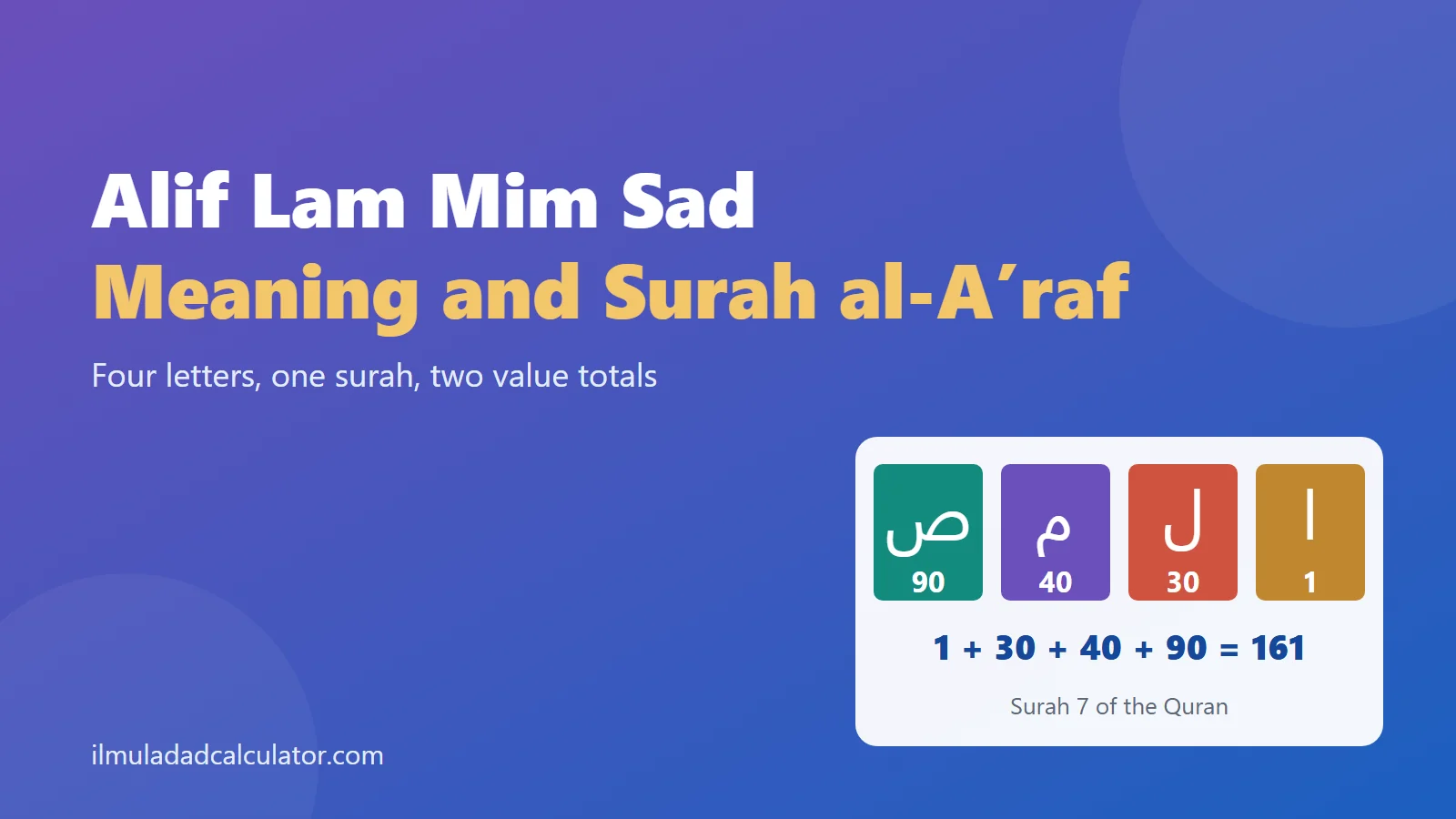
Alif Lam Mim Sad (المص) is the opening of Surah al-A’raf, the seventh surah of the Quran. It is made of four letters: alif, lam, mim and sad. Their Abjad values add up to 161 in the Mashriqi order.
What Does Alif Lam Mim Sad Mean?
The most widely held position is that its meaning is known with certainty only to God. This is the general belief of most Muslims, and it is the plain answer in classical commentary.
Alif Lam Mim Sad is one of the huruf muqattaat, the disjointed letters that open 29 surahs. Commentators have offered several explanations over the centuries.
The range of those views is set out on the huruf muqattaat overview. This page does not repeat them or choose among them.
Quick answer: المص opens only one surah, al-A’raf (7). Its four letters total 161 in the Mashriqi order and 131 in the Maghribi order.
What this page can report is factual. It covers the surah the letters open, how the group is built, and what its letters add up to.
Which Surah Opens With Alif Lam Mim Sad?
Only one surah opens with this group, and it is Surah al-A’raf, number 7. The name is usually translated as The Heights. Wikipedia also lists the names The Battlements and The Purgatory for the same surah.
Al-A’raf comes right after Surah al-An’am (6) and right before Surah al-Anfal (8). Those two neighbors have no opening letters. So the letters stand alone in this part of the book.
Is the Opening Counted as a Verse?
Yes. In the standard count the four letters form the first verse of the surah by themselves. Wikipedia’s inventory of the muqattaat marks al-A’raf as having a complete verse of letters.
That is not true for every opening. Ar-Ra’d, which opens with المر, is marked the other way in the same table. The Alif Lam Mim Ra page covers that case.
What Are the Key Facts About Surah al-A’raf?
Surah al-A’raf is one of the longest surahs of the Quran. Only al-Baqarah (286) and ash-Shu’ara (227) have more verses. Al-A’raf has 206.
| Item | Fact |
|---|---|
| Number and name | 7, al-A’raf, usually translated The Heights |
| Classification | Meccan |
| Verses | 206, with 24 rukus |
| Position in the text | Juz’ 8 to 9, after surah 6 and before surah 8 |
| Prostration verse | One, at verse 206 |
| Words and letters | 3,341 words and 14,435 letters |
| Egyptian standard revelation order | 39 |
| Nöldeke revelation order | 87 |
The surah has one prostration verse, which is its last verse, number 206. That means the final verse of the surah is also the verse with the prostration mark. This is a detail of the text layout and not a ruling.
Printed Order Versus Revelation Order
The number 7 is the place of the surah in the printed book. The revelation orders are separate lists, and they do not match each other.
The Egyptian standard list puts al-A’raf at 39, while Nöldeke’s scheme places it at 87. Scholars built these lists by different methods, so neither is a single fixed answer.
Being Meccan means the surah is placed before the Hijra, the move to Madinah. It is a statement about timing, not a statement about where any single verse was first recited.
How Does Sad Extend Alif Lam Mim?
The simplest way to see المص is as الم with one letter added at the end. The first three letters are alif, lam and mim. The fourth is sad, written ص.
Alif Lam Mim on its own opens six other surahs: 2, 3, 29, 30, 31 and 32. The Alif Lam Mim page lists them. Al-A’raf is the only surah that adds sad to those three letters.
Where Else Does Sad Appear?
Sad is used in three of the 29 openings, and each surah is different.
- Surah 7, al-A’raf: المص, with sad in the fourth place.
- Surah 19, Maryam: كهيعص, with sad at the end of five letters. See Kaf Ha Ya Ain Sad.
- Surah 38, Sad: ص, where the single letter is the whole opening.
So the same letter ends two different openings and stands alone in a third. Each pairing belongs to its own surah and should not be mixed with the others.
What Are the Letter Values of Alif Lam Mim Sad?
Each letter has a value in the Abjad system. Alif is 1, lam is 30, mim is 40 and sad is 90 in the Mashriqi order. Adding them gives the total.
ا 1 + ل 30 + م 40 + ص 90 = 161
- Take the four letters in turn: ا, ل, م, ص.
- Look up each value in the letter values chart: 1, 30, 40 and 90.
- Add them. The sum is 161.
This is plain addition. It is the same method used for any Arabic word, and it says nothing about the meaning of the letters.
| Letter | Name | Mashriqi place | Mashriqi value | Maghribi place | Maghribi value |
|---|---|---|---|---|---|
| ا | alif | 1 | 1 | 1 | 1 |
| ل | lam | 12 | 30 | 12 | 30 |
| م | mim | 13 | 40 | 13 | 40 |
| ص | sad | 18 | 90 | 15 | 60 |
Why Is the Maghribi Total 131?
The Maghribi order places sad at a different spot, so it carries a different value there. In the Mashriqi order sad is 90. In the Maghribi order it is 60.
Alif, lam and mim keep the same value in both orders, so الم stays at 71. Only the fourth letter moves, and the whole total drops by 30 to 131.
The reasons behind the two orders are explained on the page about why values differ. If you see 161 in one book and 131 in another, the book is probably using the other order.
Please note: both totals are correct for their own order. Neither one is a hidden meaning of the letters, and this site does not read meaning into any such sum.
How Is Alif Lam Mim Sad Written and Read?
In print the four letters sit together as one cluster, المص. Alif does not join the letter after it, so it stands slightly apart. Lam, mim and sad then run together in the usual way.
Many copies add small prolongation marks, giving a form such as الٓمٓصٓ. Those marks guide the reciter and are not extra letters. The engine on this site ignores them, so both forms give 161.
The group is read as four separate letter names: alif, lam, mim, sad. It is never read as one word. Wikipedia notes that each letter of the muqattaat is pronounced on its own.
The written name of sad is صاد, which is how Urdu readers also spell it. The muqattaat pronunciation page has the full guide to the sounds.
Urdu books often spell the group out as four words, الف لام میم صاد. Pakistani readers may also say alif laam meem saad. These are the same four letters with different spellings in English.
The names of the other three letters are ألف, لام and ميم. Their spelled-out values are 111, 71 and 90. Sad spelled out is 95.
Historically some writers counted these full names. The standard total uses the single letters only.
How Long Is This Opening Compared With the Others?
The 29 openings range from one letter to five. Alif Lam Mim Sad has four letters, which puts it near the long end. Only two surahs have exactly four letters, and this is one of them.
| Letters | Distinct openings | Surahs |
|---|---|---|
| 1 | 3 | 3 |
| 2 | 4 | 9 |
| 3 | 3 | 13 |
| 4 | 2 | 2 |
| 5 | 2 | 2 |
The other four-letter opening is المر, which opens ar-Ra’d. It shares the first three letters with al-A’raf. The difference is the last letter, ra instead of sad.
Across all 29 surahs, the openings use 78 letters in 14 distinct combinations. This matches the count in Wikipedia’s inventory of the muqattaat.
Where Does al-A’raf Sit Among the Openings?
Wikipedia’s inventory of the muqattaat lists the surahs below. Al-A’raf is the third surah on the list, and only al-Baqarah and Al Imran come before it.
- Surahs 2, 3 and 7.
- Surahs 10 to 15, then 19 and 20.
- Surahs 26 to 32, then 36 and 38.
- Surahs 40 to 46, then 50 and 68.
After al-A’raf come two surahs with no letters, al-Anfal (8) and at-Tawbah (9). The next opening is Alif Lam Ra at surah 10, Yunus. That group of surahs is covered on the Alif Lam Ra page.
The full table of all 29 surahs is on the muqattaat list. It shows each opening in one place, so you can compare them side by side.
Is the Value of the Surah Name the Same as the Opening?
No. The name of the surah and its opening letters are two different pieces of text. The name الأعراف has its own value of 383, while the opening المص totals 161.
The difference is a useful reminder. Each string of letters is counted on its own, and a surah name is not part of the opening group.
Where Does Sad Sit in the Alphabet?
In the Abjad order, sad is the 18th letter in the Mashriqi order and the 15th in the Maghribi order. In the everyday alphabet order it sits after shin and before dad.
The Abjad order and the everyday order are two separate lists, and only the Abjad order carries values. The Abjad and hijai order page explains the difference.
How Can You Check the Sum Yourself?
You can check the total in a few seconds. Open the Abjad value calculator and type المص. It returns 161 for the Mashriqi order.
To see the Maghribi figure beside it, use the multi-system Abjad calculator. The compare tool puts the orders next to each other. For doing it by hand, see how to calculate by hand.
The wider story of how writers added up the opening letters is on the muqattaat and Abjad page. It is background only, and it does not endorse any numerological reading. Wikipedia records that such readings have been proposed since the 19th century.
خلاصہ
الف لام میم صاد سورۃ الاعراف کے شروع میں آتا ہے، جو قرآن کی ساتویں سورت ہے۔ یہ چار حروف ہیں اور انہیں الگ الگ نام لے کر پڑھا جاتا ہے۔ مشرقی ترتیب میں ان کا مجموعہ ایک سو اکسٹھ ہے، اور مغربی ترتیب میں ایک سو اکتیس، کیونکہ صاد کی قدر دونوں میں مختلف ہے۔ سب سے مشہور رائے یہ ہے کہ ان کا یقینی مطلب صرف اللہ جانتا ہے۔ یہ صفحہ صرف حقائق اور گنتی بیان کرتا ہے۔
Sources and Further Reading
- Al-A’raf (surah), Wikipedia. Classification, verse count, juz’, rukus, prostration verse and word counts.
- List of chapters in the Quran, Wikipedia. Names, verse counts, place of revelation and both revelation orders.
- Muqattaʿat, Wikipedia. The inventory of openings, the complete-verse column, how the letters are read and the majority view.
- Letter values and sums come from this site’s tested engine. See the methodology.
Frequently Asked Questions
What does Alif Lam Mim Sad mean?
The most widely held view is that its meaning is known with certainty only to God. Commentators have also proposed several explanations.
Which surah starts with Alif Lam Mim Sad?
Surah al-A’raf, the seventh surah. It is a Meccan surah with 206 verses.
What is the Abjad value of Alif Lam Mim Sad?
It is 161 in the Mashriqi order, from 1 plus 30 plus 40 plus 90. It is 131 in the Maghribi order.
Why is the Maghribi value different?
Sad is worth 90 in the Mashriqi order and 60 in the Maghribi order. The other three letters keep their values.
How is Alif Lam Mim Sad different from Alif Lam Mim?
It adds the letter sad. Alif Lam Mim opens six other surahs, and only al-A’raf has the longer form.
Does the number 161 hold a hidden meaning?
No. It is the sum of four letter values, and this site makes no claim of a hidden meaning.