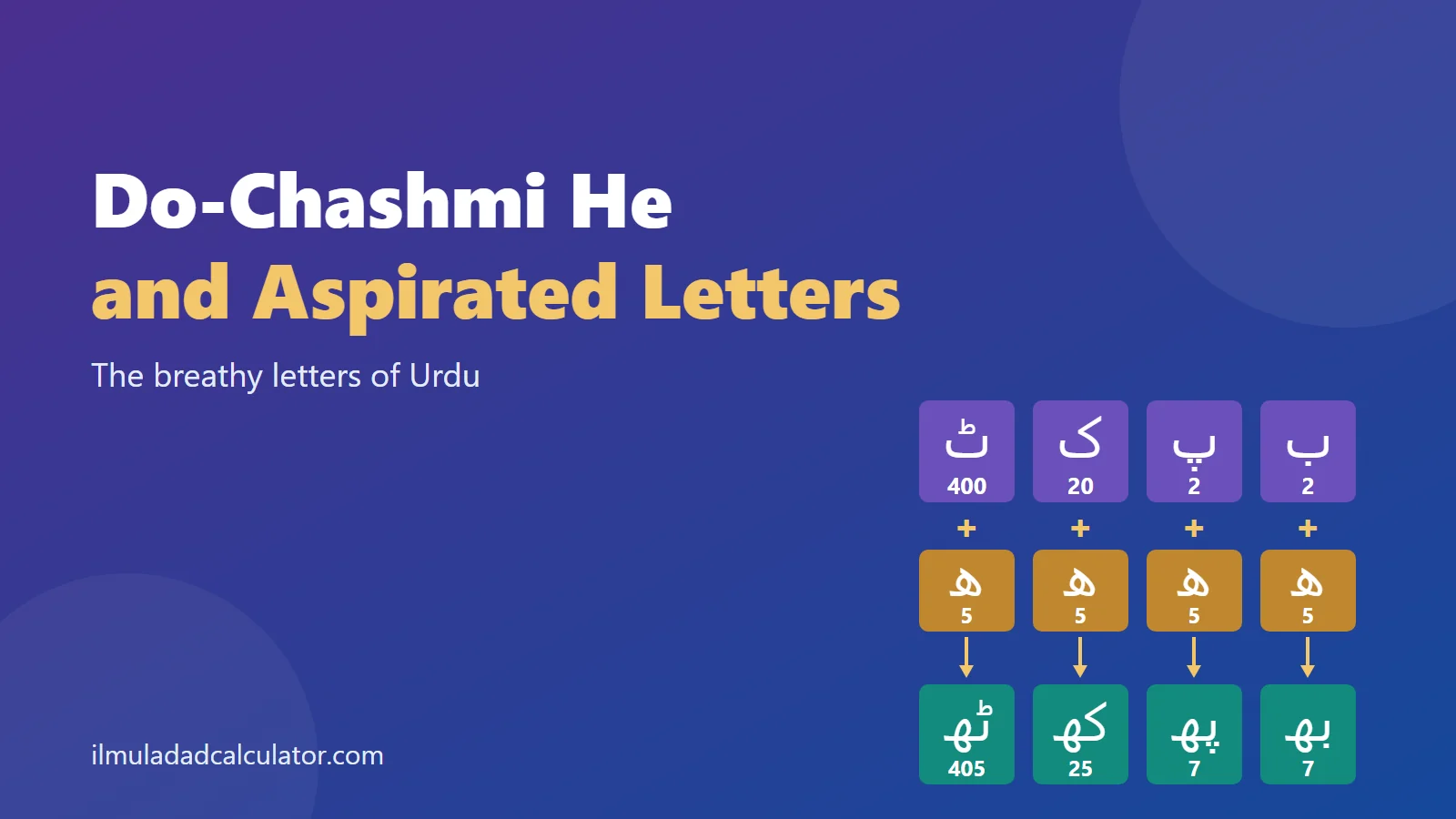
Do-chashmi he (ھ) is the Urdu letter that adds a puff of breath to a consonant. It never stands alone, since it joins a base letter to form pairs such as بھ, کھ and ٹھ. In Ilm-ul-Adad it counts as 5.
What Is Do-Chashmi He?
The name means “two-eyed he”. The name comes from the two loops in its shape, which look like a pair of eyes.
It has no sound of its own. It follows a consonant and adds a strong puff of air. Linguists call this puff aspiration.
A university course in Texas says the letter cannot be pronounced without a letter before it. The consonant and the puff are said together as one sound.
For the full alphabet, see the page on how many letters are in the Urdu alphabet. This page focuses on one letter and the sounds it builds.
Which Letters Take Do-Chashmi He?
Fifteen pairs are usually listed. The exact number depends on the source, so it helps to know which list you are reading.
The table gives each pair with its sound, its working, and an example word. The example words come from the Wikipedia digraph table, and every value comes from the calculator.
| Pair | Sound | Working | Value | Example word | Word value |
|---|---|---|---|---|---|
| بھ | bh | 2 + 5 | 7 | بھاری | 218 |
| پھ | ph | 2 + 5 | 7 | پھول | 43 |
| تھ | th | 400 + 5 | 405 | تھیلا | 446 |
| ٹھ | ṭh | 400 + 5 | 405 | ٹھنڈا | 460 |
| جھ | jh | 3 + 5 | 8 | جھاڑی | 219 |
| چھ | chh | 3 + 5 | 8 | چھتری | 618 |
| دھ | dh | 4 + 5 | 9 | دھوبی | 27 |
| ڈھ | ḍh | 4 + 5 | 9 | ڈھول | 45 |
| رھ | rh | 200 + 5 | 205 | تیرھواں | 672 |
| ڑھ | ṛh | 200 + 5 | 205 | اڑھائی | 227 |
| کھ | kh | 20 + 5 | 25 | کھانسی | 146 |
| گھ | gh | 20 + 5 | 25 | گھوڑا | 232 |
| لھ | lh | 30 + 5 | 35 | دولھا | 46 |
| مھ | mh | 40 + 5 | 45 | تمھیں | 505 |
| نھ | nh | 50 + 5 | 55 | ننھا | 106 |
The 11 Common Pairs
Beginner charts at the University of Texas and UNC Chapel Hill list eleven pairs. They are bh, ph, th, ṭh, jh, chh, dh, ḍh, ṛh, kh and gh.
The UNC chart separates dental and retroflex types. So تھ is a dental th, while ٹھ is a retroflex th made with the tongue curled back.
The Four Rarer Pairs
Wikipedia adds four more: رھ, لھ, مھ and نھ. Examples are ننھا (small) and تمھیں (you, plural).
The Center for Language Engineering’s Urdu phonetic inventory also lists these four. It adds a pair for ye as well, which brings its total to sixteen.
The UNC course notes that not every Urdu consonant has an aspirated version. Wikipedia also gives دولھا as an alternative spelling of دُلہا.
Two Kinds of Breath
The letter stands for two slightly different sounds. Wikipedia’s digraph table marks five pairs as plain puffs of air. These are ph, th, ṭh, chh and kh.
The other ten are breathy-voiced. The voice keeps going while the breath escapes, as in bh, dh, jh and gh.
Urdu writes both kinds the same way. The base letter tells the reader which sound to expect, since پ is voiceless and ب is voiced.
Nasal letters: a nasal consonant can take the puff too. The Texas course gives منھ (face), which is read muñh. It counts 95.
How Do You Read and Write Do-Chashmi He?
Its Four Forms
Do-chashmi he connects on both sides. So it has a detached form, an initial form, a medial form and a final form.
In practice it is never the first letter of a word. It appears in the middle or at the end, as in بھی (also), ہاتھ (hand) and سمجھ (understanding).
Northwestern University notes that the pen stops and reverses direction when you write the medial and final forms. That small movement makes the two loops.
For the position forms of other letters, see the page on Arabic letter forms.
Where Do the Vowel Marks Go?
Vowel marks go on the consonant, not on ھ. So the short vowel in کُھلا (open) sits over the kaf.
The same book says a consonant with ھ is often read, and even alphabetized, as one unit.
What Does the Puff Change?
Aspiration changes meaning in Urdu. The Texas course contrasts پھل (fruit) with پل (moment).
Hold your palm in front of your mouth and say both words. You should feel a strong puff on the first one and almost none on the second.
The two words differ by exactly one letter. The calculator gives 37 for پھل and 32 for پل.
Is Do-Chashmi He the Same as Gol He?
Not today, although they were once the same letter. The Texas course says the two were used interchangeably until the early twentieth century. Northwestern says older texts mix them too.
Modern Standard Urdu keeps them apart. Gol he (ہ) makes the plain h sound, and do-chashmi he (ھ) aspirates the letter before it.
The Texas course shows how one choice changes a sentence. ندی بھی means “the river, too”, while ندی بہی means “the river flowed”.
| Feature | Do-chashmi he ھ | Gol he ہ |
|---|---|---|
| Role | Aspirates the letter before it | Plain h sound, or a final long a |
| Stands alone? | No, it needs a base letter | Yes |
| Starts a word? | Almost never | Yes |
| Unicode | U+06BE | U+06C1 |
| Abjad value | 5 | 5 |
The UNC course adds that do-chashmi he is occasionally used in place of gol he. This is rare, and it is the main exception to the rule about word starts.
How Does Do-Chashmi He Count in Ilm-ul-Adad?
The calculator counts ھ as 5, the same as ہ and ه. This holds in both the Mashriqi and the Maghribi systems.
So every aspirated pair equals its base letter plus 5. The page on Urdu alphabet letters shows بھ as 2 plus 5. The table above extends that rule to all fifteen.
Here is the word ہاتھ written out in full:
ہ 5 + ا 1 + ت 400 + ھ 5 = 411
Notice that it contains two he letters. The first is gol he and the last is do-chashmi he. Each adds 5.
Counting a Word With Do-Chashmi He
- Write the word in its Urdu spelling.
- Split it into single letters, and keep ھ as its own letter.
- Give each letter its value from the calculator.
- Add the values together.
Same total, different word: ھ, ہ and ه all count 5. So کھا (eat) and کہا (said) both total 26. The total alone cannot show which he was typed.
Leaving the letter out does change the total, by exactly 5. The page on why Abjad values differ explains other spelling choices that move a total.
Which Everyday Words Use Do-Chashmi He?
Aspirated pairs are everywhere in daily Urdu. The six words below come from the Texas and Northwestern course books.
| Word | Meaning | Working | Total |
|---|---|---|---|
| بھی | also | 2 + 5 + 10 | 17 |
| ہاتھ | hand | 5 + 1 + 400 + 5 | 411 |
| سمجھ | understanding | 60 + 40 + 3 + 5 | 108 |
| کھا | eat! | 20 + 5 + 1 | 26 |
| پھل | fruit | 2 + 5 + 30 | 37 |
| اچھا | good | 1 + 3 + 5 + 1 | 10 |
Northwestern writes the last word as اچّھا, with a shadda over the chim. The calculator gives the same total for both spellings. It adds no value for the shadda by default.
The page on the hamza in Ilm-ul-Adad shows how another sign is handled in the same way.
Why Do Typing and Searching Go Wrong?
Three he letters look alike on screen but are stored as three different characters. The figure shows their code points.
This can break a search. Wikipedia describes a digital dictionary at the University of Chicago, where a search for بھارت (India) with ھ finds nothing. The same word typed with ه returns the entry.
The medial form of ھ looks identical to the medial form of Arabic heh. A reader sees the same word, but the computer sees two different strings.
This site’s calculator treats both as 5, so بھارت and بهارت each give 608. The word search on other sites may not be so forgiving.
- Use ھ after a consonant to aspirate it.
- Use ہ for the plain h sound.
- When you paste text from an Arabic source, check which he came with it.
Is Do-Chashmi He Part of the 39 Letters?
It depends on the list. The Texas chart places ھ in the same row as gol he, so the two are treated as one family.
Some counts fold it into he, because it only works with a base letter. Others give it its own place. That choice is one reason Urdu letter counts range from 37 to 40.
The page on the Urdu letter count lists every sign on the border. Whichever count you use, the Abjad value of ھ stays 5.
How Do Hindi and Urdu Write Aspirated Sounds?
Hindi gives each aspirated sound its own letter. Northwestern University lists भ for bh, थ for th and ख for kh.
Urdu writes the same sounds with two letters instead. The Texas course adds that aspiration changes meaning in Indic languages, but not in Arabic, English or Persian.
UNC warns learners about three look-alike pairs. A breathy pair is not the same as a separate Urdu letter:
- پھ is a breathy p, not ف. The values are 7 and 80.
- کھ is a breathy k, not خ. The values are 25 and 600.
- گھ is a breathy g, not غ. The values are 25 and 1000.
These letters sound different, and their Abjad values are far apart. Always check the spelling before you count.
Common Slips to Avoid
- Do not write ہ where the word needs ھ, or the reverse. The two letters make different words.
- Do not put vowel marks on ھ. They belong on the consonant before it.
- Do not count a pair as a new base letter. It is a base letter plus 5.
To count your own Urdu word, use the Abjad value calculator. For the alphabet in order, see the Urdu alphabet with English names.
خلاصہ
دو چشمی ہے (ھ) اردو کا وہ حرف ہے جو کسی حرف کے بعد آ کر سانس والی آواز پیدا کرتا ہے۔ یہ کبھی اکیلا نہیں آتا اور لفظ کے شروع میں بھی نہیں ہوتا۔ عام طور پر پندرہ جوڑے گنے جاتے ہیں، جیسے بھ، پھ، کھ اور گھ۔ علمِ اعداد میں ھ کی قیمت پانچ ہے، اس لیے ہر جوڑے کی قیمت بنیادی حرف کی قیمت جمع پانچ ہوتی ہے۔
Sources and Further Reading
- Urdu Script and Pronunciation, University of Texas at Austin. Aspiration, the 11-pair chart, gol he and do-chashmi he, and the muñh example.
- Do Chashmi HAY, The Urdu Alphabet, UNC Chapel Hill. The 11 aspirated consonants, the four forms and the look-alike warnings.
- Chhoṭī he, do-chashmī he, chhoṭī ye, baṛī ye, Zer o Zabar, Northwestern University Libraries. Hindi and Urdu compared, vowel marks, and the pen movement.
- Urdu Phonetic Inventory, Center for Language Engineering, Lahore. Aspirated sounds including lh, mh, nh and rh.
- Urdu alphabet, Wikipedia. The 15-digraph table with example words, and the Unicode and dictionary search example.
- Abjad values and Unicode code points come from this site’s tested engine and the Python Unicode database. See the methodology.
Frequently Asked Questions
How many aspirated letters does Urdu have?
Fifteen pairs are usually listed. Beginner charts show eleven, and some lists add more.
Is do-chashmi he a letter on its own?
Yes, it has its own place in the alphabet. In use, it always follows a base consonant.
What is the Abjad value of do-chashmi he?
It is 5, the same as gol he and Arabic heh. So an aspirated pair equals its base letter plus 5.
Can do-chashmi he start a word?
Almost never. It aspirates the letter before it, so it sits in the middle or at the end.
Is کھ the same letter as خ?
No. The pair is a breathy k, and khe is a scratchy sound made in the throat.