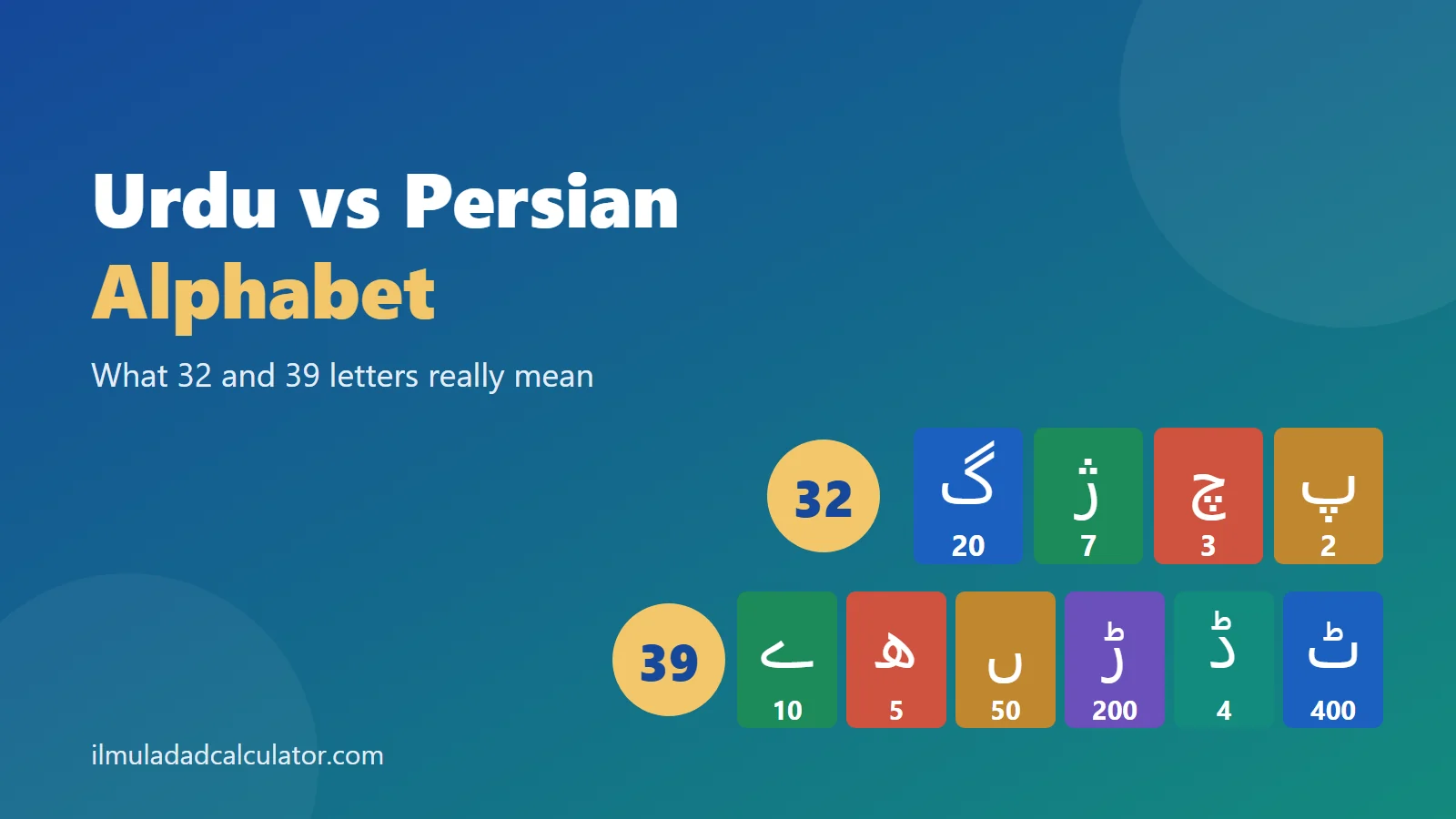
Persian has 32 letters and Urdu usually has 39. Urdu grew out of the Persian set, so the two share most of their letters and their Nastaliq style. The difference is a short list of letters that Urdu added for its own sounds.
How Many Letters Do Urdu and Persian Have?
Persian took the 28 basic Arabic letters and added four more. That makes 32. A research paper from Google Research describes Urdu as built on those 32 Persian characters.
Urdu then added six new letters. The usual Urdu count of 39 also includes the hamza sign. So the gap between the two alphabets is seven signs: six letters and hamza.
Urdu lists still differ a little. The page on how many letters are in the Urdu alphabet explains why. This page uses the common count of 39.
Persian leaves hamza out of its 32. Wikipedia notes that hamza is technically a diacritic, not a letter. Urdu lists often give it a place of its own.
Which Letters Did Persian Add to Arabic?
Arabic had no letters for the sounds p, ch, zh and g. Persian built them from existing shapes by adding dots or a stroke. Urdu kept all four.
| Letter | Name | Built from | Abjad value |
|---|---|---|---|
| پ | pe | ب | 2 |
| چ | che | ج | 3 |
| ژ | zhe | ز | 7 |
| گ | gaf | ک | 20 |
Persian also swapped two Arabic letters for new shapes. It uses ک in place of Arabic ك, and ی in place of ي. Urdu took over both of those shapes too.
Every added letter counts as its base letter in Ilm-ul-Adad. The page on Urdu and Persian letter values lists the full swap.
What Does Urdu Add Beyond Persian?
The Google Research paper lists five additions. Together they cover the sounds Persian does not need.
- Three retroflex letters: ٹ, ڈ and ڑ, made with the tongue curled back.
- Nun ghunna: ں, which marks a nasal sound.
- Do-chashmi he: ھ, which adds a puff of breath to a consonant.
- Bari ye: ے, which stands for the e sound at the end of a word.
- Gol he: ہ, a rounder shape of he that replaces the Persian ه.
The fifth item swaps one shape for another, so it adds no new place to the count. That leaves six new letters, and hamza makes the seventh sign.
Count check: 32 Persian letters plus 6 new Urdu letters plus the hamza sign gives 39. The checks in this page’s build script confirm that the 39 letters are exactly this set.
Which Sounds Need the Extra Urdu Letters?
Each addition answers a real sound in Urdu. Pronunciation notes here come from a University of Texas at Austin guide to Urdu script.
Retroflex Sounds
The guide describes ٹ as an unaspirated retroflex t and ڈ as its voiced partner. It calls ڑ a retroflex flap. Persian has no letters for these sounds.
Aspirated Sounds
In Urdu, a puff of breath can change a word. The guide gives تالی (clapping) and تھالی (plate) as a pair.
It adds that the same is not true in Persian, even though Persian has aspirated sounds.
The guide lists eleven combinations with ھ, such as بھ, پھ and کھ. The Google Research paper says it can follow 17 or 18 letters. Counts depend on how you list them.
The page on do-chashmi he covers these pairs in full.
Nasal and Final Sounds
The guide says ں marks nasalization and can show the difference between singular and plural. It says ے ends a word with an ai or e sound, which the plain ی does not.
Persian Sounds That Urdu Uses Less
The same guide calls ژ a Persian letter that is somewhat rare in Urdu. Both languages keep several Arabic letters for the spelling of borrowed words. In Persian, for example, ث is pronounced like s, while Arabic says it differently.
What Are the Main Differences at a Glance?
The table puts the two alphabets side by side. Counts follow the sources named below.
| Feature | Persian | Urdu |
|---|---|---|
| Usual letter count | 32 | 39 |
| Added to Arabic | پ چ ژ گ | Those four, plus ٹ ڈ ڑ ں ھ ے |
| Hamza in the count | Not counted | Counted as the 39th sign |
| Breathy consonants | No letter for them | Written with ھ |
| Retroflex sounds | None | ٹ, ڈ, ڑ |
| Letter he | ه (U+0647) | ہ (U+06C1) |
| Final e sound | One yeh, ی | ی and ے |
Do Persian and Urdu Share the Same Letter Forms?
Mostly, yes. Persian and Urdu both use ی and ک, which differ from the Arabic ي and ك.
Persian yeh has two dots below only at the start and middle of a word. Arabic keeps them in every position.
The he is the one common letter where Urdu differs. Persian uses ه, and Urdu uses ہ.
Look-alike letters can hide behind different Unicode code points. The Google Research paper notes that text can look identical on screen yet be stored differently, which may break searches. The Abjad value is unaffected, since each pair counts the same.
A Quick Example
The word for house is written خانه in Persian and خانہ in Urdu. The last letters are different code points, yet both give the same total.
خ 600 + ا 1 + ن 50 + ہ 5 = 656
The word کتاب (book) is spelled the same way in both languages, and it totals 423. Typing it with Arabic ك instead also gives 423.
Which Arabic Letters Sound Alike in Persian?
Persian kept every Arabic letter, but it says several of them the same way. Wikipedia’s table groups them by sound.
- S: ث, س and ص all sound like s. Their values are 500, 60 and 90.
- Z: ذ, ز, ض and ظ all sound like z. Their values are 700, 7, 800 and 900.
- T: ت and ط both sound like t, with values 400 and 9.
- H: ح and ه both sound like h, with values 8 and 5.
Urdu shows the same pattern, as the page on the Urdu alphabet in order shows. The spelling stays fixed even though the sounds merge. That is why the Abjad value depends on the letter written, not on how it sounds.
How Did Urdu Come to Use the Persian Script?
The Google Research paper calls the Urdu writing system an abjad, borrowed from Persian, which borrowed it from Arabic.
The paper links the name Urdu to a Turkic word for army. It also notes that Urdu shares an Indo-Aryan base with Hindi, but Hindi is written in Devanagari.
Persian was the courtly language of the Delhi Sultanate. Under the Mughals, who ruled from 1526 to 1857, it was the official language of the empire. It was also the language of culture, education and prestige.
Indians took up many administrative posts that Iranians and Turks once held.
Act No. 29 of 1837 later ended its use in official proceedings across India. That long contact is why the Urdu set starts from the Persian letters, not the Arabic ones.
Do Persian and Urdu Use the Same Digits?
Both languages use the Extended Arabic-Indic digits, written U+06F0 to U+06F9. Arabic uses a separate set, U+0660 to U+0669. Wikipedia notes that Persian shapes for 4, 5 and 6 differ from the Arabic ones.
It also notes that Urdu keeps the Persian code points but draws 4, 6 and 7 differently. A font decides which shapes you see. Digits carry no Abjad value in this calculator, so they never change a total.
How Can You Tell Persian From Urdu Text?
A few quick checks help when you meet a line of script in a book or on a screen.
- Look for ٹ, ڈ or ڑ. Any of them points to Urdu.
- Look for ھ joined to a consonant, as in کھ. This also points to Urdu.
- Look for ں at the end of a word, or ے as a final letter. Both are Urdu signs.
- Check the he. A rounded ہ is Urdu, while ه is Persian or Arabic.
Text with none of these signs could be either language, since the shared letters look the same.
How Do Persian and Urdu Share Nastaliq?
Nastaliq developed in Iran from the Naskh style, around the 13th or 14th century. Both Persian and Urdu writers have used it ever since.
The two traditions use it differently today. In Pakistan and India, Nastaliq is the standard style for Urdu. In Iran, it is now used mainly for poetry and calligraphic art, according to Wikipedia.
Nastaliq is easy to write by hand, but the paper says it caused problems when moved to metal type. Digital typography has solved much of that. Wikipedia notes that Noori Nastaliq, released in 1981, was developed largely for the newspaper industry in Pakistan.
The research paper adds that web content tends to prefer Naskh. How a letter looks depends on the font, so the same letters can appear very different in each style. See Nastaliq vs Naskh for a closer comparison.
How Do the Two Alphabets Count in Ilm-ul-Adad?
Ilm-ul-Adad gives each added letter the value of its base. In this calculator, Persian پ is 2, چ is 3, ژ is 7 and گ is 20. The Urdu additions give ٹ 400, ڈ 4, ڑ 200, ں 50, ھ 5 and ے 10.
The aspirated pair above shows the effect. The word تالی totals 441, and adding ھ gives 446, which is 5 more.
Two short words show the pattern. The Persian word پدر (father) totals 206, and the Urdu word ڈاک (post) totals 25. Each added letter simply takes the value of its base.
ڈ 4 + ا 1 + ک 20 = 25
Different spelling choices can still change a total. The page on why Abjad values differ explains this. For the Arabic side, see the Arabic alphabet in order and the Urdu alphabet in order.
خلاصہ
فارسی حروفِ تہجی میں بتیس حروف ہیں، یعنی عربی کے اٹھائیس حروف کے ساتھ پ، چ، ژ اور گ۔ اردو میں عام طور پر انتالیس حروف گنے جاتے ہیں۔ اردو نے فارسی کے اوپر ٹ، ڈ، ڑ، ں، ھ اور ے کا اضافہ کیا اور ہمزہ بھی شامل ہے۔ دونوں زبانیں نستعلیق انداز سے جڑی ہیں۔ ابجد میں ہر اضافی حرف اپنے بنیادی حرف کی قیمت لیتا ہے۔
Sources and Further Reading
- Graphemic Normalization of the Perso-Arabic Script, Doctor, Gutkin, Johny, Roark and Sproat, Google Research (2022). Persian 28 plus 4 equals 32, Urdu’s added letters, Nastaliq and Naskh, and the code point issue.
- Urdu Script and Pronunciation, University of Texas at Austin. Retroflex, aspirated and nasal letters, and notes on Persian.
- Persian alphabet, Wikipedia. Letter count, sound groups, hamza, digits and code points.
- Nastaliq, Wikipedia. Origin in Iran and present-day use for Persian and Urdu.
- Persian language in South Asia, Wikipedia. Persian at the Delhi and Mughal courts, the 1837 act, and its influence on Urdu and its script.
- Abjad values come from this site’s tested engine. See the methodology.
Frequently Asked Questions
How many letters does the Persian alphabet have?
Persian has 32 letters. That is the 28 basic Arabic letters plus pe, che, zhe and gaf.
Does Persian use the letters ٹ, ڈ and ڑ?
No. Urdu added these three retroflex letters. Persian has no use for them.
Is Urdu written in the Persian script?
Urdu is written in an extended form of the Perso-Arabic script. It starts from the Persian letters and adds its own.
Do Persian and Urdu letters have the same Abjad values?
Shared letters have the same values. Each added Urdu letter counts as its base letter.
Is hamza part of the Persian 32 letters?
No. Persian counts 32 letters without it, and Wikipedia calls hamza technically a diacritic. Urdu lists usually add it as the 39th sign.
Why does Urdu have two forms of ye?
Urdu uses bari ye to show the e sound at the end of a word. The plain ye is used elsewhere.