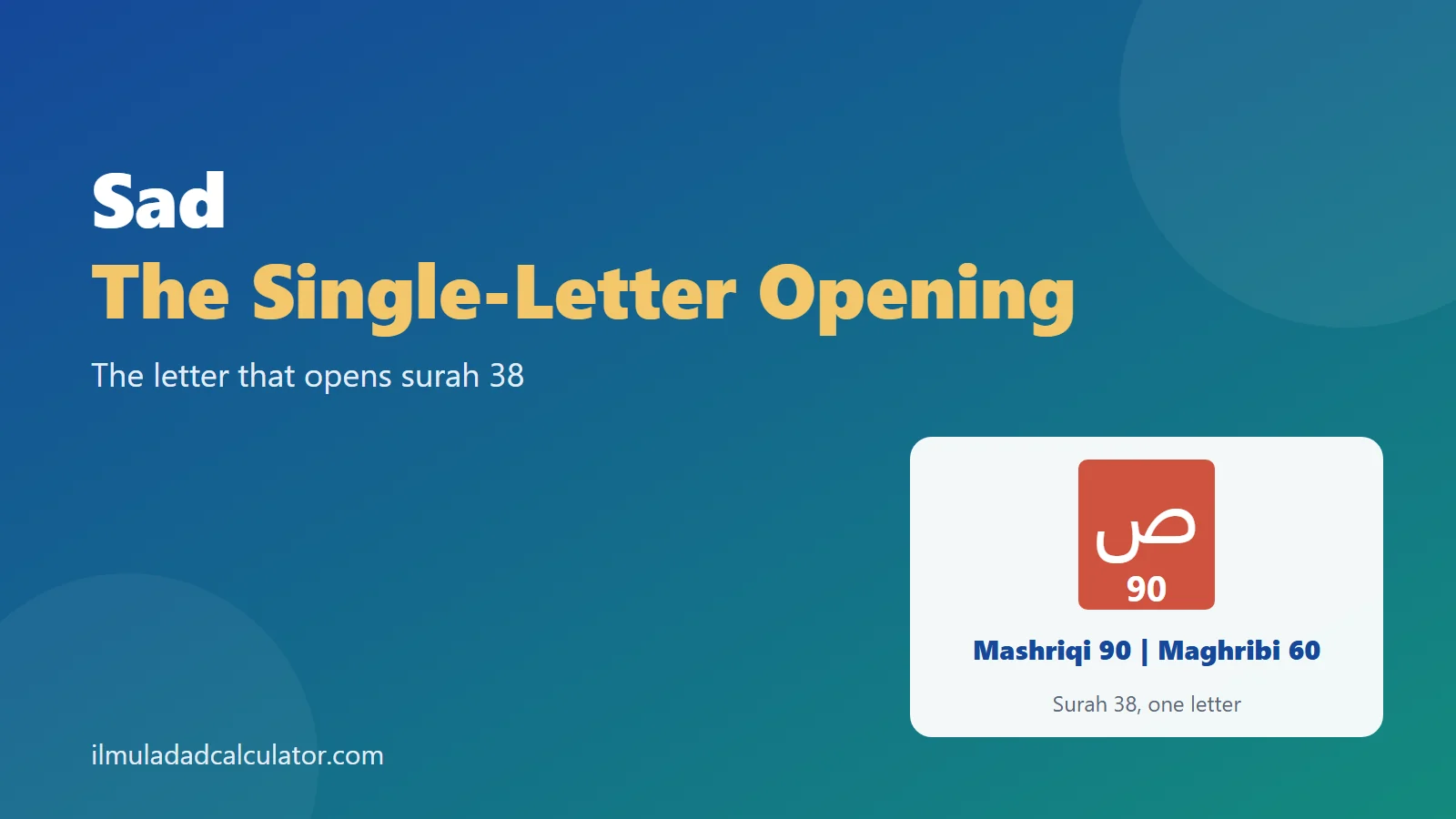
Sad (ص) is the single letter that opens surah 38 of the Quran. Its Abjad value is 90 in the Mashriqi system and 60 in the Maghribi system. This page covers the surah, the letter and its values.
What Is the Sad Opening?
Sad is one of the huruf muqattaat, the disjointed letters that open 29 surahs. It is one of only three openings made of a single letter. The other two are ق and ن.
The most widely held position is that the meaning of these letters is known with certainty only to God. Commentators have also put forward several explanations over the centuries. The huruf muqattaat overview sets out those views neutrally, so they are not repeated here.
Quick answer: Sad opens surah 38, a Meccan surah of 88 verses. The letter is ص, and its value is 90 (Mashriqi) or 60 (Maghribi). This page reports facts and arithmetic only.
Which Surah Begins With Sad?
Surah 38 begins with this letter, and the surah takes its name from it. It sits between as-Saffat (37) and az-Zumar (39). The table collects the main reference facts.
| Item | Detail |
|---|---|
| Surah number | 38 of 114 |
| Name in Arabic | ص (also listed under the alternative title Dawud) |
| Verses | 88 |
| Place | Meccan |
| Revelation order | 38 (Egyptian standard) or 59 (Noldeke) |
| Juz | 23 |
| Previous surah | As-Saffat (37), 182 verses |
| Next surah | Az-Zumar (39), 75 verses |
The Egyptian revelation order happens to match the printed number here. The Noldeke list does not, and it places the surah 59th. The two lists were built by different methods, so they rarely agree.
Surah 37 before it is more than twice as long, with 182 verses against 88. Surah 39 after it has 75. Neither of the neighbors opens with letters.
Where Does Surah Sad Sit Among the 29 Openings?
In Quran order, surah 38 is the twentieth of the 29 surahs that open with letters. 19 openings come before it and 9 come after it. Its nearest neighbors in that list are Ya Sin (surah 36) and the first Ha Mim surah (surah 40).
Wikipedia counts four or five chapters that are named for their opening letters. They are Ta-Ha, Ya-Sin, Sad, Qaf and, in some lists, Nun. Each has its own page here: Ta Ha, Ya Sin, Qaf and Nun.
The Opening Is Not a Full Verse by Itself
The Wikipedia inventory has a column that marks whether the letters form a complete verse. For Ya Sin, Ha Mim and Alif Lam Mim the answer is yes. For surah 38 the answer is no.
That means the first verse of the surah does not end with the letter. Further words follow it inside the same verse. The letter is still the very first thing after the Bismillah.
The same note applies to surah 10 and a few others. A full table of all 29 is on the muqattaat list page.
How Is Surah Sad Divided by Verse Range?
Writers outline the surah in different ways. One outline given on Wikipedia divides it into three parts by verse range. The source gives no range for verse 65 itself.
| Part | Verses | Number of verses |
|---|---|---|
| First | 1 to 11 | 11 |
| Middle | 12 to 64 | 53 |
| Last | 66 to 88 | 23 |
The middle part is the longest, with 53 of the 88 verses. The article lists David, Solomon and Job among the figures named in it. Near the end it lists Adam and Iblis.
Other outlines on the same page give slightly different ranges for the same passages. So treat the verse numbers as a map, not as a fixed rule. This site does not comment on the content of the verses.
The Wikipedia infobox also gives the size of the surah as 818 words and 3,020 letters. Counts like these depend on the text and the counting method. They are shown only so you can compare surahs.
How Is the Letter Sad Written?
In Arabic script, sad is a wide, rounded letter with a closed loop on the line. It has no dots, and it has four forms that depend on its place in a word. Because it joins on both sides, it keeps one body and only changes its connecting stroke.
The nearest letter in shape is dad (ض), which is the same body with one dot above. Wikipedia lists dad as a letter derived from sad. When a dot is missing or added by mistake, the letter and its value both change.
Wikipedia says the shape may come from a dotless nun joined to the lower part of ta. The line of descent runs from the Phoenician letter through Aramaic and Nabataean to the Arabic form. Wikipedia also shows a Kufic fragment of surah 38 dated to the late 9th century.
How Is Sad Named and Pronounced?
The letter is named صاد, written in Latin letters as sad, ṣād or saad. In Modern Standard Arabic it stands for an emphatic s sound, a heavier s than the plain sin. English has no letter for it, which is why the spellings vary.
The opening is read as the letter name, not as a sound. A reader says the name of the letter once, and does not form a word from it. The muqattaat pronunciation page covers how the letters are read as a group.
Sad in Urdu and Persian
Wikipedia notes that this emphatic sound is not native to Urdu, Persian or Ottoman Turkish. In loanwords the letter is pronounced like the plain s of س. So in Urdu speech, sad and sin often sound the same, even though they are written differently.
This is one reason why Urdu readers need to pay attention to the written shape. Two words can be spoken alike and still carry different totals. The Urdu and Persian letters page shows how the alphabet is extended for those languages.
What Is the Abjad Value of Sad?
In the Mashriqi order, sad is the 18th letter and counts as 90. In the Maghribi order it is the 15th letter and counts as 60. In the ordinary alphabet order it is the 14th.
ص 90 = 90
ص 60 = 60
The two systems are explained on the why values differ page. The gap here comes from a different letter order, not from an error. The Abjad and hijai order page adds the alphabet order.
| Order | Place of sad | Value | Memory word that holds it |
|---|---|---|---|
| Alphabet (hijai) | 14 | No value | None |
| Abjad, Mashriqi | 18 | 90 | سعفص, last letter |
| Abjad, Maghribi | 15 | 60 | صعفض, first letter |
The memory words come from the abjad hawwaz mnemonic. In the Mashriqi set the fifth word is سعفص, and sad ends it. In the Maghribi set the same slot reads صعفض, and sad begins it.
The Spelled-Out Name
The letter name صاد is written with three letters: sad, alif and dal. Its arithmetic is shown below.
ص 90 + ا 1 + د 4 = 95
The spelled-out name totals 95 in the Mashriqi order and 65 in the Maghribi order. This is a different count from the single letter. A writer should say which one is being used.
How Is Sad Different From Sin and Dad?
Sad, sin and dad are three separate letters, and each has its own value. Sin (س) has no dots but carries three small teeth. Dad (ض) has the body of sad with a dot above it.
| Letter | Name | Marks | Mashriqi | Maghribi |
|---|---|---|---|---|
| ص | sad | No dots | 90 | 60 |
| س | sin | No dots, three small teeth | 60 | 300 |
| ض | dad | One dot above | 800 | 90 |
Please note: the Mashriqi value of sin (60) equals the Maghribi value of sad (60). The match comes from the two orders, not from any link between the letters. Always check which system a figure uses.
Sad and sin never meet in the 29 openings. Sin appears in 5 of them, in 4 different combinations: طسم, طس, يس and عسق. Sad appears only in the three openings listed in the next section.
Where Else Does Sad Occur Among the Openings?
Besides surah 38, the letter closes two longer openings. المص opens surah 7 and كهيعص opens surah 19. So sad is found in three of the 29 surahs and in three of the 14 distinct combinations.
| Surah # | Name | Opening | Verses | Egyptian order | Noldeke order | Mashriqi | Maghribi |
|---|---|---|---|---|---|---|---|
| 7 | Al-Araf | المص | 206 | 39 | 87 | 161 | 131 |
| 19 | Maryam | كهيعص | 98 | 44 | 58 | 195 | 165 |
| 38 | Sad | ص | 88 | 38 | 59 | 90 | 60 |
All three surahs are Meccan. Together they hold 392 verses. In the Egyptian order they sit close together, at 38, 39 and 44.
The two longer openings have their own pages: Alif Lam Mim Sad and Kaf Ha Ya Ain Sad. Neither should be confused with the single letter on this page. Each is a separate opening with its own sum.
Wikipedia also lists a published paper on the consonant sad in these three chapters: surah 38, Maryam and al-Araf. This site did not open that paper, so it draws no conclusion from it. It is named here only as a pointer for further reading.
How Can You Find Surah Sad in a Printed Quran?
Surah 38 is easy to locate in a printed copy. Follow these steps.
- Find surah 37, as-Saffat, which has 182 verses and is in juz 23.
- Turn the page at its end to the next surah heading.
- Check that the heading shows the number 38, the name Sad and a count of 88 verses.
- Read the single letter ص on the first line after the Bismillah.
Layouts differ between printings, so the line and page number will vary. The surah number and the letter stay the same. Use them as your guide.
How Is Sad Spelled in English and Urdu?
Because the sound has no English letter, a reader will meet several spellings. This page uses Sad, as the Wikipedia article titles do. The table sets out the forms you may see.
| Form | Script | What it refers to |
|---|---|---|
| ص | Arabic and Urdu | The letter, and the opening of surah 38 |
| صاد | Arabic and Urdu | The spelled-out letter name |
| Sad, Ṣād, Saad | Latin letters | Transliterations of the letter name and the surah |
| سعد | Arabic and Urdu | A different word, often used as a given name |
Take care with the last row.
The name often written Saad in English can be spelled سعد, with sin, ain and dal. That word totals 134 in the Mashriqi order and 374 in the Maghribi order. Neither is the total of the letter.
The English word sad, meaning unhappy, is unrelated to the letter. Searches sometimes mix the two. The page on how spelling changes a value shows why a small change in spelling changes the sum.
How Can You Check the Value Yourself?
Type ص into the Abjad value calculator to see the single value in the system you choose. The multi-system Abjad calculator shows both orders side by side. For a longer opening such as المص, use the phrase value calculator.
Historically, writers added up such openings as a counting exercise. The muqattaat and Abjad page gives that background. This site records the counting method only and does not endorse any numerological reading.
The method is described on the methodology page. The words and phrases section lists more pages of this kind.
خلاصہ
حرف ص قرآن کی اڑتیسویں سورت کے شروع میں آتا ہے، جو مکی سورت ہے اور اس میں اٹھاسی آیات ہیں۔ اس حرف کا نام صاد ہے اور اس پر کوئی نقطہ نہیں ہوتا۔ ابجد کے مشرقی نظام میں اس کی قدر نوے اور مغربی نظام میں ساٹھ ہے۔ یہ حرف سورت اعراف اور سورت مریم کے آغاز میں بھی آتا ہے۔ سب سے مشہور رائے یہ ہے کہ ان حروف کا یقینی مطلب صرف اللہ جانتا ہے۔ یہ صفحہ صرف حقائق اور گنتی بیان کرتا ہے۔
Sources and Further Reading
- Surah Sad, Wikipedia. Verse count, Meccan setting, juz, the neighboring surahs and the outline by verse range.
- List of chapters in the Quran, Wikipedia. Verse counts, place and revelation orders for surahs 7, 19 and 37 to 39.
- Tsade, Wikipedia. The Arabic letter sad, its written forms, alphabet place and sound, and its use in Urdu.
- Muqattaʿat, Wikipedia. The 29 openings, the chapters named for their letters and the majority view.
- Letter values and sums come from this site’s tested engine. See the methodology.
Frequently Asked Questions
What does the letter Sad mean at the start of the surah?
The most widely held view is that its meaning is known with certainty only to God. Commentators have also proposed several explanations, which are covered on the muqattaat overview.
Which surah starts with Sad?
Surah 38, also called Sad. It is a Meccan surah of 88 verses and sits between as-Saffat and az-Zumar.
What is the Abjad value of Sad?
Sad is 90 in the Mashriqi system and 60 in the Maghribi system. This is arithmetic only.
Which other openings contain Sad?
Alif Lam Mim Sad opens surah 7, and Kaf Ha Ya Ain Sad opens surah 19. Sad is the last letter of both.
How is Sad different from Sin?
Sad is a broad letter with no dots and a closed loop. Sin has no dots either but carries three small teeth, and its value is 60 Mashriqi and 300 Maghribi.
Is the letter Sad the same as Saad the name?
No. The letter name is written with sad, alif and dal. The given name Saad is often spelled with sin, ain and dal, so its total is different.