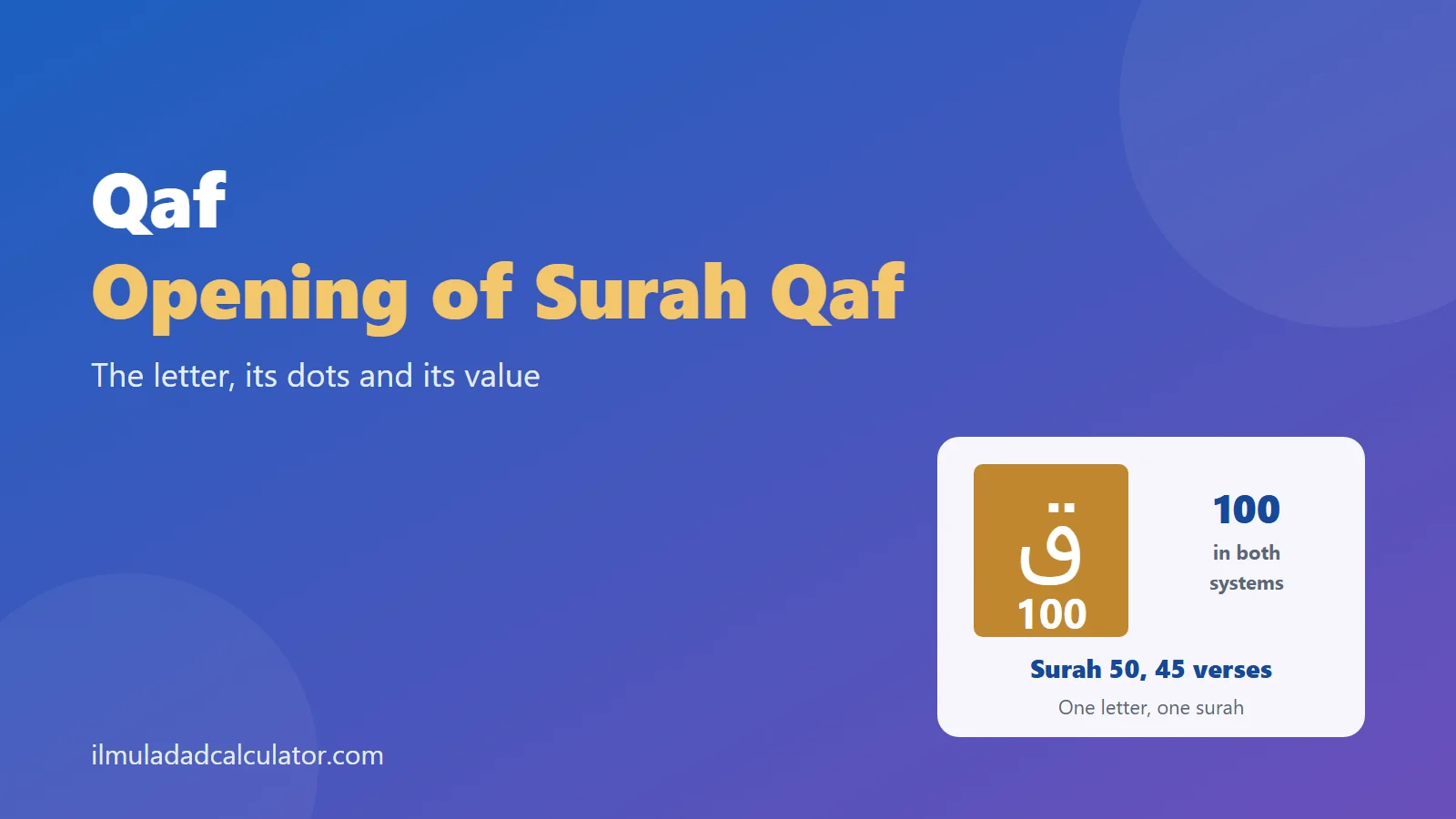
Qaf (ق) is the single letter that opens surah 50 of the Quran, which carries the same name. The letter is worth 100 in the Abjad system. It also returns once more inside the longer opening of surah 42.
What Is Qaf in the Opening of Surah 50?
Qaf is one of the huruf muqattaat, the disjointed letters that open 29 surahs. It stands alone at the start of its surah, with no other letter beside it. Only Sad and Nun share this single-letter pattern.
The most widely held position is that the meaning of these letters is known with certainty only to God. Commentators have also proposed several explanations over the centuries. The huruf muqattaat overview sets out those views, so they are not repeated here.
Quick answer: Qaf opens surah 50, which has 45 verses and is classed as Meccan. The letter is 100 in both the Mashriqi and Maghribi systems.
This page is a reference, not a commentary. It covers the surah’s basic facts, how the letter is drawn and sounded, and what it adds up to.
What Are the Basic Facts About Surah 50?
The surah takes its name from the letter that opens it. The table gathers the main facts in one place.
| Item | Detail |
|---|---|
| Surah number | 50 |
| Verses | 45 |
| Rukus | 3 |
| Words and letters | 373 words, 1,507 letters |
| Classification | Meccan |
| Position | Juz 26 |
| Neighbors | Al-Hujurat (49) before it, Adh-Dhariyat (51) after it |
| Revelation order | 34th (Egyptian standard), 54th (Noldeke) |
| Other Arabic title | The list also gives al-Baasiqat as an alternative title |
| Rank among the 29 lettered openings | 28th |
The two revelation orders in the table do not agree, which is common for these lists. Printed order and revelation order are two separate things, and scholars have reconstructed the second from reports.
The Letter Is Not a Verse by Itself
In some openings the letters form a whole verse alone. Wikipedia’s table of the muqattaat marks Qaf as not a complete verse. The letter shares verse 1 with the words that follow it.
So the verse count of 45 is not changed by the letter standing apart. The letter is simply the first word of verse 1.
How Is Surah 50 Laid Out by Verse Range?
Wikipedia gives a short summary of the surah by verse range. The table below paraphrases it in neutral terms and adds no commentary of its own.
| Verses | Subject, in brief |
|---|---|
| 1 | The letter and a mention of the Quran |
| 2 to 5 | People express surprise at the idea of a return after death |
| 6 to 11 | Features of the natural world are given as signs |
| 12 to 15 | Earlier peoples who rejected their messengers are recalled |
| 16 to 18 | The nearness of God, and the recording of speech and deeds |
| 19 to 22 | Death and the day of reckoning |
| 24 to 35 | Accounts of the hereafter for those who denied and for those who believed |
| 36 to 38 | Earlier generations as a warning, and the creation of the heavens and earth |
| 39 to 45 | Patience is urged, and the closing reminder that the task is to warn |
The source summary skips verse 23. The surah is classed as a Meccan one, and its dominant theme in the same article is resurrection and judgment. This page does not discuss the content any further.
How Is the Letter Qaf Written?
Qaf is spelled قاف and is the 21st letter of the Arabic alphabet in the usual order. In the Abjad order it is the 19th. The standard form has a round bowl that dips below the line, with two dots above it.
Like most Arabic letters, it changes shape by position. Wikipedia lists four forms: isolated ق, final ـق, medial ـقـ and initial قـ. The two dots stay above the letter in every form.
Mashriqi and Maghribi Dots
The eastern, or Mashriqi, style puts two dots above qaf, while the western, or Maghribi, style traditionally uses one. Wikipedia adds that older Maghribi writing sometimes left qaf unpointed. This happened when it stood alone or ended a word.
This is where fa comes in. In the Maghribi style fa takes a dot below, so the two letters are not confused. In the Mashriqi style fa has one dot above, and qaf has two.
The same source notes that Libya and Algeria mostly use the two-dot Mashriqi form today. So the single-dot qaf is mainly a feature of older manuscripts and of some North African styles.
Letters That Look Alike
Qaf has near neighbors in shape and in dots. The table puts the four most likely to be confused side by side.
| Letter | Name | Dots | Alphabet place | Abjad value |
|---|---|---|---|---|
| ق | qaf | two dots above | 21 | 100 |
| ف | fa | one dot above | 20 | 80 |
| ت | ta | two dots above | 3 | 400 |
| ن | nun | one dot above | 25 | 50 |
How Is Qaf Written in Urdu?
Urdu uses the same letter, with the name قاف. Wikipedia’s page on the Urdu alphabet gives it the sound /q/ and places it 27th in Urdu dictionary order. The Urdu alphabet counts up to 39 or 40 letters, so its order differs from the Arabic one.
The same page notes that in Nastaliq a hamza can look like two dots above, as in ت and ق. For the wider set of letters, see the Urdu and Persian letters page.
How Is Qaf Pronounced?
In Modern Standard Arabic, qaf is a voiceless uvular stop, written /q/ in phonetic symbols. It is made far back in the mouth, farther back than the English k. Some English speakers hear it as a deep k sound.
Spoken dialects vary. Wikipedia lists a g sound in much of Arabia and a glottal stop in the Levant and Egypt. Rural Palestinian speech uses a k sound.
In Urdu, speakers often say /q/ or /k/. The letters of the opening are read by name, so a reader says qaf. The muqattaat pronunciation page covers how all of the letters are named.
What Is the Abjad Value of Qaf?
Qaf is the 19th letter of the Abjad order and counts as 100. It is the first of the hundreds, right after the tens end with sad at 90. In the Maghribi order it also counts as 100.
ق 100 = 100
- Take the single letter ق.
- Look up its value in the letter values chart: 100.
- Check the second system. The Maghribi order gives 100 as well.
Qaf is one of the letters that does not change between the two systems. Some letters do change, such as sad, which is 90 in one and 60 in the other. The page on why values differ explains the cause.
The Spelled-Out Name
The letter name is itself a word of three letters, قاف. Its parts are qaf (100), alif (1) and fa (80). The total is 181 in both systems.
The number 181 belongs to the word قاف, not to the opening. The opening is one letter, and its value is 100. The spelling changes value page explains why a longer spelling gives a different total.
Please note: these sums show how letters are counted. They do not show what the letter means, and this site reads no meaning into any total.
Where Else Does Qaf Appear Among the Openings?
Across the 29 openings, Qaf appears twice. The first time is the single-letter opening of surah 50. The second is inside the longer opening of surah 42, ash-Shura.
- Surah 42 begins with Ha Mim, then adds a second opening, عسق, which is read as ain, sin, qaf.
- Qaf is the last letter of that group. Qaf and ain keep their values in both systems, while sin does not.
- The engine gives 230 for the group in the Mashriqi order and 470 in the Maghribi order.
The gap of 240 comes entirely from sin, which is 60 in one order and 300 in the other. The group has its own page, Ain Sin Qaf. The Ha Mim page covers the six surahs that open with Ha Mim.
Ash-Shura has 53 verses and is Meccan, according to the same list of chapters. So the letter appears in two Meccan surahs. In one it stands alone, and in the other it is part of a group.
How Does Qaf Compare With the Other Single-Letter Openings?
Three surahs open with one letter alone. Their numbers rise by 12 each time, from 38 to 50 to 68.
| Surah | Letter | Name | Verses | Mashriqi | Maghribi |
|---|---|---|---|---|---|
| 38 | ص | Sad | 88 | 90 | 60 |
| 50 | ق | Qaf | 45 | 100 | 100 |
| 68 | ن | Nun | 52 | 50 | 50 |
Qaf has the highest value of the three and the fewest verses. It sits between the two others in the book. See also the pages for Sad and Nun.
Wikipedia notes that four or five surahs are named after their opening, and Qaf is always counted among them.
Altogether the 29 openings use 78 letters, counting repeats. Qaf accounts for two of them.
Where Does the Letter Come From?
Arabic qaf descends from the Phoenician letter called qop. That letter is also the source of the Latin Q and the Greek qoppa. The Hebrew form is qof, and it shares the numeral value 100, as Wikipedia lists for the Hebrew letter.
The origin of the shape is uncertain, with a needle’s eye and the back of the head both suggested. One account says the Arabic word qaf meant the nape. These are proposals only.
The Hebrew letter is often spelled kuf in Ashkenazi usage. That spelling can lead people to confuse it with kaf, which is a different letter.
How Do English Writers Spell It?
English texts show the name in several ways. None of them is official, because each is only a way to show the Arabic sounds in Latin letters.
| Spelling | Where it is seen |
|---|---|
| Qaf | Plain form, and the title of the English Wikipedia article |
| Qāf | Scholarly style with a long-vowel mark |
| q or ḳ | Transliteration of the letter itself |
| Surah Qaf | The chapter, as opposed to the single letter |
Every variant points to the same Arabic letter, ق, with the value 100. The spelling changes the Latin form only.
How Can You Check the Value Yourself?
You can confirm the number with any ordinary tool. Type ق into the Abjad value calculator and read the total. The multi-system calculator shows the Mashriqi and Maghribi totals together.
The compare tool lets you set the letter beside its name. The steps for doing it by hand are on the calculate by hand page. For how the full set fits together, see muqattaat and Abjad and the full list of all 29 surahs.
خلاصہ
قاف قرآن کی پچاسویں سورت کے شروع میں آنے والا اکیلا حرف ہے۔ یہ سورت مکی ہے اور اس کی پینتالیس آیات ہیں۔ ابجد میں قاف کی قدر ایک سو ہے اور مشرقی اور مغربی دونوں ترتیبوں میں یہی رہتی ہے۔ یہ حرف سورہ شوریٰ کے عسق میں بھی آتا ہے۔ سب سے مشہور رائے یہ ہے کہ ان حروف کا یقینی مطلب صرف اللہ جانتا ہے۔ یہ صفحہ صرف حقائق اور گنتی بیان کرتا ہے۔
Sources and Further Reading
- Qaf (surah), Wikipedia. Surah number, 45 verses, Meccan classification, juz 26, neighbors, word and letter counts, and the summary by verse range.
- List of chapters in the Quran, Wikipedia. Verse counts, revelation order and the alternative title for surah 50, and the verse count of surah 42.
- Muqattaʿat, Wikipedia. The 29 openings, the chapters named after their letters, and the table marking the letter as not a complete verse.
- Qaf (letter), Wikipedia. Letter forms, dots in Mashriqi and Maghribi styles, pronunciation and origin.
- Urdu alphabet, Wikipedia. The Urdu name, sound and dictionary order of the letter.
- Letter values and sums come from this site’s tested engine. See the methodology.
Frequently Asked Questions
What does the letter Qaf mean at the start of surah 50?
The most widely held view is that its meaning is known with certainty only to God. Commentators have also proposed several explanations.
Which surah starts with Qaf?
Surah 50, also called Qaf. It has 45 verses and is classed as Meccan.
What is the Abjad value of Qaf?
It is 100 in both the Mashriqi and the Maghribi systems. This is arithmetic only.
Does Qaf appear in any other opening?
Yes. It is the last letter of Ain Sin Qaf, the second opening of surah 42, ash-Shura.
How does Maghribi qaf differ from Mashriqi qaf?
The Maghribi style traditionally writes qaf with one dot above, and fa with one dot below. The Mashriqi style uses two dots above qaf.
Is the spelled-out name the same value as the letter?
No. The letter is 100. The name, written qaf alif fa, adds up to 181 because it has three letters.