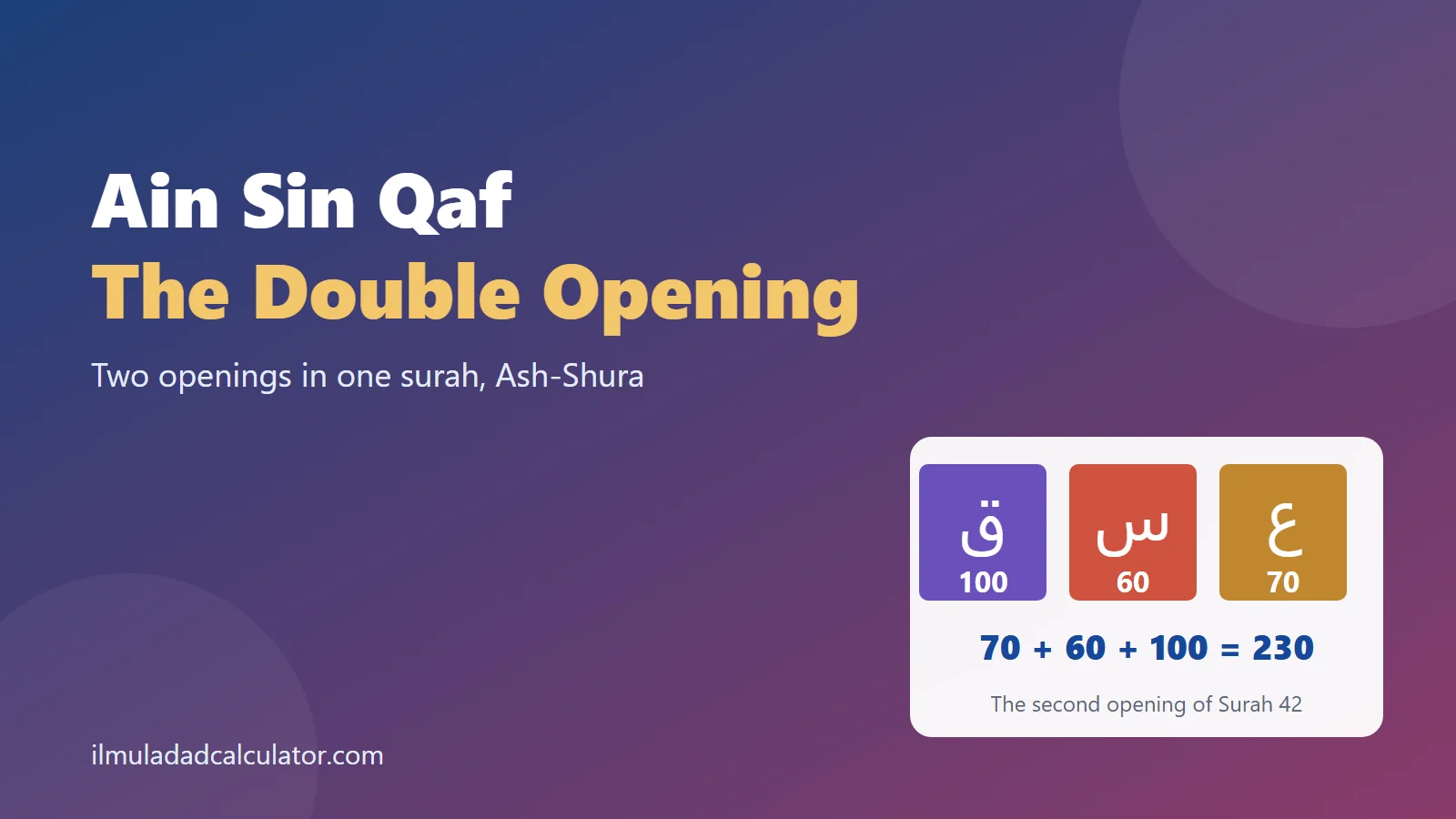
Ain Sin Qaf (عسق) is the second of two openings at the start of Surah ash-Shura, the 42nd surah. This is the only surah that begins with two separate groups of letters. The three letters have Abjad values of 70, 60 and 100, and the sum is 230.
What Does Ain Sin Qaf Mean?
The most widely held position is that its meaning is known with certainty only to God. This is a statement about the majority view, and it is the general answer in classical commentary.
Ain Sin Qaf belongs to the huruf muqattaat, the disjointed letters that open 29 surahs. The range of explanations is set out neutrally on the huruf muqattaat overview. This page does not repeat it.
Quick answer: Ain Sin Qaf is verse 2 of Surah 42, right after Ha Mim. It is read as three letter names. Its Abjad sum is 230 in the Mashriqi system and 470 in the Maghribi system.
This page is a reference, not a commentary. It reports where the opening stands and how it is numbered. It also shows how the letters are written and what they add up to.
Where Does Ain Sin Qaf Sit in Surah ash-Shura?
Surah ash-Shura is the 42nd chapter of the Quran. Its name is usually translated as Council or Consultation. The word shura occurs once in the text, in verse 38.
| Fact | Detail |
|---|---|
| Number and name | 42, Ash-Shura |
| Verses | 53 |
| Place of revelation | Meccan |
| Juz | 25 |
| Rukus | 5 |
| Words and letters | 983 words and 3,473 letters, as listed by Wikipedia |
| Surah before it | 41, Fussilat, which opens with حم |
| Surah after it | 43, Az-Zukhruf, which opens with حم |
Both neighbors begin with the same letters as the first opening of Ash-Shura. For that reason the surah is placed in the Ha Mim run, covered on the Ha Mim page.
The page you are reading is about the second part of the opening only. Ha Mim is covered in full on its own page and is not described again here.
How Are the Two Openings Numbered?
In the standard count, the two openings are two verses. Verse 42:1 is حم and verse 42:2 is عسق. Quran.com shows them this way, each with its own verse number.
Wikipedia’s table of the 29 openings has a column for whether the letters form a complete verse. For Ash-Shura the entry reads “Yes, 2”, because both groups are complete verses. Sad, Qaf and Nun are marked No in the same table.
Why Do Verse Counts Differ Between Traditions?
Scholars of the Quran have long noted that traditions of counting verses differ in where some verses end. The Kufan count, which the Hafs narration follows, gives 6,236 verses in the whole Quran.
Other early traditions give slightly different totals. These differences concern where a verse is marked, not the words of the text. The figure of 53 verses for Ash-Shura follows the standard count.
Why Is a Double Opening Unusual?
Every other opening in the Quran is one group of letters. Ash-Shura is the single surah where two groups follow each other, each in its own verse. Wikipedia lists both groups in a single row for the surah.
The numbers around the double opening give it some context:
- 29 surahs open with letters, and together they carry 78 letters.
- Ash-Shura contributes 5 of those 78 letters, 2 in verse 1 and 3 in verse 2.
- Ha Mim stands alone at the start of 6 other surahs, from 40 to 46 apart from 42.
- Ain Sin Qaf is found in no other surah.
The 14 combinations are therefore counted with عسق as one of them. Some lists instead write the five letters as a single حم عسق opening. That is why Ash-Shura is sometimes described with five letters, like Kaf Ha Ya Ain Sad.
What Are the Letter Names in Ain Sin Qaf?
As with the other openings, the letters are read by their names and not as a word. Ain is the name of ع, sin is the name of س and qaf is the name of ق.
The written names are made of letters too.
In Urdu the first name is usually spelled with a ye, as عین. The engine gives it the same value as the Arabic spelling. The table shows each letter and its name in both systems.
| Letter | Name | Written name | Letter, Mashriqi | Letter, Maghribi | Name, Mashriqi | Name, Maghribi |
|---|---|---|---|---|---|---|
| ع | ain | عين | 70 | 70 | 130 | 130 |
| س | sin | سين | 60 | 300 | 120 | 360 |
| ق | qaf | قاف | 100 | 100 | 181 | 181 |
The three written names add to 431 in the Mashriqi system and 671 in the Maghribi system. These are plain sums of spelled-out names, and they carry no extra meaning.
What Is the Abjad Value of Ain Sin Qaf?
Ain is the sixteenth letter of the Abjad order and counts as 70. Sin is 60 and qaf is 100. Adding the three gives the Mashriqi total.
ع 70 + س 60 + ق 100 = 230
The Maghribi system gives a different total, because sin is not placed in the same slot there. Ain and qaf keep their values, but sin becomes 300.
ع 70 + س 300 + ق 100 = 470
| Letter | Mashriqi | Maghribi |
|---|---|---|
| ع | 70 | 70 |
| س | 60 | 300 |
| ق | 100 | 100 |
| Sum | 230 | 470 |
The reason for this split is explained on the why values differ page. The two letter orders are compared on the Abjad and hijai order page.
What Is the Value of the Whole Double Opening?
Ha Mim has the sum 48 in both systems. Adding it to Ain Sin Qaf gives 278 in the Mashriqi system and 518 in the Maghribi system. Writing the five letters with or without a space makes no difference to the engine.
Please note: these totals are arithmetic only. This site reads no hidden meaning into any sum. It does not endorse numerological claims about the letters.
What Comes Right After the Opening?
Verse 42:3 follows the two openings. In the Clear Quran translation it speaks of revelation sent to the Prophet, as to those before him. This is a plain description of the text, not an interpretation.
Wikipedia notes that in all but three of the 29 cases, mention of the revelation follows almost at once. The exceptions it names are al-Ankabut, ar-Rum and al-Qalam. Ash-Shura is therefore one of the majority.
The pillar page describes this pattern in general terms. Whether it carries any significance is a question for commentators, and this page takes no side.
Where Else Do Ain, Sin and Qaf Appear Among the Openings?
Each of the three letters turns up in other openings, but only Surah 42 holds all three together. The figure below marks the surahs that contain each letter.
- Ain is in 2 openings: Kaf Ha Ya Ain Sad in Surah 19 and Ain Sin Qaf in Surah 42.
- Sin is in 5 openings: Ta Sin Mim in surahs 26 and 28, and Ta Sin in 27. It is also in Ya Sin in 36 and Ain Sin Qaf in 42.
- Qaf is in 2 openings: Ain Sin Qaf in Surah 42 and the single letter Qaf in Surah 50.
The full list of the 29 surahs shows every opening in one table. Sin is the most spread of the three, and ain and qaf are each limited to two surahs.
How Is Ain Sin Qaf Written?
The letters are written close together, as one string, عسق. Wikipedia’s alphabet article notes that only six Arabic letters refuse to join the letter after them. Ain, sin and qaf are not among them, so all three connect on both sides.
Dots and Marks
Ain and sin carry no dots. Qaf carries two dots above. The dots are part of the letter and tell it apart from similar shapes.
Printed copies often add a small prolongation mark over each letter, as in عٓسٓقٓ. These marks guide the reader. The engine ignores them, so the marked form still gives 230.
The Maghrebi Form of Qaf
There is a traditional Maghrebi form of qaf. Wikipedia describes it as generally dotless when isolated or final, and dotted when initial or medial.
In Ain Sin Qaf the qaf comes last, so this regional style would draw it without a dot. The muqattaat calligraphy page shows how different hands handle such letters.
Three Ways the Opening Is Set in Text
- As its own verse, عسق, numbered 2, as in the standard printed text.
- With a space after the first opening, as حم عسق, in lists and tables.
- Joined as one string, حمعسق, in some indexes and name lists.
All three forms give the same engine total, 278, because spaces and marks do not carry a value.
How Is the Name Spelled in English and Urdu?
English spellings of the name vary, because the letter ain has no direct English sound. The table shows forms that appear in the sources used for this page.
| Spelling | Where it appears |
|---|---|
| ʿAin Sīn Qāf | Wikipedia, Muqattaʿat |
| ’Aĩn-Sĩn-Qãf | Quran.com, transliteration of verse 42:2 |
In Urdu the three names are written عین, سین and قاف. Many Pakistani readers say them as ain, seen and qaaf. The pronunciation of the throat sound in ain differs between regions, and the pronunciation guide covers it.
This site uses Ain Sin Qaf in its titles. It matches the way the other openings are named on the words section.
How Can You Check the Opening Yourself?
- Open a printed Quran at Surah 42, Ash-Shura, and find the first line after the Bismillah.
- Read verse 1, حم, and note its verse marker.
- Read verse 2, عسق, and note that it has its own marker.
- Look up ain, sin and qaf in the letter values chart and add 70, 60 and 100.
- Compare your total with 230, or test it in the Abjad value calculator.
These steps rely only on the written text and simple addition. The muqattaat and Abjad page explains how such sums are worked and why they are only counting.
خلاصہ
سورۃ الشوریٰ قرآن کی بیالیسویں سورت ہے اور اس کی تریپن آیات ہیں۔ یہ واحد سورت ہے جس کے شروع میں حروف کے دو الگ گروہ آتے ہیں: پہلی آیت حم اور دوسری آیت عسق۔ عسق کو عین، سین اور قاف کے نام لے کر الگ الگ پڑھا جاتا ہے۔ ابجد میں ان کی قدریں ستر، ساٹھ اور سو ہیں اور مجموعہ دو سو تیس بنتا ہے۔ سب سے مشہور رائے یہ ہے کہ ان کا یقینی مطلب صرف اللہ جانتا ہے۔ یہ صفحہ صرف حقائق اور گنتی بیان کرتا ہے۔
Sources and Further Reading
- Muqattaʿat, Wikipedia. The table of the 29 openings, the entry for Ash-Shura, the 78 letters, the 14 combinations and the majority view.
- Ash-Shura, Wikipedia. Surah number, 53 verses, Meccan setting, juz, rukus, word and letter counts, neighboring surahs and the origin of the name.
- Quran 42:2, Ash-Shuraa and Quran 42:1-3, Quran.com. The separate numbering of verses 1 and 2 and the transliterations.
- Arabic alphabet, Wikipedia. Joining behavior of letters and the Maghrebi form of qaf.
- What Is the Total Number of Words, Verses, and Letters in the Quran?, SeekersGuidance. Differences between counting traditions and the Kufan total.
- Letter values and sums come from this site’s tested engine. See the methodology.
Frequently Asked Questions
What does Ain Sin Qaf mean?
The most widely held view is that its meaning is known with certainty only to God. Commentators have also proposed several explanations.
Which surah starts with Ain Sin Qaf?
Surah ash-Shura, the 42nd surah. Ain Sin Qaf is verse 2, and Ha Mim is verse 1.
Is Ain Sin Qaf part of Ha Mim?
No. It is a second opening in the same surah, with its own verse number. Ha Mim is a separate group of letters.
What is the Abjad value of Ain Sin Qaf?
Ain is 70, sin is 60 and qaf is 100, so the Mashriqi sum is 230. The Maghribi sum is 470 because sin is 300 there.
How is Ain Sin Qaf read aloud?
As three letter names, one after the other: ain, sin, qaf. It is not read as one word.
Does the sum 230 have a hidden meaning?
No. It is the total of three letter values, and this site makes no claim of any hidden meaning.