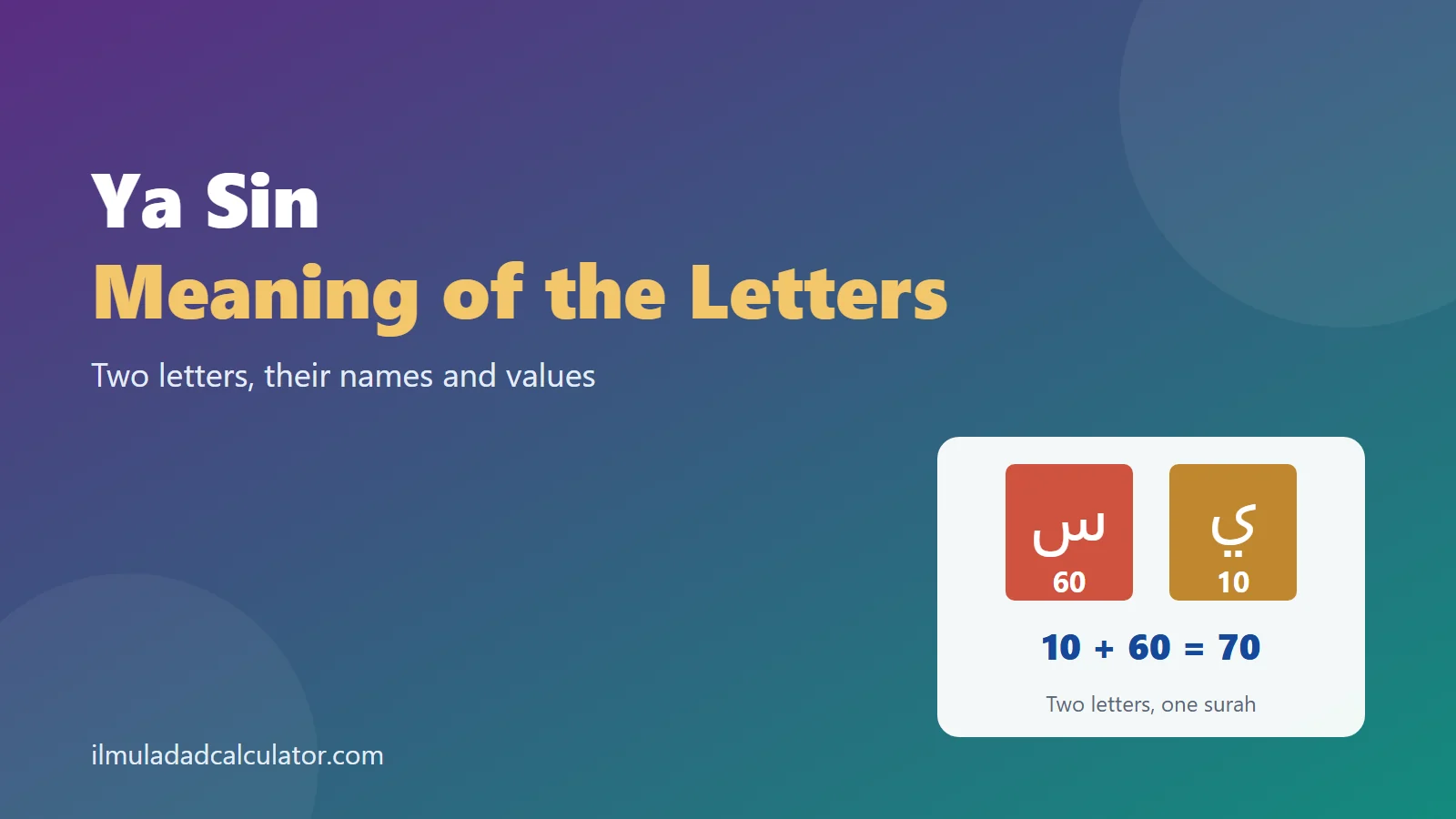
Ya Sin (يس) is the opening of surah 36 of the Quran. It is made of just two letters, ya and sin. Their Abjad values are 10 and 60, and the sum is 70.
What Do the Letters Ya Sin Mean?
The most widely held position is that their meaning is known with certainty only to God. This describes the majority view, and it is the usual answer in classical commentary.
Ya Sin belongs to the huruf muqattaat, the disjointed letters that open 29 surahs. Commentators have offered several explanations. They are set out on the huruf muqattaat overview, so they are not repeated here.
Quick answer: Ya Sin is a two-letter opening, ya (10) and sin (60), total 70. It opens surah 36 only. Most hold its meaning to be known only to God.
This page is a reference, not a commentary. It reports where the letters stand, how they are named and written, and what they add up to. It does not describe the surah itself and it does not choose between views.
Which Surah Opens With Ya Sin?
Only one surah opens with these two letters. It is surah 36, which carries the same name, Ya Sin. No other surah shares the opening.
That sets it apart from Alif Lam Mim, which opens six surahs. Ya Sin stands alone, in the same way as Sad, Qaf and Nun.
| Item | Detail |
|---|---|
| Surah number | 36 |
| Verses | 83 |
| Classification | Meccan |
| Position | Juz 22 to 23 |
| Neighbors | Fatir (35) before it, As-Saffat (37) after it |
| Revelation order | 41st in the Egyptian standard list |
| Rank among the 29 lettered openings | 19th |
Wikipedia also gives the size of the surah as 730 words and 2,988 letters, arranged in five rukus. These are plain counts of the text, and they say nothing about the opening itself.
The Opening Is the First Verse
The two letters form the first verse of the surah by themselves. That is why the verse count of 83 includes a first verse of only two letters.
The surah is also one of four or five chapters that are named after their opening letters. The others are Ta Ha, Sad, Qaf and, in some lists, Nun.
How Are Ya and Sin Named and Written?
The two letters are read by name. Ya is spelled يا and sin is spelled سين. The group is read as ya, then sin, with a short stop between them.
In the printed Quran the pair is written يس, often with a small prolongation mark over the sin. The engine on this site ignores that mark, so the plain and marked forms both give 70.
Arabic Ya and Urdu Ye
Arabic ya carries two dots under it in every position. Urdu and Persian use a related form, written ی, whose dots are dropped at the end of a word. For the opening, the Urdu spelling یس has the same value, 70.
Sin has three small teeth and no dots, so it is easy to tell apart from shin. The Urdu and Persian letters are covered on the Urdu and Persian letters page.
In ordinary Arabic and Urdu words, ya can stand for a consonant or a long vowel. In the opening it is read only as a letter name.
For the sounds and the spoken length of each letter, see the muqattaat pronunciation page. For the pen and the page, see the muqattaat calligraphy page.
How Can You Find the Opening in a Printed Quran?
A printed copy makes the opening easy to spot. Follow these steps.
- Turn to surah 36, which comes right after Fatir, surah 35.
- Find the line after the Bismillah at the top of the surah.
- Read the two letters, يس, which carry the first verse marker.
Many Pakistani readers say the names as ya seen. The sounds shift a little between regions, but the two-part reading stays the same.
What Are the Abjad Values of Ya and Sin?
Ya is the tenth letter of the Abjad order and counts as 10. Sin is the fifteenth and counts as 60. The sum follows by plain addition.
ي 10 + س 60 = 70
- Take each letter in turn: ي then س.
- Look up its value in the letter values chart: 10 and 60.
- Add the two values to get 70.
Two orders are in use. In the Mashriqi order sin is 60, and in the Maghribi order it counts as 300.
The same two letters therefore total 310 in the Maghribi order. That figure is arithmetic only, and the page on why values differ explains the cause.
| Letter | Name | Alphabet place | Abjad place | Mashriqi | Maghribi |
|---|---|---|---|---|---|
| ي | ya | 28 | 10 | 10 | 10 |
| س | sin | 12 | 15 | 60 | 300 |
The two letters sit far apart in the everyday alphabet, at 28 and 12. In the Abjad order they are at 10 and 15. The gap between the two lists is described on the Abjad and hijai order page.
Please note: the sum 70 shows how the letters are counted. It does not show what they mean, and this site reads no meaning into it.
How Is Ya Sin Spelled in English?
Writers use several Latin spellings for the same two letters. None is official, because each one is only a way to show the Arabic sounds in English letters.
| Spelling | Where it is seen |
|---|---|
| Ya-Sin | Title of the English Wikipedia article |
| Yā-Sīn | Scholarly style with long-vowel marks |
| Yasin | Plain form, also used for the name |
| Yaseen | Common spelling of the name and the surah |
The spelling in English letters does not change the Arabic form. Every variant above points to the same two letters, يس, with the value 70.
Yasin as a Given Name
Yasin, Yassin and Yaseen are also used as given names. Wikipedia lists them as Arabic-based names. In Arabic and Urdu the name is usually written ياسين.
That spelling is different from the opening. It writes out the two letter names, ya (11) and sin (120), one after the other. The total is 131 in the Mashriqi order and 371 in the Maghribi order.
So a name and an opening can sound alike and still add up to different numbers. The reason is explained on the spelling changes value page. This page makes no claim about how the name and the letters relate in meaning.
How Does Ya Sin Compare With the Other Short Openings?
Five surahs open with a very short opening of one or two letters. The table puts them side by side, with the engine value of each.
| Surah | Opening | Name | Letters | Value | Verses |
|---|---|---|---|---|---|
| 20 | طه | Ta Ha | 2 | 14 | 135 |
| 36 | يس | Ya Sin | 2 | 70 | 83 |
| 38 | ص | Sad | 1 | 90 | 88 |
| 50 | ق | Qaf | 1 | 100 | 45 |
| 68 | ن | Nun | 1 | 50 | 52 |
Ya Sin is the only one of the five with a value of 70. Sad and Qaf are single letters. Ta Ha and Ya Sin are the two-letter openings in the set.
Do Ya and Sin Appear in Other Openings?
Yes, each letter returns elsewhere in the list of 29. Ya appears in 2 openings and sin appears in 5.
- Ya appears in كهيعص (Kaf Ha Ya Ain Sad) and in يس itself.
- Sin appears in طسم (twice, in surahs 26 and 28), in طس, and in حم عسق.
The first of these is covered on the Kaf Ha Ya Ain Sad page. The last is the second opening of ash-Shura, described on the Ha Mim page. The full list of all 29 surahs shows every opening in one table.
Where Do Ya and Sin Rank Among the 14 Letters?
Across all 29 openings, only 14 different letters appear. That is half of the 28-letter alphabet. Ya and sin are two of the 14.
The table counts how many of the 29 openings contain each letter. Mim leads with 17, followed by alif and lam with 13 each. Sin comes sixth with 5, and ya sits in the lower half with 2.
| Rank | Letter | Name | Openings | Value |
|---|---|---|---|---|
| 1 | م | mim | 17 | 40 |
| 2 | ا | alif | 13 | 1 |
| 3 | ل | lam | 13 | 30 |
| 4 | ح | ha | 7 | 8 |
| 5 | ر | ra | 6 | 200 |
| 6 | س | sin | 5 | 60 |
| 7 | ط | ta | 4 | 9 |
| 8 | ص | sad | 3 | 90 |
| 9 | ه | ha | 2 | 5 |
| 10 | ي | ya | 2 | 10 |
| 11 | ع | ain | 2 | 70 |
| 12 | ق | qaf | 2 | 100 |
| 13 | ك | kaf | 1 | 20 |
| 14 | ن | nun | 1 | 50 |
Ranks are listed in the order of the count, and ties follow the Abjad value. The count treats Ha Mim Ain Sin Qaf as one opening, so a letter is counted once per opening.
Is the Opening the Same as the Surah?
People use the words Ya Sin in two ways. One use names the surah as a whole, and the other names only its two opening letters.
This page deals with the second use. It looks at the written letters, how they are named, and what they add up to. The surah itself, with its themes and its place in daily life, is outside its scope.
The same split applies to Ta Ha, Sad, Qaf and Nun. In each case the surah carries the name of its opening. A reader must decide which one a source means.
How Can You Check the Value Yourself?
You can confirm the sum with any ordinary tool. Type يس into the Abjad value calculator and read the total. The multi-system calculator shows the Mashriqi and Maghribi totals together.
Doing it by hand is just as quick, and the steps are on the calculate by hand page. The methodology page describes how the engine treats marks such as the prolongation sign.
How Does Ya Sin Connect to Abjad?
The link is only through counting. Ya and sin are ordinary letters, so each has a value, and the total follows from the chart. Writers in earlier centuries added up such openings, and the muqattaat and Abjad page gives that wider background.
The words and phrases section holds more reference pages like this one. The Alif Lam Mim page is a good companion for a longer opening.
The introduction to ilm-ul-adad explains the whole system from the start.
خلاصہ
یٰسین قرآن کی چھتیسویں سورت کے شروع میں آنے والے دو حروف ہیں: یا اور سین۔ یہ سورت مکی ہے اور اس کی تراسی آیات ہیں۔ ابجد میں یا کی قدر دس اور سین کی ساٹھ ہے، اس لیے مجموعہ ستر بنتا ہے۔ سب سے مشہور رائے یہ ہے کہ ان حروف کا یقینی مطلب صرف اللہ جانتا ہے۔ یہ صفحہ صرف حقائق اور گنتی بیان کرتا ہے۔
Sources and Further Reading
- Ya-Sin, Wikipedia. Surah number, 83 verses, Meccan classification, juz 22 to 23, and neighboring surahs.
- List of chapters in the Quran, Wikipedia. Verse counts, revelation order, and the translator’s note on the phrase reading.
- Muqattaʿat, Wikipedia. The 29 openings, their order, and the chapters named after their letters.
- Yasin, Wikipedia disambiguation page. Spelling variants of the name.
- Letter values and sums come from this site’s tested engine. See the methodology.
Frequently Asked Questions
What is the meaning of the letters Ya Sin?
The most widely held view is that their meaning is known with certainty only to God. Commentators have also proposed several explanations.
Which surah starts with Ya Sin?
Surah 36, also called Ya Sin. It has 83 verses and is classed as Meccan.
What are the letters of Ya Sin?
Ya (ي) and sin (س), read as two letter names one after the other.
What is the Abjad value of Ya Sin?
Ya is 10 and sin is 60, so the sum is 70. In the Maghribi order sin is 300 and the sum is 310.
Is Yasin the same as Yaseen?
Both are English spellings of the same Arabic word. The spelling varies because the Arabic sounds can be written in several ways.
Does the name Yasin have the same value as the opening?
No. The opening يس is 70. The name written ياسين is 131 because it spells out both letter names.