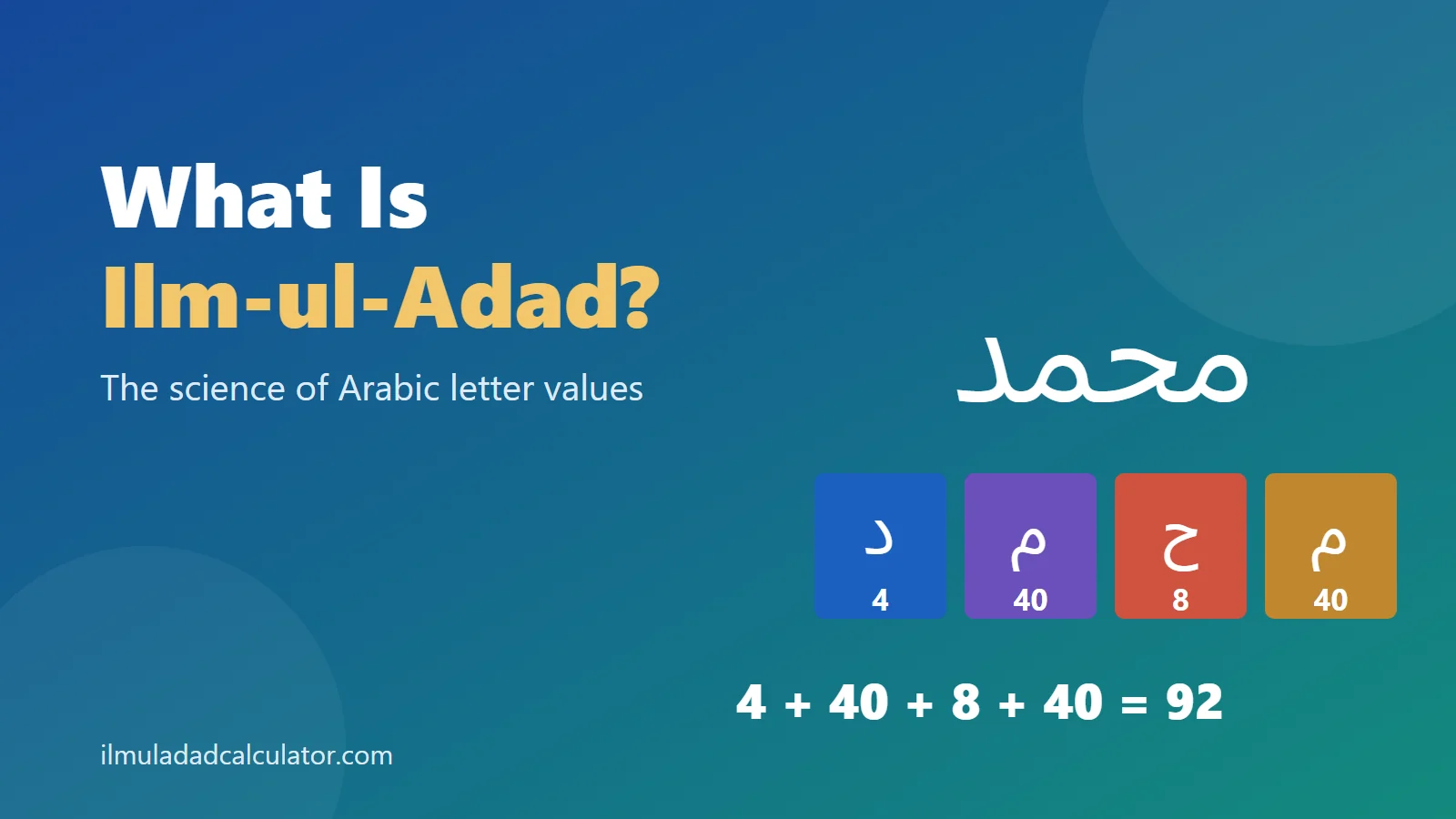
Ilm-ul-Adad (علم الاعداد) gives each of the 28 Arabic letters a fixed number, from alif (1) to ghayn (1000). Adding the letters of a word gives its total, so محمد equals 92 in the Mashriqi system. Scholars and poets used these values to write numbers and record dates.
What Does Ilm-ul-Adad Mean?
The name joins two Arabic words. Ilm means knowledge or science, and adad means number. So Ilm-ul-Adad means “the science of numbers.”
Urdu speakers often write it علمِ اعداد and say ilm-e-adad. English sources spell it Ilm ul Adad, Ilm-e-Adad or Ilm al-Adad. All of these spellings name the same subject.
The letter values behind it have other names too. Arabic sources call them hisab al-jummal, or the reckoning of totals. English books usually say abjad numerals, after the first four letters: alif, ba, jim and dal.
How Does Ilm-ul-Adad Work?
Every letter has a place in a fixed sequence called the abjad order. The first nine letters count from 1 to 9. The next nine count by tens, from 10 to 90.
The next nine count by hundreds, from 100 to 900. The last letter, ghayn, stands for 1000. That makes 28 letters in all.
A Worked Example
To find a total, write the word in Arabic letters and add the value of each letter. Short vowel marks are not counted. Here is the name Muhammad in the Mashriqi system:
م 40 + ح 8 + م 40 + د 4 = 92
The same steps work for any word. The name of God, الله, gives 66. The full Bismillah, بسم الله الرحمن الرحيم, gives 786.
The Counting Rules in Brief
A few rules decide how each written form is counted. This site follows the most common conventions:
- Short vowel marks, such as fatha and kasra, have no value.
- A shadda does not double a letter. The letter counts once.
- Ta marbuta (ة) counts as ha, so it is worth 5.
- A hamza on a seat takes the value of its seat. So أ is 1 and ؤ is 6.
- A standalone hamza (ء) is not counted by default. Some traditions count it as 1.
The calculation methods guide explains each rule with examples. The methodology page shows how the site tests its results.
The Eight Letter Groups
Learners remember the order with eight short group words. The words have no meaning of their own. They simply hold the letters in counting order.
| Group word | Letters | Values |
|---|---|---|
| أبجد | ا ب ج د | 1, 2, 3, 4 |
| هوز | ه و ز | 5, 6, 7 |
| حطي | ح ط ي | 8, 9, 10 |
| كلمن | ك ل م ن | 20, 30, 40, 50 |
| سعفص | س ع ف ص | 60, 70, 80, 90 |
| قرشت | ق ر ش ت | 100, 200, 300, 400 |
| ثخذ | ث خ ذ | 500, 600, 700 |
| ضظغ | ض ظ غ | 800, 900, 1000 |
The Arabic letter values table lists all 28 letters with their names and both systems.
Where Did the Letter Values Come From?
The abjad order is older than Arabic. It follows the letter order of the ancient Semitic alphabets, such as Phoenician, Aramaic and Hebrew. Those alphabets had 22 letters, ending with taw at 400.
Arabic has six letters those alphabets lacked: ث خ ذ ض ظ غ. They were placed after the old 22, with the values 500 to 1000. Scholars call them the rawadif, “the ones that follow.”
Hebrew and Greek also used letters as numbers. Before Indian digits came into wide use, Arabic writers used letters for all kinds of counting. Modern Arabic still uses أ, ب, ج to number lists, much like A, B, C in English.
What Is Ilm-ul-Adad Used For?
The documented uses are practical. They involve writing numbers, dating events and teaching the alphabet.
Writing Numbers With Letters
Letters can stand in for digits. Scribes wrote page numbers, chapter numbers and years this way in manuscripts. For example, 1446 is written غتمو: 1000 + 400 + 40 + 6.
The number to abjad numerals converter writes any number this way and explains the rule for thousands.
Recording Dates in Poetry
A chronogram is a line of verse whose letters add up to a year. Persian, Urdu and Ottoman poets wrote them for births, deaths and new buildings.
Most chronograms give a year in the Hijri calendar. That calendar counts from the Prophet’s migration to Medina in 622 CE.
The phrase خاک مصلی gives 791, the Hijri year the poet Hafez died. You can test any line with the chronogram decoder.
Short Forms Like 786
Many South Asian Muslims write 786 at the top of a letter. It stands for the Bismillah, whose letters total 786. Scholars differ on whether the number can replace the words.
The phrase value calculator shows the 786 working word by word, with the scholarly views.
Where Is It Used Today?
Letter values are still part of daily life in some places. Arabic textbooks number their lists with letters. In Pakistan and India, poets still write chronograms for mosques, books and graves.
Teachers of Arabic and Urdu also use the values in class. Adding up words is a simple way to practice reading the letters.
Is Ilm-ul-Adad a Science?
It is a science in the old sense of an organized body of knowledge. The values are fixed, and anyone can check a total by hand. Two careful people will always reach the same answer.
It is not a science in the modern, experimental sense. No study shows that a letter total affects a person’s life. The parts you can test are the arithmetic and the history.
The page on the reality of Ilm-ul-Adad puts the common claims to the test.
What Ilm-ul-Adad Is Not
A letter total is a fact about spelling. It says nothing about the person or thing a word names. Two people whose names are spelled the same share the same total.
In some traditions, people link numbers to luck, character or the future. This site does not make those claims. Islamic teaching forbids fortune-telling (kahana), and many scholars warn against using numbers to predict events.
Spelling also changes the result. The name Rashid can be written رشيد (514) or راشد (505). Always check which spelling a source used.
Mashriqi and Maghribi: The Two Main Systems
There are two main sets of values. The Mashriqi (Eastern) system is used in most of the Muslim world, including South Asia. The Maghribi (Western) system was used in North Africa and al-Andalus.
Six letters have different values in the two systems: س ص ش ض ظ غ. The word صبر (patience) is 292 in Mashriqi and 262 in Maghribi.
This site uses Mashriqi by default. The Mashriqi and Maghribi comparison tool shows both totals side by side.
How Do Urdu and Persian Letters Count?
Urdu and Persian use letters that Arabic lacks, such as پ, چ, ژ and گ. Each one takes the value of the Arabic letter it is built from. So پ counts as ب (2), and گ counts as ک (20).
Urdu also has ٹ, ڈ and ڑ. They count as ت, د and ر. Here is the Urdu name Parvez:
پ 2 + ر 200 + و 6 + ی 10 + ز 7 = 225
How Is Ilm-ul-Adad Different From Related Terms?
| Term | What it means | How it relates |
|---|---|---|
| Abjad | The letter order, named after its first four letters | The system Ilm-ul-Adad is built on |
| Hisab al-jummal | “The reckoning of totals” | The Arabic name for the same values |
| Abjad numerals | Letters used as written numbers | The usual English name for the values |
| Gematria and isopsephy | Letter values in Hebrew and Greek | Parallel systems in other alphabets |
| Ilm al-huruf | A wider “science of letters,” often esoteric | Separate subject, not covered on this site |
How Can You Start Learning Ilm-ul-Adad?
- Learn the eight group words and their values from the letter values table.
- Test yourself with the Abjad quiz until you know each letter.
- Keep a printable letter value chart next to you while you practice.
- Add up a short name by hand, then check it with the Ilm-ul-Adad calculator.
- Move on to phrases and chronograms once single words feel easy.
Teachers can make practice sheets with the Abjad worksheet generator.
Sources and Further Reading
- Abjad numerals, Wikipedia. Covers the letter order, the Mashriqi and Maghribi sequences and the 786 total.
- Hebrew numerals and Greek numerals, Wikipedia. The parallel letter-number systems.
- Chronogram, Wikipedia. Dates hidden in verse, in Arabic script and in Latin.
- Our methodology and sources and bibliography pages explain how this site checks values.
Frequently Asked Questions
Is Ilm-ul-Adad the same as numerology?
No. Ilm-ul-Adad began as a way to write numbers with letters. Western numerology uses the Latin alphabet and claims to read character, which this site does not do.
Does the Quran mention Ilm-ul-Adad?
No. The Quran does not describe letter values. The system comes from the older alphabet order and was used by later scholars and poets.
Can I find the value of an English name?
Yes, once the name is written in Arabic or Urdu letters. The total depends on the spelling you choose, so check it with someone who reads Arabic.
Do vowel marks change the total?
No. Short vowel marks such as fatha and kasra have no value. A shadda does not make a letter count twice.
Which system should I use?
Use Mashriqi for most sources, including all South Asian ones. Use Maghribi for older North African or Andalusian texts.
Is it allowed to learn Ilm-ul-Adad?
Learning letter values to read dates and numbers is widely seen as harmless. Using them to predict events is different, and many scholars forbid it. Ask a qualified scholar about your own situation.