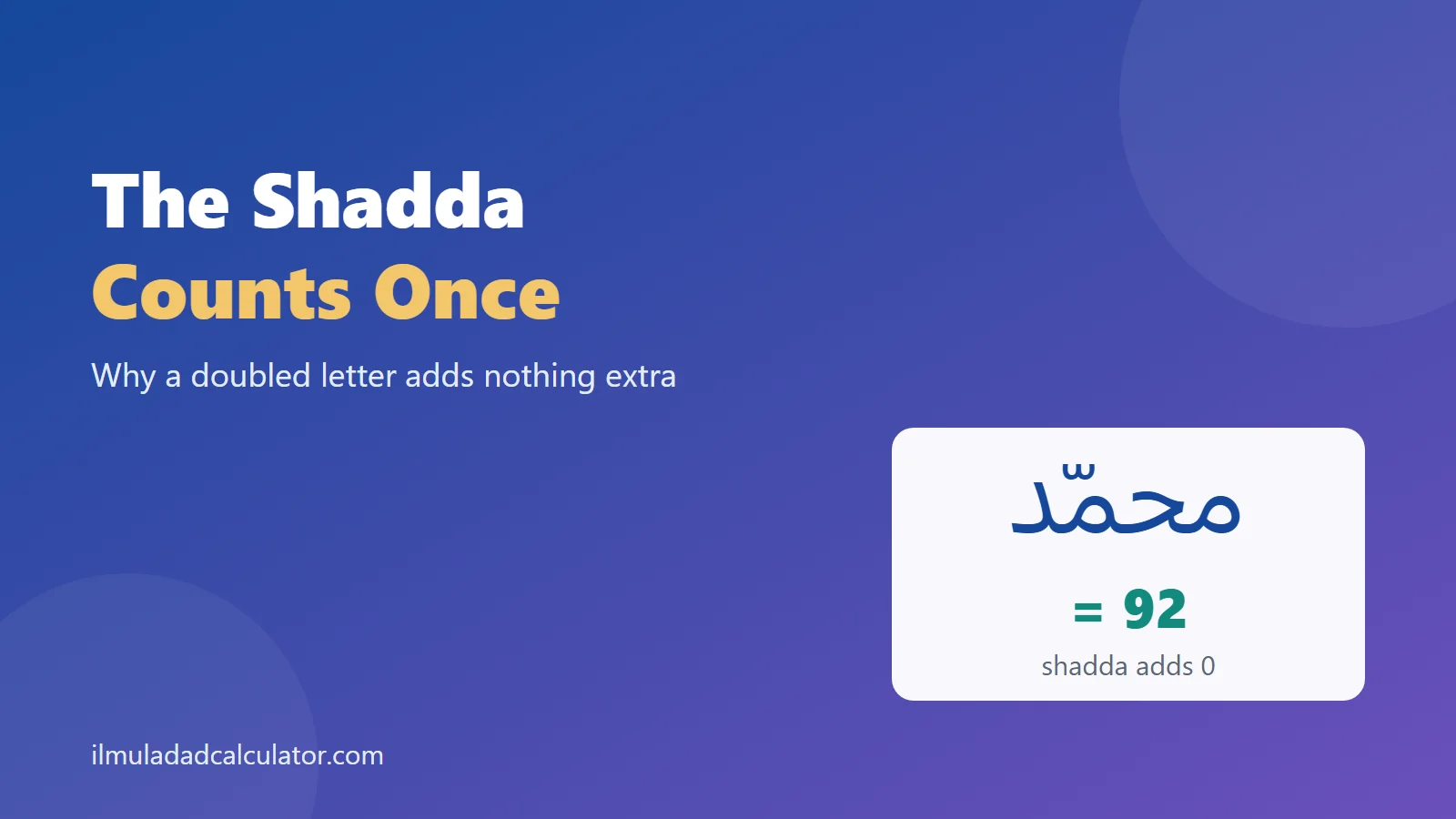
The shadda (ـّ), also called tashdid, is a small sign that marks a doubled consonant. In Ilm-ul-Adad the standard rule is simple: the shadda adds nothing, and the letter it sits on is counted once. So محمّد gives 92, the same as محمد without the mark.
What Is the Shadda (Tashdid)?
The shadda is a small sign shaped like a rounded w. It sits above a single letter to show that the sound is doubled, or geminated.
Arabic calls it شَدّة, from a root that means to strengthen. Urdu and Persian readers call the same mark tashdid.
The key point is about writing. A doubled consonant is spoken twice but written only once, with the shadda on top.
Where Does the Shadda Come From?
The sign has a long history. The grammarian al-Khalil ibn Ahmad devised it in the eighth century, replacing an earlier dot.
Its shape is drawn from a small sin (س), the first letter of the word shadda. Scribes placed it above a letter to flag the doubling.
Before the mark existed, readers leaned on context to catch a doubled sound. The shadda made that reading clear on the page.
Early Quran copies show the mark in careful hands, sometimes in gold. From there it passed into Arabic, Persian and Urdu writing.
Does Ilm-ul-Adad Count the Shadda?
No. Ilm-ul-Adad adds the values of letters, and the shadda is a mark, not a letter. It has no place in the 28-letter abjad order, so it adds nothing.
This site’s engine follows that rule. It removes the shadda before it adds, so a word gives the same total with or without the mark.
م 40 + ح 8 + م 40 + د 4 = 92
Here the second mim carries a shadda, yet it is counted once as 40. The name still totals 92.
Why Is a Doubled Letter Written Only Once?
Arabic writing has two layers. The letters sit on the line, and small signs float above or below them.
The shadda lives in that upper layer, next to the short-vowel marks. It guides the voice, but it never joins the line as a letter.
So the word ربّ (lord) is read “rabba,” with a long, held b. On the line there is still just one ba.
Ilm-ul-Adad counts what is written on the line, not what is heard. A doubled sound comes from the shadda, so the extra beat is spoken, not counted.
How Does the Shadda Compare With Other Marks?
The shadda behaves like every other mark in the upper layer. None of them add to a total.
| Mark | Name | What it shows | Adds |
|---|---|---|---|
| ـّـ | tashdid (shadda) | a doubled consonant | 0 |
| ـَـ | zabar | a short a | 0 |
| ـِـ | zer | a short i | 0 |
| ـُـ | pesh | a short u | 0 |
| ـْـ | jazm | no vowel | 0 |
| ـٰـ | khari zabar | a long aa | 0 |
The dagger alif and the signs on a hamza work the same way. For the ending ta, see ta marbuta.
Does the Shadda Ever Change a Word’s Meaning?
Yes, in speech it can. A doubled consonant often marks a different word, so the shadda matters for reading.
The classic pair is درس (darasa, “he studied”) and درّس (darrasa, “he taught”). The second word holds a doubled ra.
Even so, both words are written with the same letters on the line. Each one totals 264, because the shadda adds nothing to the count.
Is There a Practice of Counting It Twice?
Yes, a minority of practitioners count the doubled letter twice. They follow the spoken sound rather than the written shape.
This changes a total whenever a word carries a shadda. The extra amount is always the value of the doubled letter.
This site does not use that practice. If you follow a source that counts twice, state that choice next to the total.
Why Would Anyone Count It Twice?
The reasoning is about sound. A reader hears two beats, so they add the letter two times to match.
It is a choice, not a mistake, and some older sources use it. The main thing is to be clear about which rule produced a total.
Two careful people can still reach different numbers this way. Neither is wrong, as long as each one names the rule they followed.
How Much Does the Doubled Count Add?
The gap between the two readings is easy to predict. It equals the value of the letter under the shadda.
- In ربّ the doubled letter is ba, so the gap is 2: 202 becomes 204.
- In محمّد the doubled letter is mim, so the gap is 40: 92 becomes 132.
- In ستّ the doubled letter is the open ta, so the gap is 400: 460 becomes 860.
So the gap can be as small as a few points or as large as several hundred. It all depends on which letter is doubled.
Which Common Words and Names Carry a Shadda?
Many everyday words and names hold a shadda. The table shows each one with the standard total and the “count twice” total side by side.
| Word | Meaning | Standard | Counted twice | Gap |
|---|---|---|---|---|
| محمّد | Muhammad, a name | 92 | 132 | +40 |
| كلّ | kull (every) | 50 | 80 | +30 |
| ربّ | rabb (lord) | 202 | 204 | +2 |
| حجّ | hajj (pilgrimage) | 11 | 14 | +3 |
| امّ | umm (mother) | 41 | 81 | +40 |
| ستّ | sitt (six) | 460 | 860 | +400 |
| النجّار | al-Najjar, a family name | 285 | 288 | +3 |
Every standard total in this table comes straight from the engine. You can repeat any row in the Abjad value calculator.
A Note on the Name Muhammad
The name is often typed as محمد, with no mark. Whether or not the shadda is written, the standard total stays 92.
A source that counts the doubled mim twice would report 132 instead. The guide to why values differ covers gaps like this one.
More Words With a Shadda
Here are a few more everyday words, each with its two totals. The standard total is the one this site uses.
- مدرّس, mudarris (teacher): standard 304, or 504 if the doubled letter is counted twice.
- حقّ, haqq (right, truth): standard 108, or 208 if the doubled letter is counted twice.
- سیّد, sayyid (a title): standard 74, or 84 if the doubled letter is counted twice.
- جنّت, jannat (garden): standard 453, or 503 if the doubled letter is counted twice.
How Does the Shadda Interact With Other Marks?
A doubled letter often carries a vowel sign as well. A shadda and a zabar can share the same letter.
Neither mark adds anything. The letter is still counted once, no matter how many signs sit on it.
Tanwin, the “-an, -in, -un” endings, works the same way. A shadda with a tanwin still leaves the letter counted once.
A letter can even carry a shadda and a dagger alif at once. Both are marks, so the letter is still counted a single time.
What If the Letter Is Actually Written Twice?
This is a different case, and it matters. A shadda is one letter with a mark, but two letters on the line are two letters.
Take ربّ with a shadda, worth 202. If a writer instead spells it ربب, with two separate ba, the engine reads both and gives 204.
So the gap comes from a real extra letter, not from the mark. Always count the spelling in front of you, letter by letter.
How Do You Type a Shadda?
Most Arabic and Urdu keyboards place the shadda on a shifted key. The exact key depends on your layout.
You can also add it after the letter it belongs to, using a code point:
- Type the carrier letter first, such as the second mim in محمد.
- Then insert U+0651 right after it. In Microsoft Word, type 0651 and press Alt+X.
- On a phone, hold the letter key or copy the mark from a word that already has it.
Either way, the total is the same. The engine removes the mark before it adds the letters.
How Can You Check a Word That Has a Shadda?
A short routine keeps your totals clear and repeatable. It also helps when two sources disagree.
- Paste the word exactly as you found it, with every mark in place.
- Find the letter under the shadda, and note its value once.
- Read the standard total from the calculator’s letter list.
- For a “count twice” total, add that letter’s value one more time.
Then write down which rule you used. A note such as “standard, shadda counted once” is enough.
How Do the Calculators Handle It?
Every calculator on this site ignores the shadda by default. You can paste a word with the mark or without it and read the same total.
The Abjad value calculator shows each letter it counted, so you can confirm the doubled letter was counted once. To test two spellings together, use the value comparison tool.
The full list of letter values sits on the Arabic letters page. Our methodology explains why only letters carry a value.
If you need the “count twice” total, add the doubled letter’s value yourself. The calculator gives the standard total, and the rest is one more small sum.
خلاصہ
تشدید یا شَدّہ (ّ) ایک چھوٹی علامت ہے جو کسی حرف کے اوپر لگتی ہے اور اس حرف کی آواز کے دوہرے پن کو ظاہر کرتی ہے۔ یہ حرف نہیں بلکہ اعراب ہے، اس لیے علمِ اعداد میں اس کی کوئی قیمت نہیں۔ جس حرف پر شَدّہ ہو، وہ ایک ہی بار گنا جاتا ہے۔ اسی لیے محمّد کا عدد 92 ہے، بالکل ویسے ہی جیسے بغیر علامت کے محمد کا۔ کچھ لوگ دوہرے حرف کو دو بار گنتے ہیں، جس سے عدد میں اُس حرف کی قیمت کے برابر اضافہ ہو جاتا ہے۔ یہ سائٹ معیاری اصول یعنی ایک بار گننے کو اختیار کرتی ہے۔
Sources and Further Reading
- Shadda, Wikipedia. The mark for gemination, its name and how it is written above a single letter.
- Gemination, Wikipedia. Why a doubled consonant is held longer in speech.
- Arabic diacritics, Wikipedia. The shadda listed among the marks in the upper layer.
- U+0651 Arabic Shadda, Compart. The Unicode name and its class as a nonspacing mark.
- Abjad numerals, Wikipedia. The 28 letters that carry a value.
- Abjad values come from this site’s tested engine. See the methodology.
Frequently Asked Questions
Does the shadda change the value of a word?
No, not on this site. The letter under it is counted once, so محمّد and محمد both give 92.
Is the shadda counted twice in Ilm-ul-Adad?
The standard rule counts it once. A minority practice counts the doubled letter twice, which raises the total by that letter’s value.
What is the difference between shadda and tashdid?
They are two names for the same mark. Shadda is the Arabic name, and tashdid is common in Urdu and Persian.
Does the shadda have its own abjad value?
No. It is a mark in the upper layer, like zabar or zer, so it adds nothing to a total.
Why do two calculators give different totals for a word with a shadda?
One may count the doubled letter twice while the other counts it once. Ask which rule each one used.
Do I need to type the shadda to get the right value?
No. The engine ignores it, so the total is the same whether you type the mark or leave it out. You can paste the plain spelling and still read the correct number.