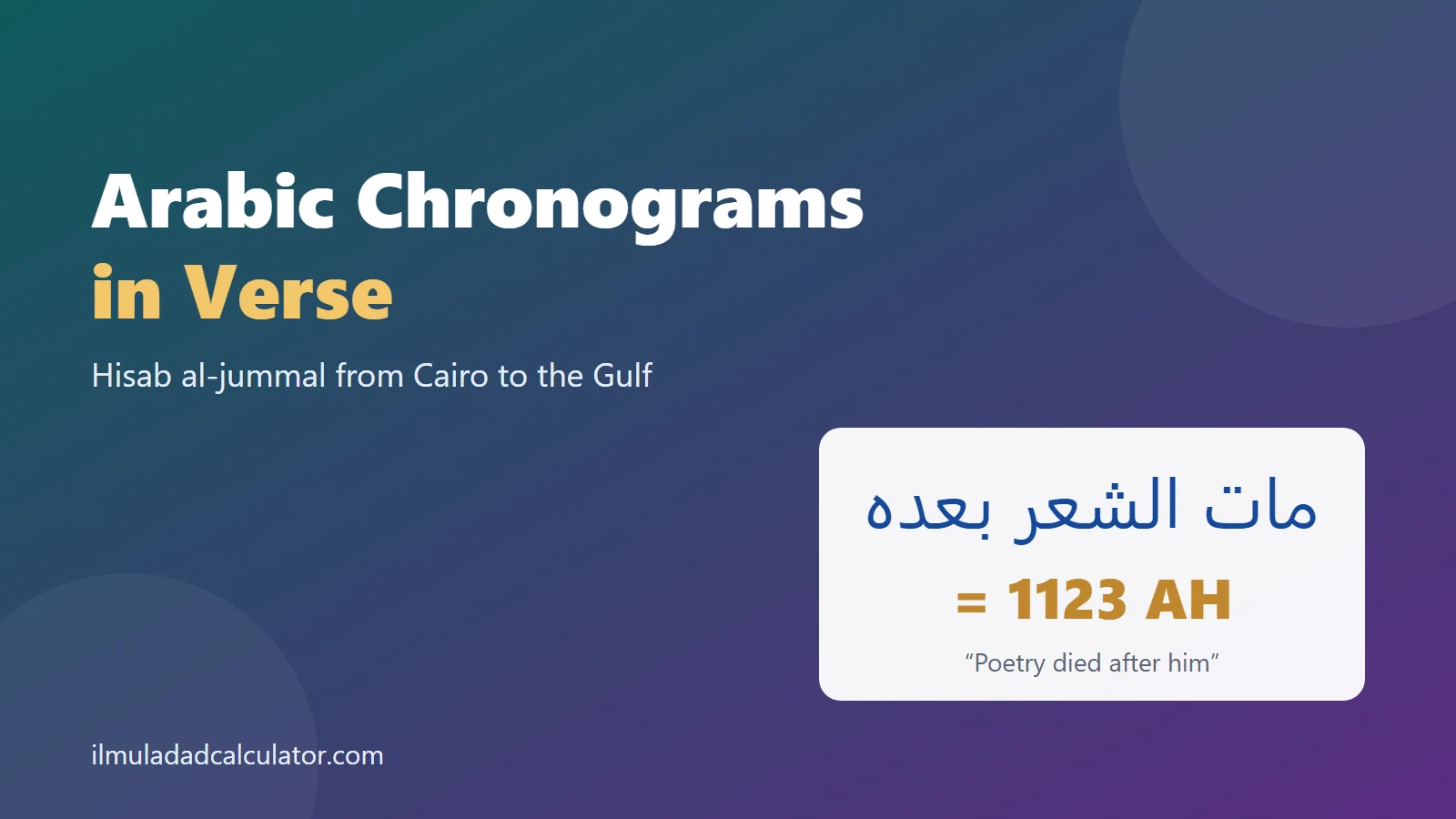
An Arabic chronogram is a line of verse whose letters add up to a year.
Arabic writers called the method حساب الجمل, hisab al-jummal. This page follows the tradition through Mamluk Egypt, Ottoman Egypt and the Gulf. Each example is sourced and worked letter by letter.
What Is an Arabic Chronogram?
Every Arabic letter has a number in the abjad system, from alif (1) to ghayn (1000). A writer picks words that suit an event, and the letters give the Hijri year.
Persian and Urdu poets used the same idea. Our guide to Persian chronograms covers that branch, and the page on what a chronogram is gives the general idea.
What Terms Did Arabic Writers Use?
Arabic has several names for the practice. Riham Miqdadi, who studied Gulf inscriptions in 2020, lists the common ones.
| Arabic | Roman | Meaning |
|---|---|---|
| تاريخ | ta’rikh | Date; also the line that hides a date |
| تاريخ شعري | ta’rikh shi‘ri | A poetic chronogram, found in a poem or on a building |
| تاريخ معنوي | ta’rikh ma‘nawi | A meaningful date, worked out from letter values |
| حساب الجمل | hisab al-jummal | Calculating the value of letters |
| حساب أبجد | hisab abjad | Calculating by the abjad letters |
| أرخوا | arrikhu | A cue verb meaning “date it,” placed before the date |
Miqdadi also notes that a poetic chronogram is called ta’rikh shi‘ri. It may sit in a book of poems, called a diwan, or on the front of a building.
Note: in Arabic, ta’rikh means “history” and also “date.” Context shows if a line is a chronogram.
Where Do Arabic Chronograms Appear?
The Arabic Wikipedia says Arab writers used letter values in sciences, trade, astronomical tables and weights. They also used them to date battles, deaths and buildings.
Inscriptions in Egypt
Miqdadi summarizes a 1994 study by H. Ibrahim of 154 chronogram inscriptions on Islamic buildings in Egypt. They range from 600 AH to 1312 AH.
Of these, 87 fall between 1111 AH and 1212 AH, the 18th century. About 40 are poetic.
Each poetic one follows a form of the verb arrakha, which means to date. The earliest is on the al-Ma’ini mosque in Damietta, dated 710 AH, and it is a rare early case.
Poetry Books
Miqdadi also cites a study of Arabic diwans by al-Sadhan (2008) with more than fifty building chronograms. According to that study, the earliest examples come from Syria in the 16th century.
The Ottoman Arab Provinces
The Arabic Wikipedia says the art of the tarikh spread in Arabic prose and poetry in the Ottoman period. Each event had a date in the last half-line of a poem. Each name could also be dated by its letters.
The Gulf
Two forts in Al-Ain, now in the United Arab Emirates, show the tradition in the 19th and 20th centuries. We work through both below.
How Do You Read an Arabic Chronogram?
Look for the cue first. Miqdadi found that a form of arrakha usually comes before the date line. Words such as tarikh and mu’arrikhan also serve as cues.
- Find the cue word that says “date.”
- Copy the letters that follow it, exactly as written.
- Add each letter with its abjad value.
- Compare the total with the Hijri year.
- Convert the year with the chronogram decoder if you need a Common Era date.
The poem’s last half-line most often holds the date. The cue and the words before it are not counted.
Some inscriptions also carve the year in plain numbers. Then you can check your total at once, as with the two forts below.
What Is a Mamluk Chronogram Example?
The Arabic Wikipedia reports a witty line on the death of Sultan Barquq, the first of the Burji Mamluk sultans. It says some wits wrote “the death of Barquq is in al-mishmish,” meaning in the apricot.
The first words are the cue. Only the last two words are counted:
في المشمش
90 + 711 = 801
The total is 801, the Hijri year of Barquq’s death, which is 1398 to 1399 CE. The source says the line is “said” to have been made, so treat it as a reported anecdote.
What Is an Ottoman-Era Elegy Example?
The same page tells of a poet named al-Dalanjawi. A friend wrote an elegy for him, and its last line says the writer “dated” the death.
مات الشعر بعده
441 + 601 + 81 = 1123
The total is 1123, so the poet died in 1123 AH, which is 1711 to 1712 CE. The words mean “poetry died after him,” so the meaning fits the date.
- Mashriqi values: the total uses the eastern set, with sin as 60 and shin as 300.
- The cue: the verb “I dated” comes just before the phrase.
- Why it works: the grief and the number sit in the same three words.
What Does a Gulf Fort Chronogram Look Like?
Above the entrance of the Eastern Fort in Al-Ain, a poem names Sheikh Sultan bin Zayed as builder. Miqdadi reads the third and fourth half-lines as the chronogram, after the cue word attarikh, “the history.”
بااليوم السعيد شاد بيت الملك سلطان ابن زايد
| Word | Letters | Value |
|---|---|---|
| بااليوم | ب 2 + ا 1 + ا 1 + ل 30 + ي 10 + و 6 + م 40 = 90 | 90 |
| السعيد | ا 1 + ل 30 + س 60 + ع 70 + ي 10 + د 4 = 175 | 175 |
| شاد | ش 300 + ا 1 + د 4 = 305 | 305 |
| بيت | ب 2 + ي 10 + ت 400 = 412 | 412 |
| الملك | ا 1 + ل 30 + م 40 + ل 30 + ك 20 = 121 | 121 |
| سلطان | س 60 + ل 30 + ط 9 + ا 1 + ن 50 = 150 | 150 |
| ابن | ا 1 + ب 2 + ن 50 = 53 | 53 |
| زايد | ز 7 + ا 1 + ي 10 + د 4 = 22 | 22 |
The total is 1328 AH, which is 1910 CE. Miqdadi gives the exact date as 20 Sha‘ban 1328. The year is also carved in numbers at the center of the inscription.
Why Is the Spelling Unusual?
Miqdadi notes that the writer spelled “the day” with two alifs. He also wrote ibn with an alif, giving 53, where bin without it would give 52.
Those small choices make the total land exactly on the year. This is why a chronogram must be read letter for letter and not by modern spelling.
A Second Fort
The al-Jahili Fort, in the same city, has the cue arrikhu before a half-line. That half-line ends with the builder’s name:
دار جد شاد زايد بن خليفه
205 + 7 + 305 + 22 + 52 + 725 = 1316 AH
That is 1898 to 1899 CE. Miqdadi points out that the doubled dal in jadd counts once. The name also ends in a he, worth 5, not a ta marbuta.
Which Letter Values Do Arabic Chronograms Use?
Two value sets exist. The eastern set, called Mashriqi, gives sin 60, shin 300, sad 90 and dad 800. The western set, called Maghribi, moves six letters.
Our page on the Maghribi letter order explains the two orders in full. The Arabic Wikipedia says North African writers used a slightly changed order, which Ibn Khaldun records in his Muqaddima.
The sources for the first three examples count the Mashriqi values, and only those reach the stated years. Under the Maghribi set the same letters give 2201, 1823 and 2508.
We did not find a published North African chronogram with a source and a full working, so we show none. When you meet a Maghribi text, count it both ways. Keep the set that reaches the year.
| Source | Phrase | Mashriqi | CE | Maghribi |
|---|---|---|---|---|
| Sultan Barquq, Cairo | في المشمش | 801 | 1398 to 1399 | 2201 |
| Poet al-Dalanjawi, elegy | مات الشعر بعده | 1123 | 1711 to 1712 | 1823 |
| Al-Jahili Fort, Al-Ain | دار جد شاد زايد بن خليفه | 1316 | 1898 to 1899 | 2016 |
| Eastern Fort, Al-Ain | بااليوم السعيد شاد بيت الملك سلطان ابن زايد | 1328 | 1910 | 2508 |
How Did the Arabic Tradition Develop?
Miqdadi traces the oldest form to a single word. Early inscriptions put a word after “in the year,” and the word had no meaning except its letter total.
Poetic chronograms came later. The earliest recorded ones date from about the 14th century. The Egyptian list above agrees that word-type dates came first.
Hajj Route Forts
Miqdadi mentions two forts on the pilgrim road. One is at Ma’an in Jordan, dated 971 AH. The other is at al-Mu’azzam in Saudi Arabia, dated 1031 AH.
Their verses are in Ottoman Turkish, not Arabic. They still use the cues tarikhi and tarikhin before the letters, as the Arabic inscriptions do.
What the Examples Show
- Humor and grief: the Barquq line is a joke, and the Dalanjawi line is an elegy. Both use ordinary words.
- Spelling choices: the fort poets adjusted the letters to reach the year.
- A shared set: from Cairo to Al-Ain, the sources count the eastern values.
What Types of Arabic Chronogram Exist?
Miqdadi follows a four-part scheme that Encyclopaedia Iranica also gives for Persian writing. The scheme fits Arabic examples too.
- Explicit date: the year is written in words or numbers.
- Meaningful date: the year comes from letter values, as with Barquq and al-Dalanjawi.
- Mixed date: the inscription gives both, as the two Al-Ain forts do.
- Riddle date: the reader must add or subtract, as our page on add and subtract devices explains.
How Do Arabic Chronograms Compare With Other Traditions?
Arabic poets and Persian poets used the same values and the same idea. Urdu followed the Persian model, as our guide to tarikh goi shows. Ottoman writers worked in Turkish, and our page on Ottoman chronograms covers them.
Arabic writing has its own marks. Miqdadi reports that every letter after the cue is counted, which differs from Latin chronograms, where only capital letters count. For the Latin side, see Latin chronograms.
How Can You Check One Yourself?
- Copy the exact spelling. One extra alif can shift a total by 1, and a different letter can shift it by hundreds.
- Skip the cue. Do not count words such as “date” or “dated it.”
- Name the set. State Mashriqi or Maghribi before you add.
- Use the Hijri year. Convert the total before comparing it with a Common Era date.
Paste the line into the chronogram decoder to see every letter and the total. The chronograms hub lists the other traditions.
خلاصہ
عربی تاریخ گوئی کو حساب الجمل کہا جاتا ہے، جس میں کسی مصرع کے حروف کی ابجد قیمتیں جمع کرنے سے ہجری سال نکلتا ہے۔ یہ فن مصر، شام اور خلیج کی عمارتوں کے کتبوں اور شاعری میں ملتا ہے۔ مثلاً «مات الشعر بعده» کے حروف کا مجموعہ ۱۱۲۳ ہے۔ مشرقی اور مغربی قیمتوں کے مجموعے مختلف ہوتے ہیں، اس لیے ماخذ کا طریقہ دیکھنا ضروری ہے۔
Sources and Further Reading
- Abjad Numerals as an Absolute Dating Method: Forts from Al-Ain, UAE, Riham H. Miqdadi, Mediterranean Archaeology and Archaeometry 20(3), 2020. Terms, Egyptian and diwan studies, and both fort inscriptions (full text: PDF).
- حساب الجمل, Arabic Wikipedia. The Barquq and al-Dalanjawi examples.
- الشعر العربي في العصر العثماني, Arabic Wikipedia. The tarikh in Ottoman-era Arabic poetry.
- ترتيب أبجدي, Arabic Wikipedia. The Maghribi order recorded by Ibn Khaldun.
- Chronograms, Encyclopaedia Iranica, by J. T. P. de Bruijn. The four types of chronogram.
Frequently Asked Questions
What is hisab al-jummal?
It is the Arabic name for calculating the value of letters. Chronograms use it to turn a phrase into a year.
What is a ta’rikh shi‘ri?
It is a poetic chronogram. It sits in a poem or on an inscription, and its letters add up to a year.
Do Arabic chronograms use Maghribi values?
It depends on the source. The examples on this page reach their years with the Mashriqi values, so always test both sets.
Which calendar do Arabic chronograms use?
Almost always the Hijri calendar. Convert the total before comparing it with a Common Era date.
Where is the date line in the poem?
Usually in the last half-line, after a cue such as arrikhu or attarikh.