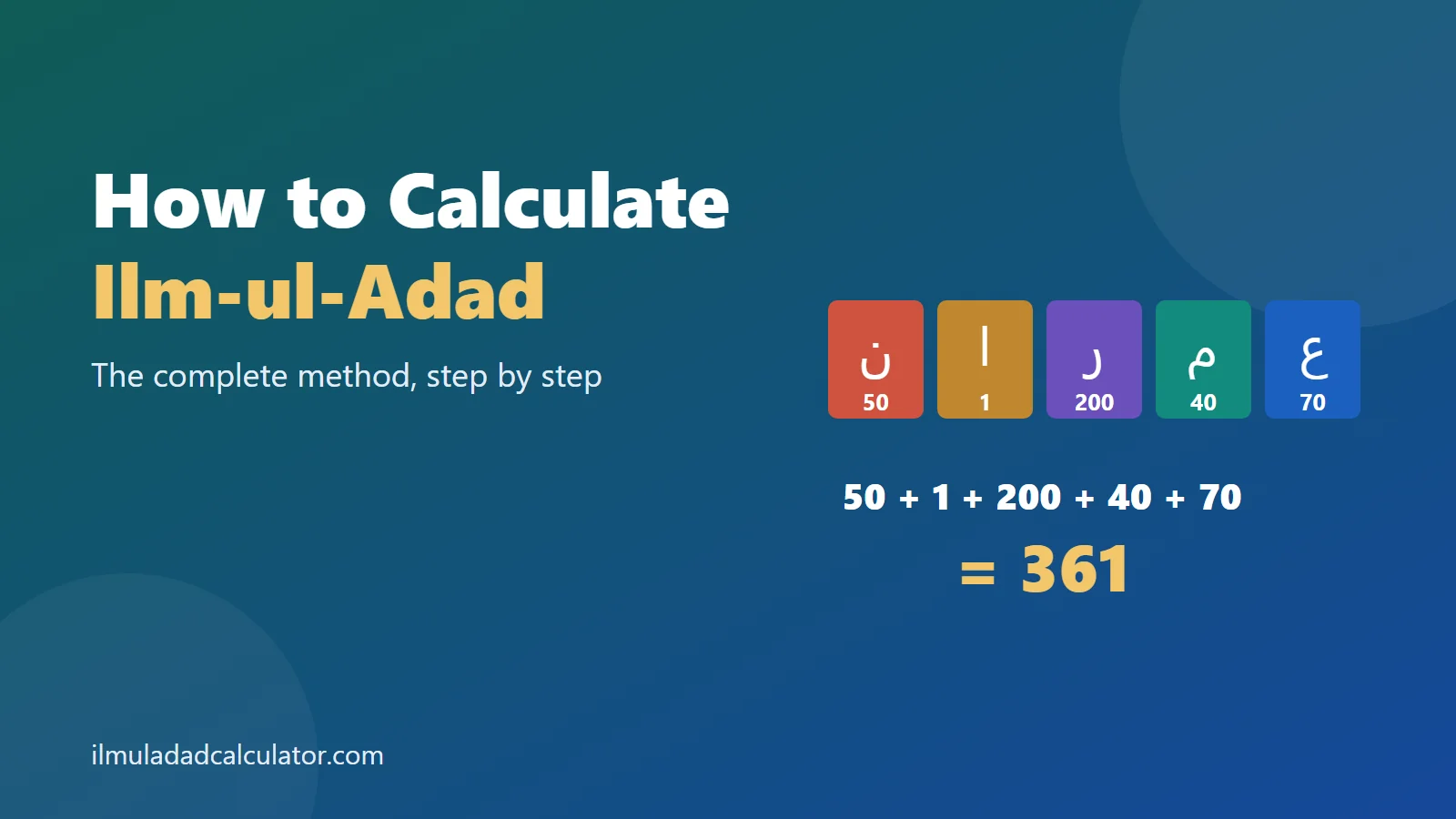
To calculate Ilm-ul-Adad, write the word in Arabic or Urdu letters, find each letter’s value, and add them up. For example, عمران (Imran) gives 361 in the Mashriqi system. Note the rules you used, so anyone can repeat your result.
What Do You Need Before You Start?
You need only three things. Each one affects the final number, so settle them before you add anything.
- The exact spelling. Different spellings give different totals, so use the spelling your family or source uses.
- A letter value table. The letter values page lists all 28 letters with both systems.
- A system. Use Mashriqi, the common Eastern system, unless your source says otherwise.
How Do You Calculate a Value Step by Step?
- Spell it. Write the word in Arabic or Urdu letters, exactly as your source does.
- Clean it. Ignore vowel marks such as zabar, zer and pesh. They have no value.
- Look up each letter. Write its value under it, working from right to left.
- Add the values. For a phrase, total each word first, then add the word totals.
- Check. Add again in the other direction, or test your answer with a calculator.
- Record. Write the total with the system and any special rule, such as “Mashriqi, hamza not counted.”
Worked Example: A Single Name
Take the name Imran, written عمران in Urdu and Arabic. It has five letters: ain, mim, ra, alif and nun.
ع 70 + م 40 + ر 200 + ا 1 + ن 50 = 361
None of these letters is special, so the name is a good first exercise. The total is the same in the Maghribi system, because none of its letters changes value there.
Worked Example: A Full Name
For a name of several words, total each word first. Here is the full name of Muhammad Ali Jinnah, the founder of Pakistan, in Urdu spelling.
| Word | Working |
|---|---|
| محمد | م 40 + ح 8 + م 40 + د 4 = 92 |
| علی | ع 70 + ل 30 + ی 10 = 110 |
| جناح | ج 3 + ن 50 + ا 1 + ح 8 = 62 |
The three word totals are 92, 110 and 62, which add up to 264. Spaces between the words have no value.
Tip: word totals make mistakes easy to find. When your answer differs from a calculator, compare one word at a time.
Worked Example: Urdu Letters
Urdu letters that Arabic lacks take the value of the Arabic letter they are built from. The name Tipu, written ٹیپو, uses two of them.
ٹ 400 + ی 10 + پ 2 + و 6 = 418
Here ٹ counts as ت (400) and پ counts as ب (2). The Urdu ی counts as ya (10), the same as its Arabic form.
How Do You Calculate a Phrase?
A phrase works like a full name: total each word, then add the totals. Take the slogan پاکستان زندہ باد (long live Pakistan).
The three words give 534, 66 and 7, so the phrase totals 607. The phrase value calculator shows this breakdown for any phrase.
How Do You Work With Dates and Numbers?
Sometimes you start with a number and need letters, as in old manuscripts. The number to abjad numerals converter writes any number in abjad letters.
Sometimes a verse hides a year in its words. The chronogram decoder adds the letters and converts the Hijri year for you.
What Counting Rules Should You Know?
Most letters are simple, but a few written forms need a rule. This site follows the most common conventions.
- Shadda does not double a letter. The letter counts once, even when it sounds doubled.
- Ta marbuta counts as 5. See why in ta marbuta: 5 or 400.
- A seated hamza takes its seat’s value. The full rules are in hamza in Ilm-ul-Adad.
- Aspirated pairs count as two letters. So بھ is ba (2) plus he (5).
What Urdu Spelling Tips Help Most?
Urdu names often reach us in Roman letters, such as Ayesha or Parveen. Turning them back into Urdu script is the step where most totals go wrong.
- Shapes that look different count the same. Urdu ک, ی and ہ equal Arabic ك, ي and ه.
- Endings matter. A final ہ or ۃ counts 5, while a final ے counts 10.
- Nasal endings count. Nun ghunna (ں) is worth 50, the same as nun.
- Check with the family. Ask how the name is written on documents in Urdu.
The guide on how to write your name in Arabic explains how sounds map to letters.
Which Way Should You Calculate?
Learn by hand first, because it teaches you the values. Then use the Ilm-ul-Adad calculator to check your work and to handle long phrases quickly.
The calculator shows the value of every letter it counted. That makes it a teacher as well as a shortcut.
How Do You Check Your Answer?
- Add in reverse. Add the letter values from left to right the second time.
- Group the tens. Add the hundreds, then the tens, then the ones, and compare.
- Count the letters. The number of values you added must match the number of letters.
- Test known words. Your method should give محمد = 92 and علی = 110.
Should You Use Mashriqi or Maghribi Values?
Use Mashriqi for almost everything, including all Urdu and Persian sources. Maghribi values belong to older North African and Andalusian texts.
Only six letters differ between the two systems. So حسن (Hasan) is 118 in Mashriqi but 358 in Maghribi, because of its sin. The Mashriqi and Maghribi comparison tool shows both.
What Mistakes Do Beginners Make?
- Counting vowel marks, or counting a shadda letter twice.
- Counting ta marbuta as 400 without saying so.
- Changing the spelling halfway, such as عائشہ in one place and عایشہ in another.
- Using a Maghribi table by accident.
When two totals disagree, the size of the gap usually reveals the cause. The guide to why calculators give different values explains how to read it.
Can You Try a Few Yourself?
Calculate these three names by hand, using Mashriqi values. Then open each answer to check your work.
زینب (Zainab)
ز 7 + ی 10 + ن 50 + ب 2 = 69
پروین (Parveen)
پ 2 + ر 200 + و 6 + ی 10 + ن 50 = 268
اقبال (Iqbal)
ا 1 + ق 100 + ب 2 + ا 1 + ل 30 = 134
More Guides on Calculation
- Why Two Calculators Give Different Values: find the cause from the size of the gap.
- Hamza in Ilm-ul-Adad: seated and standalone hamza.
- Ta Marbuta: 5 or 400?: the bound ta and its value.
- Abjad Hawwaz Hutti: memory words for the letter order.
- How to Calculate a Name by Hand: paper layout, running totals and checks.
- How to Calculate an Urdu Name: the extra Urdu letters and what each one counts as.
- How to Calculate Letter Values in Excel: a lookup table and one SUMPRODUCT formula.
- Worked Examples for Tricky Names: ta marbuta, hamza and shadda, letter by letter.
خلاصہ
علمِ اعداد نکالنے کا طریقہ یہ ہے کہ لفظ کو صحیح املا کے ساتھ لکھیں، اعراب چھوڑ دیں اور ہر حرف کی ابجد قیمت جمع کر لیں۔ مثال کے طور پر «عمران» کے اعداد ۳۶۱ ہیں۔ آخر میں نتیجہ دوبارہ جانچ لیں اور بتا دیں کہ مشرقی نظام استعمال کیا گیا ہے۔
Sources and Further Reading
- Abjad numerals, Wikipedia. The letter values in both systems.
- All values on this page come from this site’s tested engine. See the methodology.
Frequently Asked Questions
What is adad nikalne ka tarika?
It is Urdu for the method of finding the number. It means adding the letter values of a word, as this page shows.
Do I add the values of my father’s name too?
Only if you want the total of the full name. Decide which words to include, and say so with the result.
Can I calculate an English name?
Yes, after writing it in Arabic or Urdu letters. The total depends on the spelling you choose.
Does the order of letters change the total?
No. Addition gives the same total in any order, so a word and its anagram share a value.
Is there a quick way to learn all the values?
Learn the eight memory words, abjad hawwaz hutti, and practice with the Abjad quiz.