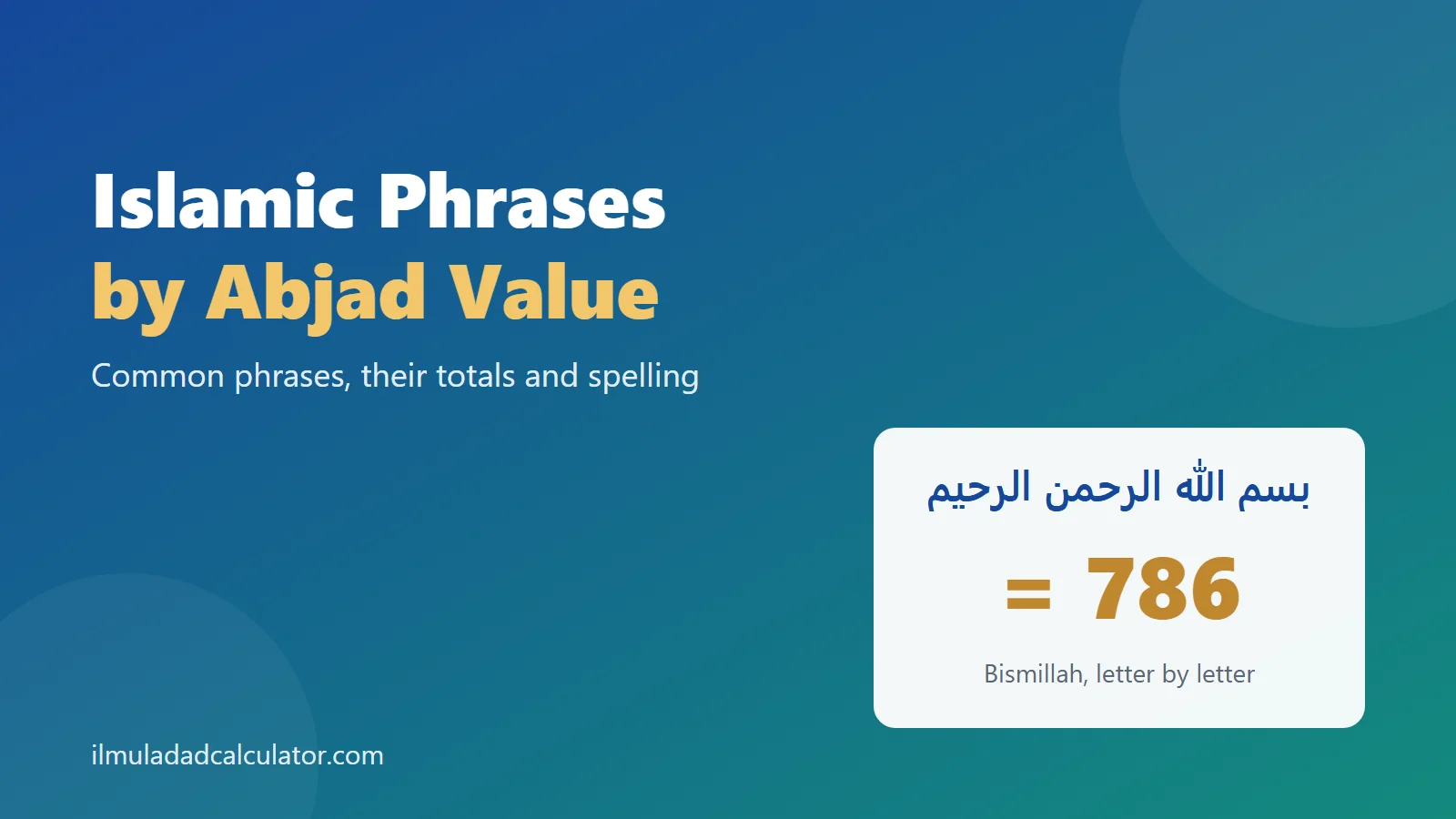
Every Arabic phrase has a number, found by adding the value of each letter. This page lists the totals of ten common phrases and shows how each is worked out. It also explains why a small change in spelling can move a total.
How Is the Value of an Islamic Phrase Worked Out?
A phrase is treated like any other word. Each letter has a fixed value in the Abjad table, and the total is the sum of all the letters. This page uses the Mashriqi table, the one most readers in Pakistan and the Middle East know.
Spaces carry no value, and neither do the small marks above and below letters. So the length of a phrase does not matter, only the letters you count.
Take the single word الله as a small case. Its letters add up as follows:
ا 1 + ل 30 + ل 30 + ه 5 = 66
Notice that the lam appears twice, and each lam counts 30. The doubled lam is written once with a shadda, but the sum still uses both.
The guide to calculating by hand shows the steps. Or paste any phrase into the phrase value calculator for a word-by-word breakdown.
How Does the Bismillah Reach 786?
The full Bismillah has four words. Its text, بسم الله الرحمن الرحيم, means “In the name of God, the Most Gracious, the Most Merciful.”
Add the four word totals and you reach 786. Reference works on the Abjad numerals note that the phrase sums to this number letter by letter.
The short form بسم الله gives 168, which is the first two words only. So 786 belongs to the full four-word text, not to the short phrase.
What Are the Values of Common Islamic Phrases?
The table below gives each phrase in the spelling used, a plain English translation, and its word-by-word totals. Translations are only there to identify the phrase. The numbers are pure arithmetic.
| Phrase | Name and translation | Word by word | Total |
|---|---|---|---|
| بسم الله الرحمن الرحيم | Bismillah, full In the name of God, the Most Gracious, the Most Merciful | بسم 102 + الله 66 + الرحمن 329 + الرحيم 289 | 786 |
| بسم الله | Bismillah, short In the name of God | بسم 102 + الله 66 | 168 |
| الحمد لله | Alhamdulillah All praise is due to God | الحمد 83 + لله 65 | 148 |
| سبحان الله | Subhan Allah Glory be to God | سبحان 121 + الله 66 | 187 |
| ما شاء الله | Masha Allah What God has willed | ما 41 + شاء 301 + الله 66 | 408 |
| إن شاء الله | Insha Allah If God wills | إن 51 + شاء 301 + الله 66 | 418 |
| لا إله إلا الله | La ilaha illa Allah There is no god but God | لا 31 + إله 36 + إلا 32 + الله 66 | 165 |
| الله أكبر | Allahu Akbar God is greater | الله 66 + أكبر 223 | 289 |
| أستغفر الله | Astaghfirullah I seek God’s forgiveness | أستغفر 1741 + الله 66 | 1807 |
| السلام عليكم | As-salamu alaykum Peace be upon you | السلام 162 + عليكم 170 | 332 |
The chart shows that length is a poor guide. أستغفر الله has only two words, yet it totals 1807. The reason is one letter: ghayn in the first word is worth 1000.
What Patterns Show Up in the Table?
- Allah is a fixed block. The word الله is worth 66, and it appears as a separate word in 8 of the ten phrases.
- One phrase uses a contracted form. In الحمد لله, the final word لله is worth 65, one less than الله.
- Shared words give close totals. ما شاء الله and إن شاء الله share شاء (301) and الله. Their totals differ only by the first word: ما is 41 and إن is 51, a gap of 10.
Remember: a phrase total is the sum of its letters and nothing more. The arithmetic makes no claim about meaning, merit or ruling.
Use these patterns as a quick check on your own work. When two phrases share a word, subtract the shared part and compare the rest. If the gap is not the difference between the remaining words, a letter was probably missed or added.
Why Do Spelling and Orthography Change the Total?
Abjad counts letters, not sounds. Two ways of writing the same phrase can therefore give two different numbers, even though a reader hears no difference.
Three kinds of choices cause most of the differences. Each is small, but each is worth knowing before you quote a number.
Is a Long Vowel Written Out?
Some words can be written with or without an alif. بسم الله leaves out the alif of باسم, giving 168 against 169 when it is written in full.
The same happens with الرحمن, which is 329. Written as الرحمان with a full alif, it totals 330.
Is the Article Joined or Dropped?
When الله follows الحمد, the alif of the article is not written. The phrase becomes الحمد لله, which totals 148, while a spelling with the alif gives 149.
Both are seen in print, and neither is a mistake of arithmetic. They are different orthographic choices.
Is the Hamza Counted?
The word شاء ends in a standalone hamza. Many calculators skip it, so ما شاء الله gives 408. If the hamza is counted as 1, the same phrase gives 409.
The guide to hamza in Ilm-ul-Adad explains each way of counting it.
What About Marks and Different Scripts?
Marks such as the shadda and the dagger alif carry no value of their own. So الله, اللّه and اللّٰه all give 66. See the dagger alif and the shadda for details.
Spacing is also free.
إن شاء الله and the joined إنشاء الله both give 418. To a reader the joined form is a different word. For a full survey of causes, read why values differ.
Does the Keyboard You Type On Matter?
Arabic and Urdu keyboards produce different characters for the same sound. The Arabic kaf ك and Urdu kaf ک are separate characters, though they look alike in a phrase.
The same is true of the ya forms ي and ی, and the ha forms ه and ہ. A good calculator treats each pair as one letter, so السلام علیکم and السلام عليكم both give 332.
Problems arise only when text is copied from a source that mixes in look-alike characters. If a total looks wrong, retype the phrase on one keyboard and try again.
Do Other Letter Tables Give Other Totals?
Yes. The Maghribi table, used in North Africa, gives some letters different values. Sad and sin are the best-known letters whose values change.
The table below shows four phrases under both systems. Only the phrases that contain affected letters change.
| Phrase | Mashriqi | Maghribi |
|---|---|---|
| بسم الله الرحمن الرحيم | 786 | 1026 |
| سبحان الله | 187 | 427 |
| السلام عليكم | 332 | 572 |
| الحمد لله | 148 | 148 |
الحمد لله stays at 148 because none of its letters changes value. To see any phrase in several tables at once, use the multi-system calculator or the compare tool.
How Can You Check a Phrase Yourself?
A careful check takes only a minute. The order of steps matters most when you need to compare your answer with another source.
- Write the phrase exactly as it appears in your source.
- Split it into words and note any dropped alif or joined article.
- Decide how to treat a standalone hamza, and keep that choice for every phrase.
- Add each letter using one table, such as Mashriqi.
- Record the spelling next to the total, so others can repeat it.
If two sources disagree, compare the spelling first. Most disagreements trace back to an alif or a hamza.
Keep a short note of each result in a table of your own. A column for the spelling and a column for the system make later comparison quick. This habit also helps when you share a total with someone else.
Why Do People Calculate Phrase Values at All?
The practice is old. Scholars and poets used letter values for centuries to number lists, to date events and to set verses in chronograms.
Today most readers meet it as a curiosity, a classroom exercise or a family tradition. The introduction to Ilm-ul-Adad explains the field, and the history section follows its development.
A phrase total is also the basis of the chronogram. Poets chose words whose letters summed to a year, a craft described in the chronograms section. In that craft the arithmetic marks a date, and it is nothing more than a date.
What Kinds of Words Content Does This Site Cover?
The words section has three strands. Each answers a different question about written Arabic and Urdu.
Phrase Values
This page and the phrase value calculator belong here. They cover the totals of everyday phrases and how spelling changes them.
The Huruf Muqattaat Cluster
Twenty-nine surahs of the Quran open with the disjointed letters. They are 14 distinct letters in 14 combinations, and they are read by letter name. The section is a reference, not a commentary.
- Huruf Muqattaat: the overview of what they are and where they appear.
- The muqattaat list: all 29 surahs, with the 14 letters and 14 combinations.
- Muqattaat and Abjad: how the letters have been summed in history.
- Muqattaat pronunciation: how each letter name is read aloud.
- Alif Lam Mim, Kaf Ha Ya Ain Sad and Ha Mim: single openings in detail.
- More single openings: Alif Lam Ra, Alif Lam Mim Sad, Alif Lam Mim Ra, Ta Ha, Ya Sin.
- Remaining single openings: Ta Sin Mim, Ta Sin, Sad, Ain Sin Qaf, Qaf, Nun.
The Shorthand Culture
Readers in South Asia often meet numbers used as shorthand for names and phrases. The best-known case is the number 786 itself. A further section on this culture is planned and will describe where such numbers are seen and how they began.
Guides in This Section
- Phrase Value Calculator: totals any phrase word by word.
- Huruf Muqattaat: the disjointed letters that open 29 surahs.
- How Many Huruf Muqattaat Are in the Quran?: the complete list of openings.
- Muqattaat and Abjad: the written letters and their sums.
- Muqattaat Pronunciation: reading each letter by name.
- Alif Lam Mim: the opening of six surahs.
- Kaf Ha Ya Ain Sad: the five-letter opening.
- Ha Mim: the opening of a run of surahs.
- Alif Lam Ra: the opening of five surahs, 10 to 15.
- Alif Lam Mim Sad: the four-letter opening of al-A’raf.
- Alif Lam Mim Ra: the four-letter opening of ar-Ra’d.
- Ta Ha: the two-letter opening of surah 20.
- Ya Sin: the two-letter opening of surah 36.
- Muqattaat in Calligraphy and Design: how the openings are written and typeset.
- Ta Sin Mim: the opening of surahs 26 and 28.
- Ta Sin: the opening of an-Naml.
- Sad: the single letter that opens surah 38.
- Ain Sin Qaf: the second opening of ash-Shura.
- Qaf: the single letter that opens surah 50.
- Nun: the single letter that opens surah 68.
- Hamza in Ilm-ul-Adad: how the standalone hamza is counted.
خلاصہ
ہر عربی جملے کی ایک عددی قدر ہوتی ہے جو اس کے حروف کی قیمتیں جمع کرنے سے نکلتی ہے۔ مثلاً پوری بسم اللہ کا مجموعہ 786 بنتا ہے۔ املا بدلنے سے مجموعہ بدل سکتا ہے، جیسے الف لکھنا یا چھوڑنا، یا ہمزہ کو گننا۔ یہ صفحہ صرف حساب بیان کرتا ہے، معنی یا فضیلت کا کوئی دعویٰ نہیں کرتا۔
Sources and Further Reading
- Abjad numerals, Wikipedia. The letter values, and the sum of the Bismillah as 786 and of Allah as 66.
- Basmala, Wikipedia. The Arabic text and the meaning of the Bismillah.
- Tasbih, Wikipedia. Subhan Allah, Alhamdulillah and Allahu Akbar, with their meanings.
- Takbir, Wikipedia. The phrase Allahu Akbar and its translation.
- Shahada, Wikipedia. The Arabic text and translation of the first part of the declaration.
- Muqattaʿat, Wikipedia. The disjointed letters of the Quran, for the section overview.
- All values come from this site’s tested engine. See the methodology.
Frequently Asked Questions
What is the Abjad value of Bismillah?
The full phrase, بسم الله الرحمن الرحيم, totals 786 in the Mashriqi table. The short form, بسم الله, totals 168.
Why do some sources give a different number for the same phrase?
Spelling differs. A written or dropped alif, a counted hamza or a different letter table can each change the total.
What is the value of Alhamdulillah?
Written as الحمد لله, it totals 148. With a full alif in the last word, الحمد الله, it totals 149.
Does a higher total mean a phrase is more important?
No. A total is only the sum of letter values. It says nothing about meaning, merit or ruling.
Do the marks above letters count?
No. The shadda, dagger alif and short vowel marks carry no value in the standard tables.
Can I calculate a phrase in Urdu letters?
Yes. Urdu forms of kaf, ya and ha match their Arabic counterparts, so the total is the same.